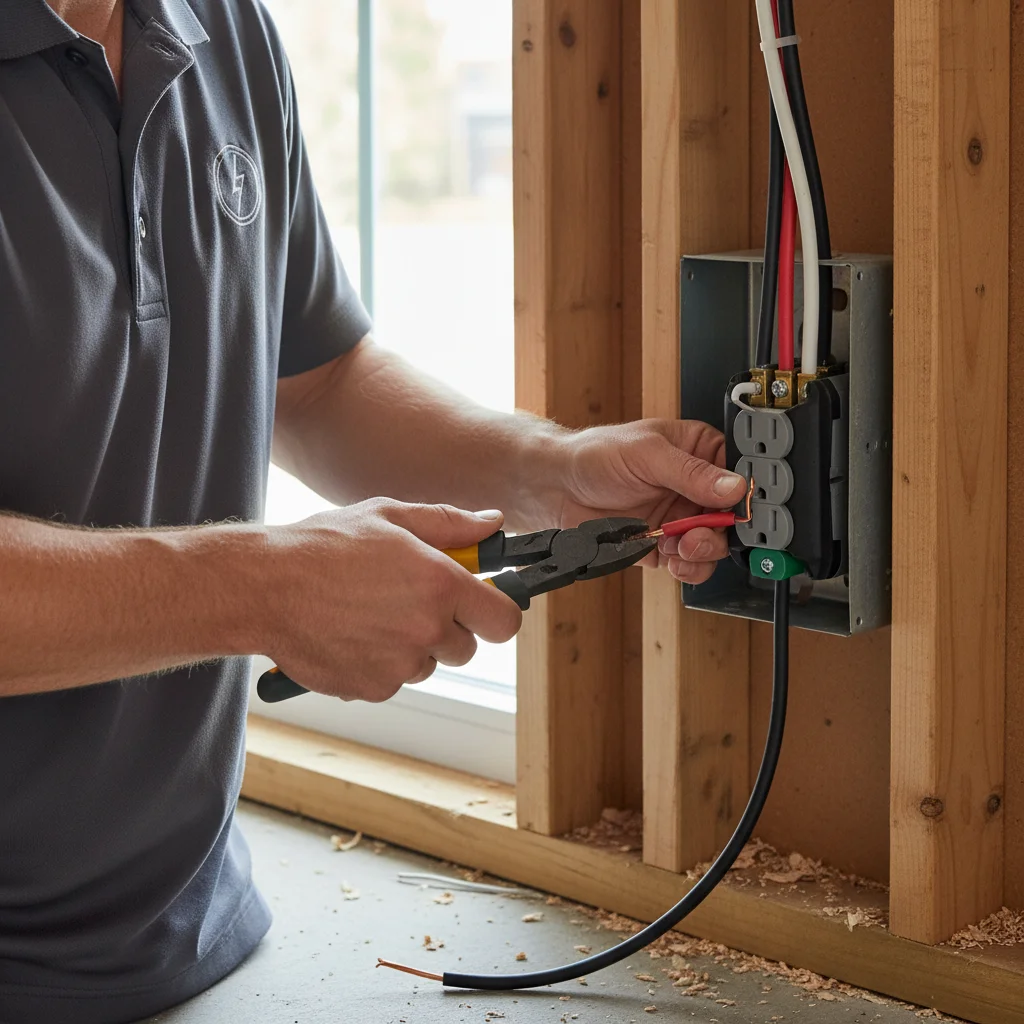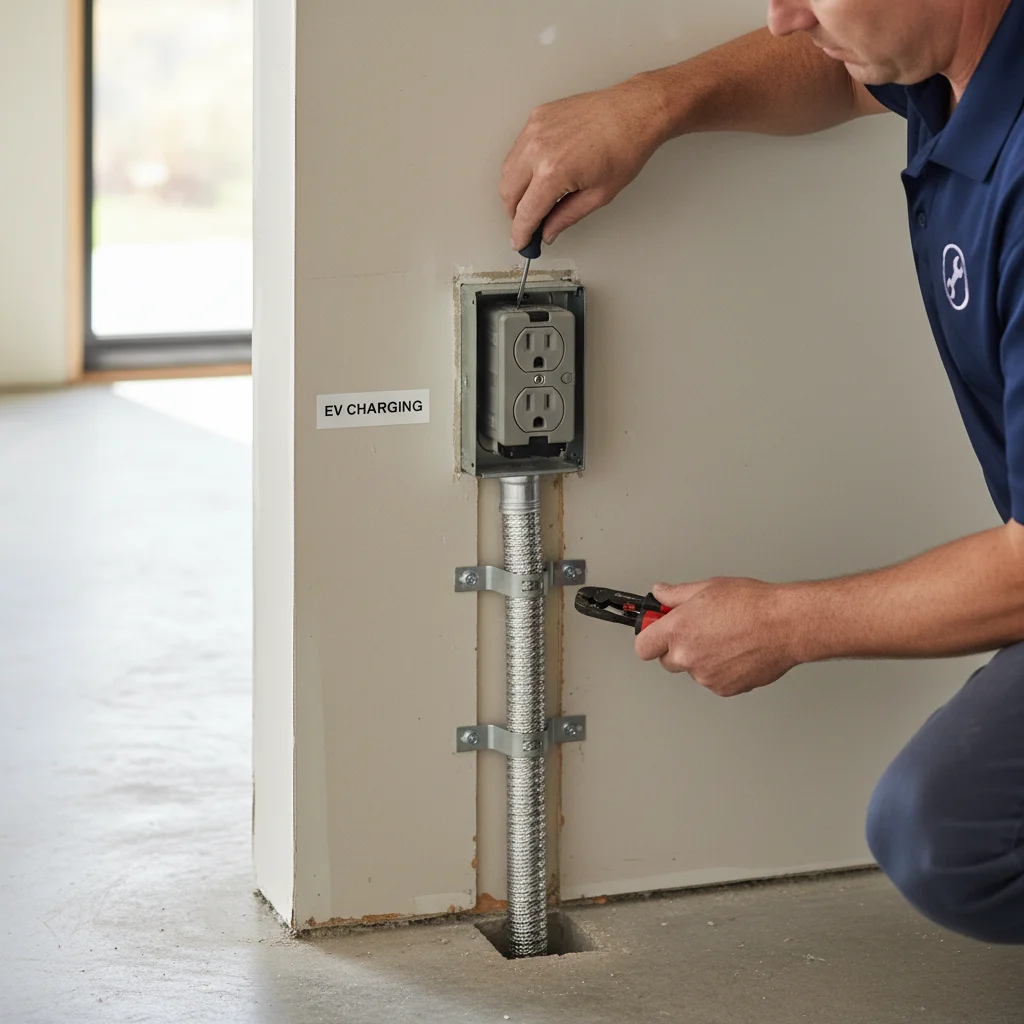
You bought the EV, the new dryer, or the MIG welder, and now you’re staring at a wall with nothing but a standard 120V outlet. Getting a 240V circuit installed is the fix, and the cost varies more than most homeowners expect. Here’s exactly what drives that number and what to budget before you call an electrician.
TL;DR
- A 240V outlet uses two hot legs from your panel to deliver double the voltage. The amperage determines the wire gauge, breaker size, and cost.
- In San Diego, a straightforward 240V install runs $250 to $700 depending on the circuit size and access. Fishing wire through finished walls adds $150 to $400.
- The most common receptacle for EVs and ranges is the NEMA 14-50 (50-amp, 4-prong). Dryers use the NEMA 14-30 (30-amp, 4-prong).
- All new 240V circuits require a permit in California. Garages and outdoors also require a GFCI breaker, adding $60 to $120.
- Every 240V circuit needs to be dedicated. Sharing with another large appliance risks overheating and equipment damage.
What a 240V outlet actually is and why amps matter
A standard household outlet runs on a single 120-volt “hot” leg from your panel. A 240V outlet, sometimes called a 220V outlet, a holdover from older grid standards, uses two hot legs, 180 degrees out of phase, to deliver roughly double the voltage. That higher voltage lets large appliances draw the power they need without pulling absurd amounts of current.
The amperage rating matters just as much as the voltage. Amps determine the wire gauge, breaker size, and ultimately the cost. A 30-amp circuit for a dryer uses 10-gauge wire. A 50-amp circuit for a welder or EV charger needs 6-gauge wire. Heavier wire costs more to buy and more to pull through walls and conduit.
When someone mentions a “220 volt outlet,” they mean the same thing as a 240V outlet. The terminology is interchangeable in conversation, even if your panel label says 240V. The NEC (NFPA 70) standardized around 240V decades ago, but the older term still shows up on product manuals and job quotes.
One more thing: voltage alone doesn’t tell you whether your panel can handle the new circuit. If your main panel is already near capacity, you may need a panel upgrade before adding any 240V load. That’s a separate cost and a separate conversation.
Common uses: dryer, range, EV, welder, mini-split
Most 240V outlet installations in San Diego homes fall into one of five categories:
Electric dryer. The classic 30-amp, 240V load. Modern dryers use a NEMA 14-30 receptacle (four-prong). Older homes may have a three-prong NEMA 10-30, which lacks a separate ground wire and no longer meets current code for new installations.
Electric range or oven. Ranges typically need a 50-amp circuit with a NEMA 14-50 or 14-30 receptacle depending on the unit. Check the nameplate. Some slide-in ranges specify 40 amps.
EV charger (Level 2). The most common request we get today. A Level 2 home charger, what most people call a “home EV charger,” runs on 240V, usually at 32 to 48 amps. The NEMA 14-50 is the standard receptacle for plug-in chargers. Hardwired units skip the receptacle entirely. If you’re planning this project, our EV charger installation guide for San Diego covers the full picture, including SDG&E rebates you can stack.
Welder or compressor. Hobbyist MIG welders often run on a NEMA 6-50 (50-amp, 240V, no neutral). Industrial-grade equipment may need 60 amps or more. Garages and workshops are the typical location.
Mini-split AC. Ductless mini-splits for San Diego garages and converted spaces usually need a 240V, 20- to 30-amp dedicated circuit. The receptacle type varies by unit, so confirm before the electrician orders materials.
Cost by scenario in San Diego homes
Pricing depends on three things: the amperage, the distance from your panel, and how much the electrician has to fish wire through finished walls versus exposed framing or conduit.
For a straightforward installation (panel capacity available, short run in a garage or utility room, no fishing through insulated walls) here’s a realistic range for San Diego in 2026:
- 30-amp dryer circuit (NEMA 14-30): $250–$500
- 50-amp EV charger or range circuit (NEMA 14-50): $350–$700
- 50-amp welder circuit (NEMA 6-50): $300–$650
- Mini-split circuit, 20–30 amp: $250–$500
Add $150–$400 if the electrician needs to fish wire through finished drywall. Add $200–$600 if a sub-panel is needed to reach a detached garage. If your main panel needs a breaker slot freed up or a full upgrade, that’s a separate line item. Our panel upgrade cost guide for San Diego breaks that down.
For a detailed comparison with standard 120V outlet work, see our post on the cost to add an outlet in San Diego.
Permits add $75–$200 in most San Diego County jurisdictions, but they’re non-negotiable for 240V work (more on that below).
Cost to run 240V from the breaker box to a stove or range location
Running a new 240V circuit from the breaker panel to a kitchen range location is one of the more involved 240V jobs, because kitchen walls are usually finished and the run is often longer than a garage EV circuit.
Typical cost in San Diego for a new 50-amp range circuit: $450–$900. That range assumes a standard panel-to-kitchen run through interior walls in a single-story home. What moves it higher:
- Long runs or two-story layouts: a panel in the garage to a kitchen on the second floor can require 40–60 feet of 6-gauge wire and two or three wall penetrations. Add $200–$500.
- No existing circuit: if there was never a range circuit (a gas-to-electric conversion is the most common scenario), the electrician is pulling wire end-to-end through finished walls. That’s labor-intensive. Budget toward the top of the range or above it.
- Panel at capacity: if the main panel doesn’t have a free 50-amp double-pole slot, you’re looking at a panel upgrade or subpanel addition before the range circuit can be added.
Most electric ranges use a NEMA 14-50 or 14-30 receptacle; check the nameplate on your appliance before the electrician orders materials. Some slide-in ranges specify 40-amp service, which uses the same 6-gauge wire but a 40-amp breaker.
For a dryer-specific circuit rather than a range, the pricing is similar but slightly lower because runs are usually shorter. See our dedicated guide on 240V dryer outlet installation cost in San Diego.
Cost to install a 240V circuit for a sauna, hot tub, or spa
Saunas, hot tubs, and outdoor spas are common 240V additions in San Diego, and the cost varies more than most homeowners expect because of the outdoor routing and GFCI requirements.
A standard 240V sauna circuit (typically 30–60 amps depending on heater size) runs $400–$900 for a straightforward install where the sauna is close to the panel or a subpanel. A hot tub or spa circuit, which requires a dedicated 50-amp or 60-amp GFCI-protected circuit and a manual disconnect within sight of the equipment, typically runs $500–$1,100 in San Diego.
What adds cost on sauna and hot tub circuits:
- Outdoor conduit routing: most municipalities require conduit for outdoor circuits in San Diego. Underground conduit from the panel to a backyard location adds $200–$600 depending on distance and whether trenching is needed.
- GFCI breaker: required for all hot tubs and most outdoor sauna locations. A 240V GFCI breaker adds $80–$150 to the circuit cost.
- Dedicated disconnect: NEC requires a manual disconnect within sight of a hot tub or spa. That’s an additional device, typically $75–$150 installed.
- Panel capacity: a 50–60 amp hot tub circuit on an already-loaded 100-amp panel almost always triggers a panel upgrade conversation.
For comparison: a whole-home surge protector is often added at the same time as a panel upgrade or new high-value circuit, since the panel is already open. See our guide on whole-house surge protector cost in San Diego for what that adds to the project.
NEMA plug types: 6-50, 14-50, 14-30, 10-30
The NEMA designation tells you the receptacle’s voltage, amperage, and pin configuration. Getting the wrong one means buying an adapter or, worse, finding out after the install that your appliance won’t connect.
NEMA 14-50
The four-prong, 50-amp, 240V receptacle. It has two hot legs, a neutral, and a ground. This is the go-to for EV chargers (Tesla, ChargePoint, and most others ship with a 14-50 plug), electric ranges, and high-draw appliances. If you’re installing a single outlet and aren’t sure which type to get, this one gives you the most flexibility.
NEMA 14-30
Four-prong, 30-amp, 240V. Standard for modern electric dryers. The pin layout is different from the 14-50, so the plugs aren’t interchangeable even though both have four prongs.
NEMA 10-30
Three-prong, 30-amp, 240V. No separate ground wire, so the neutral doubles as ground. You’ll find these in homes built before the mid-1990s. Current code (NEC 2023, adopted in California) doesn’t allow new 10-30 installations. If you’re replacing a dryer and your wall has a 10-30, it’s worth upgrading to a 14-30 at the same time.
NEMA 6-50
Two hot legs plus a ground, no neutral. Used for welders, plasma cutters, and some EV charging equipment. Because there’s no neutral, it only works for equipment that doesn’t need 120V for controls. Don’t confuse it with the 14-50; the slot configuration looks similar to a non-electrician but they’re not compatible.
Permits, GFCI rules, and code in 2026
In California, any new circuit, including a 240V outlet, requires a permit. That’s not a technicality; it’s how San Diego County verifies the work meets NEC 2023 requirements and won’t become a fire or shock hazard. Skipping the permit means unpermitted work on your home’s record, which surfaces during refinances and sales.
GFCI protection for 240V circuits depends on location. The 2023 NEC significantly expanded GFCI requirements. Garages, outdoors, and unfinished basements require GFCI protection for 240V receptacles in those spaces. A 240V GFCI breaker, not a standard receptacle-style GFCI, handles this at the panel level. Expect to add $60–$120 to the circuit cost if a GFCI breaker is required.
Arc-fault (AFCI) requirements apply in most living areas. For dedicated appliance circuits in garages and utility rooms, the requirements vary. Your electrician will know the local jurisdiction’s adopted code version. San Diego City, unincorporated county, Chula Vista, and Escondido have each adopted NEC 2023 but may have local amendments.
One practical note: if your garage has a subpanel, the GFCI and permit pull happens at that subpanel. If the subpanel is old or undersized, that’s another item to address before adding a 50-amp EV circuit.
Why running a new circuit beats sharing
It’s tempting to think you can tap into an existing 240V circuit, say, sharing an outlet with a dryer outlet nearby. Don’t. A dryer circuit is sized and protected for one appliance. Adding a second load risks tripping breakers under normal use and, more seriously, can overheat wiring that was never sized for combined loads.
Dedicated circuits also protect your equipment. Shared circuits cause voltage sag when another load kicks on. For EV chargers, that can trigger fault codes. For welders, it affects arc quality. For mini-splits, it can shorten compressor life.
Running a dedicated circuit costs more upfront. But you’re paying for wire, a breaker slot, and labor: a one-time cost spread over years of reliable use. If your panel doesn’t have a free slot, a panel upgrade or a small subpanel in the garage is often the right answer before adding high-amperage loads.
Our outlet and switch installation service covers 240V dedicated circuits for all the common applications above. We pull the permit, schedule the inspection, and leave you with documentation for your records.
Frequently asked questions
What is the most common 240V outlet for an EV charger in San Diego?
The NEMA 14-50 is the standard. It’s a 50-amp, 4-prong receptacle with two hot legs, a neutral, and a ground. Most Level 2 home chargers from Tesla, ChargePoint, and similar brands either ship with a 14-50 plug or include an adapter. A hardwired charger skips the receptacle entirely and connects directly to a 50-amp circuit.
How much does a 240V outlet for a dryer cost in San Diego?
A 30-amp dryer circuit with a NEMA 14-30 receptacle runs $250 to $500 in San Diego for a straightforward install in a garage or laundry room. If the electrician needs to fish wire through a finished wall or run a longer cable, add $150 to $400. Older homes with a 3-prong NEMA 10-30 should upgrade to a 14-30 at the same time since the older style no longer meets current code. For a dryer-specific cost breakdown covering panel work, permit details, and complex installs, see our guide on 240V dryer outlet installation cost in San Diego.
Do I need a permit to install a 240V outlet in California?
Yes. Any new circuit in California, including a 240V outlet, requires a permit. The permit triggers an inspection that confirms the work meets the current National Electrical Code. Skipping the permit creates unpermitted work on your record, which your homeowner’s insurance may use to deny claims and which shows up as a defect during a home sale or refinance.
What’s the difference between a NEMA 14-50 and a NEMA 6-50?
Both are 50-amp, 240V receptacles, but they have different pin configurations. The 14-50 has two hot legs, a neutral, and a ground (4 prongs). The 6-50 has two hot legs and a ground with no neutral (effectively 3 prongs). The 6-50 is used for welders and plasma cutters that don’t need 120V for their controls. Most homeowners installing an EV charger or range want the 14-50.
When to call us
A 240V outlet installation involves live panel work, permit coordination, and wire sizing that has to be right the first time. This isn’t a project for a general handyman or a DIY circuit add. California law requires a licensed electrician for this work, and your homeowner’s insurance may not cover damage from unpermitted electrical. You can verify any contractor’s license at the CSLB license check tool before you hire. Call us at (858) 988-5580 for a same-day estimate.