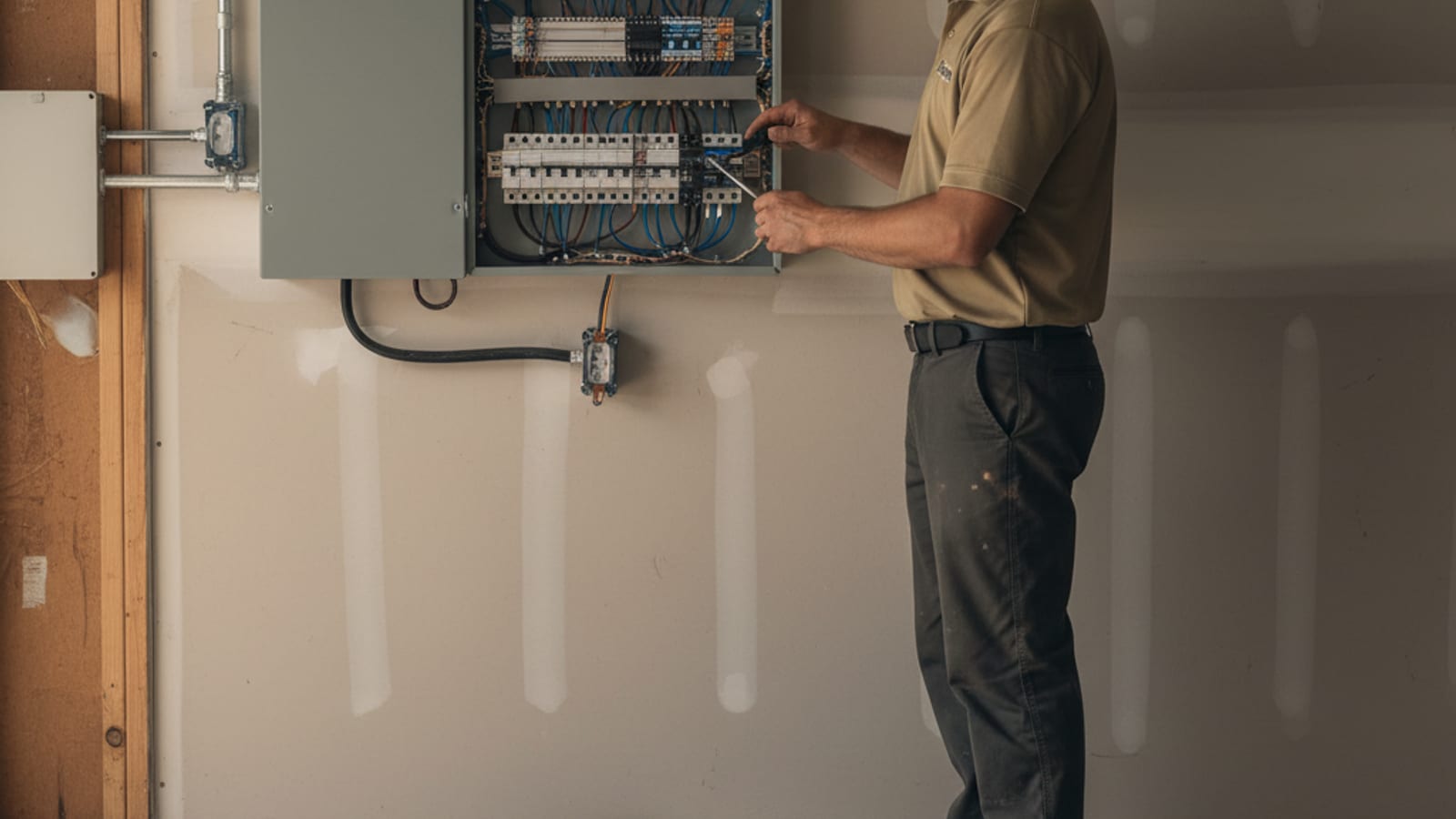
A single circuit breaker replacement in San Diego is listed here at $150 to $400 for labor plus the device, depending on breaker type and panel layout. Standard 15-amp or 20-amp: $150 to $200. AFCI: $200 to $350. Combination AFCI/GFCI: $250 to $400. Those published bands are labor and device only. They are not Bright Pro prices. Permit and inspection are a separate published add of $75 to $150, depending on the city or county. An evening or weekend call is listed as another $100 to $200 on top of the labor-and-device band.
TL;DR
- Standard 15-amp or 20-amp breaker: $150 to $200 labor plus device.
- AFCI breaker (arc-fault protection): $200 to $350 labor plus device.
- GFCI breaker (ground-fault protection, for wet areas): $200 to $300 labor plus device.
- Combination AFCI/GFCI: $250 to $400 labor plus device.
- Permit and inspection: published add $75 to $150, depending on jurisdiction.
- Never replace a breaker yourself, even if you think it’s simple. It’s live even with the main breaker off, and one slip means electrocution or fire.
- If a breaker trips repeatedly, treat it as a symptom. The breaker, an overload, or a fault on the circuit can all be the cause. Swapping the breaker without a diagnosis can hide the real issue.
- Emergency replacement on a weekend or evening adds $100 to $200.
Why does a single breaker cost so much?
The breaker itself (the part you can buy at a big-box store for $20–$50) is only a fraction of the cost. The rest covers what it takes to do it safely and legally.
Licensed electrician labor. Opening a live panel is a high-hazard job. The panel is energized even when you switch the main breaker off. The electrician has to use insulated tools, verify deenergization with a proper test, remove the dead front safely, and work inside the enclosure where a slip could cause a fatal shock or an arc flash. This is a 1 to 2-hour job for a licensed electrician, which in San Diego runs $100 to $150 in labor alone.
Permit and inspection. San Diego and San Diego County treat breaker replacement as electrical work that requires a permit ($75 to $150 depending on jurisdiction). A building inspector has to sign off to make sure the work meets code. That’s not optional; unpermitted panel work can complicate a homeowner insurance claim and blocks a future home sale. The permit fee plus the inspection call add $75 to $150 to the invoice.
Proper tools and diagnostics. A licensed electrician doesn’t just swap a breaker and leave. They’ll check whether the circuit is actually overloaded (and if so, you might need a subpanel or load management instead), test for ground faults or short circuits, verify the breaker size matches the wire gauge (15-amp breaker for 14-gauge wire, 20-amp for 12-gauge, never oversized), and make sure the new breaker is UL-listed for your specific panel type. Some panels, including Federal Pacific Stab-Lok and Zinsco, need inspection before anyone assumes a modern breaker will land. Brand name is not a replacement verdict. See Federal Pacific and Zinsco.
When do you actually need a new breaker?
The breaker trips once, twice, and then stops
If a breaker pops once during a thunderstorm or when you ran the AC and the dishwasher at the same time, it did open to protect the circuit. That one trip is still a symptom, not proof the breaker is healthy. Reset once, pull a load off that circuit, and watch. If it holds, you still do not have a diagnosis. If it trips again, leave it off and call a licensed electrician.
If the breaker trips every time you run a certain appliance, treat that as a symptom category, not one cause. It can be an overload on that circuit, a fault in the appliance, a tired breaker, or wiring. Replacing the breaker with a larger one is dangerous and illegal. You could start a fire in the walls. Fixes after diagnosis include moving the load, upgrading that circuit to the right wire gauge, or adding a dedicated circuit (see our dedicated circuit installation cost guide for pricing). A licensed electrician diagnoses which category applies.
The breaker won’t reset
You push the handle back to on and it immediately snaps back to off. Or it’s stuck in the middle position (neither fully on nor off). That is a symptom category, not a replacement verdict from this page. A persistent short, ground fault, or overload still on the circuit can look the same as a failed mechanism. Leave the breaker off. A licensed electrician diagnoses which category applies. Do not keep resetting it.
The breaker is warm or discolored
A breaker that feels warm or has burn marks means there’s a loose connection, a bad breaker, or a short circuit on that line. A loose connection is a fire risk. Have a licensed electrician inspect it immediately. They’ll tighten the connection, replace the breaker if needed, or diagnose a short circuit.
What type of breaker do you need?
This is where code requirements matter. The breaker you install has to match both the wire gauge on that circuit and the current code for that location.
Standard breaker (15-amp or 20-amp). Protects general-purpose circuits in living rooms, hallways, and storage areas. A 15-amp breaker protects 14-gauge wire; a 20-amp breaker protects 12-gauge wire. Never oversize. $150 to $200 labor plus device.
AFCI breaker (arc-fault circuit interrupter). Required in all bedrooms, living areas, kitchens, dining rooms, family rooms, laundries, closets, and hallways per current National Electrical Code (NEC Article 210.12). An AFCI breaker detects dangerous arc faults (a type of partial short circuit that can smolder and cause fires) and trips before a fire starts. Older homes often don’t have AFCI protection; upgrading when a breaker needs replacement is smart insurance. $200 to $350 labor plus device.
GFCI breaker (ground-fault circuit interrupter). Required for kitchen countertops, bathrooms, garages, basements, pools, and outdoor circuits. A GFCI breaker detects ground faults (current leaking to ground through water or a person) and trips in milliseconds. $200 to $300 labor plus device.
Combination AFCI/GFCI. Some circuits (a kitchen island, for example) need both protections. A dual-function breaker handles both and costs more to replace. $250 to $400 labor plus device.
Some electricians will recommend upgrading a standard breaker to AFCI when they’re in the panel anyway, especially for bedrooms, because it’s cheaper to do while they’re already there than to call back later. This is good practice and worth considering.
What if the breaker replacement is an emergency?
A breaker that won’t reset at 10 p.m. on a Friday means you lose power to that circuit, and you need it fixed now. An evening or weekend service call to replace a breaker typically costs an extra $100 to $200 on top of the standard replacement price. Some electricians offer same-day emergency service; others have a minimum emergency fee. Call and ask. In San Diego during summer when AC demand is peak, you might wait longer unless you prioritize the call.
Temporary workaround until your electrician arrives: move high-load appliances off that circuit. Turn off the AC if that breaker controls it, unplug the dishwasher, or move refrigeration to a different breaker if possible. But don’t try to replace the breaker yourself, and don’t leave the breaker in the reset position if it keeps tripping. Reset it once; if it trips again, leave it off and wait for a licensed electrician. If you’re in San Marcos or another North County city, the pros in our San Marcos network handle emergency breaker replacements.
Breaker replacement vs. the bigger picture
Sometimes a breaker that keeps tripping is a signal that something larger needs attention. If you’ve had the same breaker replaced twice in two years, or if multiple breakers in your panel are acting up, an electrician should run a full panel inspection. You might have:
- Overloaded panel capacity. Older homes with 100-amp service often have trouble supporting modern appliances. A panel upgrade might be the real solution.
- Loose connections. The panel’s main lugs (where service wires connect to the main breaker) or individual breaker connections can loosen over time, causing heat and nuisance trips.
- A short circuit. Damaged wire insulation, rodent damage, or a fault in an appliance can cause intermittent shorts that trip a breaker.
- Undersized circuits. Circuits that were sized for 1980s electrical demand might not handle today’s load profile (laptop chargers, streaming TV, modern HVAC, instant water heaters, EV chargers all on at once).
A $250 breaker replacement is cheaper than a $4,000 panel upgrade or a $10,000 fire claim. When in doubt, have a licensed electrician diagnose the real problem first.
Frequently asked questions
Can I replace a breaker in my panel myself? No. Panel interiors stay hazardous. This page does not walk you through the dead front. Unpermitted DIY panel work can complicate insurance and is a code problem. Hire a licensed electrician.
How long does a breaker replacement take? Typically 1 to 2 hours for a licensed electrician, including safety verification, removing the dead front, replacing the breaker, and reinstalling the cover. If additional diagnostics are needed (testing circuits, checking connections), add 30 minutes.
Will my power go out during a breaker replacement? The specific circuit that breaker controls will lose power while the work is happening, but the rest of your home stays on. The electrician doesn’t touch the main breaker unless necessary.
What’s the difference between a breaker and a fuse? Older homes (built before the 1950s) have fuse panels instead of breaker panels. Fuses are one-time-use (they melt when overloaded); breakers are reusable switches. If you have a fuse panel, breaker replacement isn’t an option. You’d need a full panel upgrade to switch to breakers. See our electrical panel replacement cost guide for that scope.
Why is a 20-amp AFCI breaker so expensive compared to a standard breaker? An AFCI breaker has internal electronics that monitor for arc faults. Those components cost more to manufacture and test. The added cost is worth it for safety in bedrooms and living spaces where fires from arc faults are a real risk.
If a breaker is tripping, can I just flip it back on and ignore it? Not safely. A tripping breaker is a symptom of an overload or a fault. Ignoring it risks damage to wiring, an appliance fire, or an electrical fire in the walls. Call a licensed electrician to diagnose why it’s tripping.
Is there a warranty on a new breaker? Most manufacturers warranty breakers for the life of the home under normal use, but the warranty typically covers the breaker only, not labor or other costs. If the breaker fails within a year, you can often get a replacement breaker for free, but labor to install it is separate.