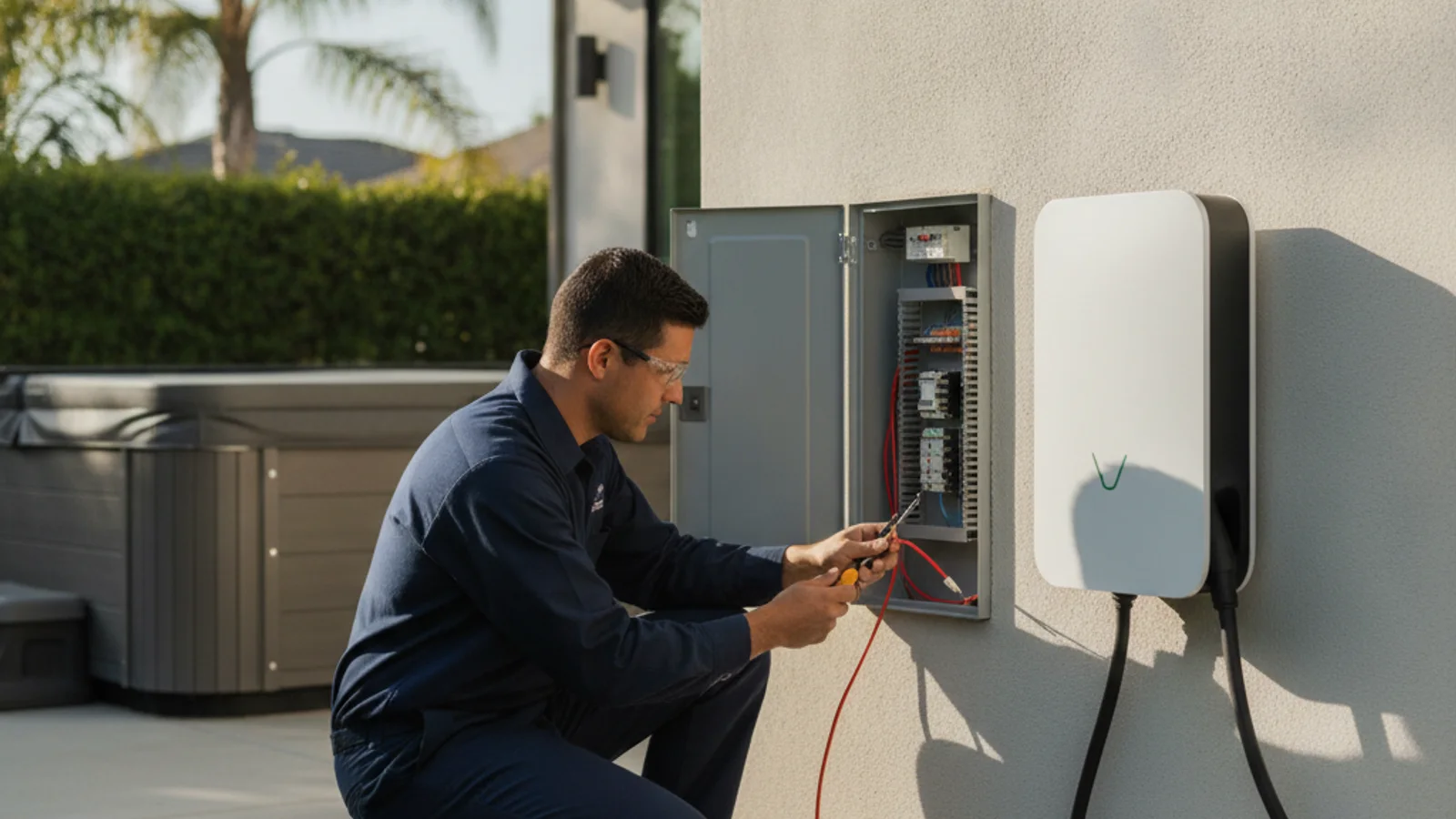
A hot tub electrical hookup costs $700 to $2,000 in San Diego, and the number that matters most isn’t the circuit, it’s the disconnect. Most quotes miss the GFCI spa disconnect rule until an inspector flags it mid-install.
TL;DR
- Straightforward hookups run $700-$1,200. Trenching or in-ground spas run $1,200-$2,000.
- Copy voltage, amperage, GFCI, and disconnect rules from the spa’s data plate and installation instructions, then the adopted California pool/spa articles.
- A common listing is a dedicated 240V circuit with GFCI and a disconnect within sight. Distance and ampacity are listing-specific, not a universal 50-amp / 5-foot rule until the nameplate says so.
- Confirm the permit path for that address. New circuits are typically permitted. Bright Pro Electric does not pull permits.
- Older 100A panels may need a load calculation before a spa circuit goes in.
What a hot tub electrical hookup actually requires
Start with the spa data plate and the manufacturer’s installation instructions. Then apply the California Electrical Code articles adopted for that permit, including the pool and spa provisions that implement NEC Article 680. This page does not replace those documents.
A typical listed portable spa wants a dedicated 240V circuit, GFCI protection as specified, and a disconnect sited per the listing and the adopted code. Sharing with a pool pump or dryer is a listing and load question, not a Bright Pro rule. Pool equipment electrical wiring covers the pump side separately. Our 240V outlet installation cost guide covers general 240V circuits. Spa work adds GFCI, disconnect, and bonding when the unit is permanently installed.
What a hot tub electrical hookup costs in San Diego
Pricing depends on how far the spa sits from the panel, whether the run is exposed or buried, and whether the panel has room for a new 50-amp double-pole breaker.
| Scenario | Cost |
|---|---|
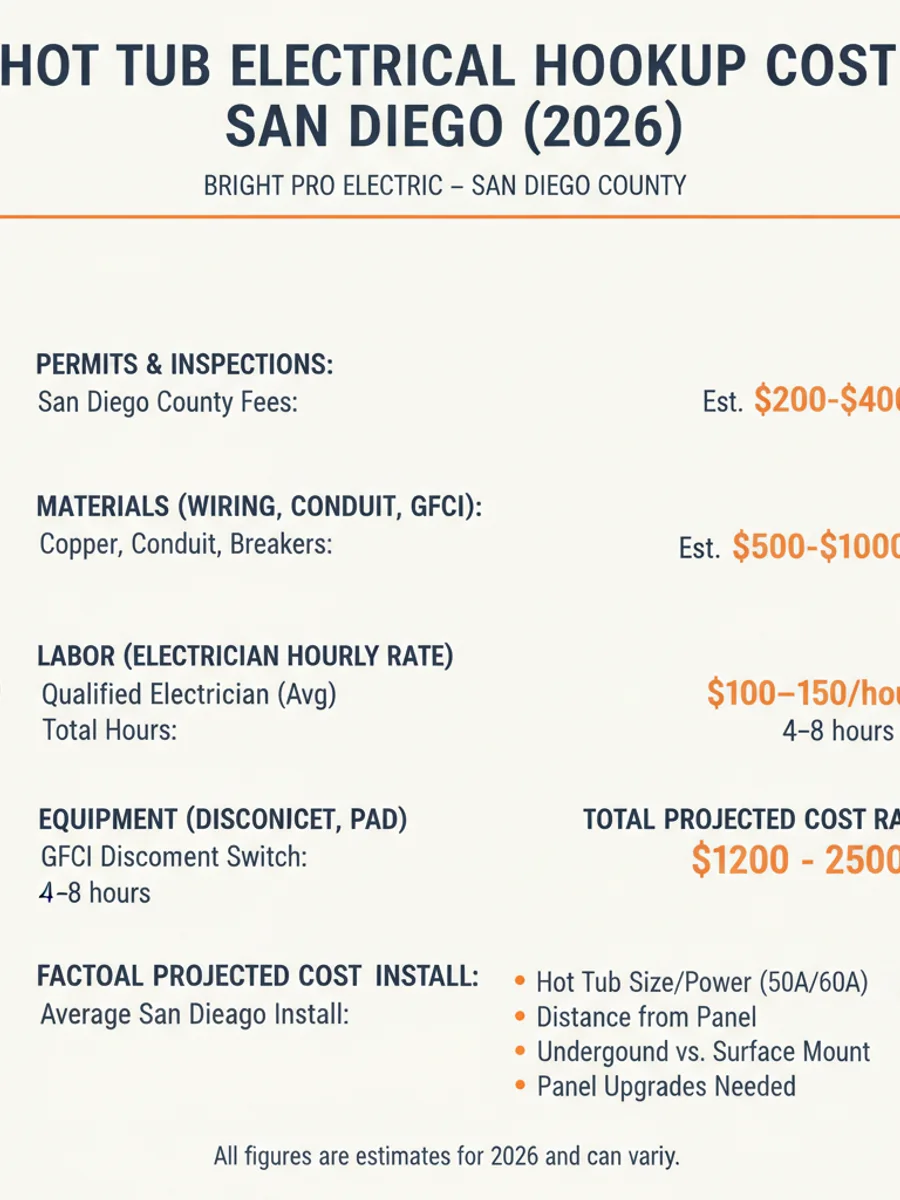
| Straightforward hookup (panel has room, spa within ~25 ft, surface conduit), incl. GFCI spa disconnect | $700-$1,200 |
| Longer run, trenching for a permanent or in-ground spa, or fishing through finished walls | $1,200-$2,000 |
| Add if a panel upgrade is required first | $2,000-$4,000 |
Permit fees are the city’s current schedule. This table does not publish a permit price. Confirm the AHJ before you budget it.
If the panel is already near capacity, the panel upgrade adds a real chunk to the project. Our panel upgrade cost guide for San Diego breaks down what drives that number for the county’s older housing stock.
The GFCI disconnect rule most homeowners miss
A spa circuit typically needs GFCI protection and a disconnect the listing and the adopted pool/spa articles can see from the equipment. Distance and ampacity are listing-specific. A common adopted layout is a disconnect within sight of the spa and a minimum horizontal distance from the water, often about 5 feet from the inside walls, unless a permanent barrier applies. That is not a universal 5-foot / 50-amp rule you can copy from this page. Confirm the data plate and the permit edition.
“Within sight” usually means the homeowner can see the disconnect from the spa and reach it without walking through a door or gate. Many installs use an outdoor GFCI-protected disconnect box, often called a spa panel, mounted on an exterior wall near the equipment. A GFCI breaker at the main panel alone may not satisfy the listing if the main panel sits around the side of the house or inside the garage.
When a 5-foot minimum applies, it typically measures from the inside walls of the spa, not the edge of the deck or patio. On a tight lot, that can force the disconnect to a spot the homeowner didn’t plan for, worth confirming before the electrician orders parts. Our GFCI outlet installation and requirements guide covers how GFCI protection works more broadly.
Circuit and wire sizing: 40, 50, or 60 amps
Read the spa’s data plate before anyone touches a breaker. The nameplate tells the electrician the exact breaker size and minimum circuit ampacity the manufacturer requires, and that number varies by model. Most residential hot tubs land on a 50-amp circuit, though some smaller units run 40 amps and larger units with dual pumps can call for 60.
A 50-amp circuit needs 6 AWG copper conductors. A 60-amp circuit steps up to 4 AWG. Getting this wrong isn’t a minor code violation, it’s an undersized conductor carrying more current than it’s rated for, a real fire risk. Outdoor runs go in conduit rated for exterior use, and any buried portion between the panel and the disconnect needs proper trench depth under California code. See our dedicated circuit guide for why a spa circuit can never share space on a breaker with anything else.
Portable spa vs. built-in spa: what changes
A portable, factory-listed spa arrives pre-bonded and only needs the circuit, GFCI protection, and disconnect wired to it correctly. A permanently installed or in-ground spa adds equipotential bonding and, often, trenching to the mix.
Self-contained portable units, the kind most San Diego backyards have, are listed by a testing lab and bonded at the factory. The electrician’s job is mostly the supply side: circuit, GFCI, disconnect, and confirming the unit’s own bonding grid connects correctly when it’s set. Nearby metal, like a metal deck frame or fence within reach of the spa, may still need attention.
Permanently installed spas, built into a deck or set in the ground, require equipotential bonding under NEC 680.26, bonding the metal fittings, pump motor, and structural metal near the spa into a common grid. That’s more labor than a portable install. In-ground spas typically add trenching for the underground conduit run, the main reason that scenario lands in the higher cost range above.
Do you need a panel upgrade first
Older San Diego homes with 100-amp panels frequently don’t have room for a 50-amp double-pole breaker once the AC, the range, and everything else is already accounted for. This shows up constantly in North County and older coastal neighborhoods where the original panel predates central air and EV chargers.
If the panel is already near its rated capacity, the electrician will flag a load calculation before touching the spa circuit. Adding 50 amps to a maxed-out 100A panel is a code violation the inspector will catch immediately. In that case, a panel upgrade usually comes first, either to 150 or 200 amps depending on total load, the difference between a spa that trips breakers under normal use and one that runs clean.
Permits and inspection in San Diego
California typically requires a permit for a new spa circuit. Confirm with the city or County. San Diego inspects GFCI, disconnect placement, and conductor size against the adopted code and the listing. Bright Pro Electric does not file that permit.
Skipping a required permit leaves the work uninspected. Ask your insurer how they treat unpermitted work. This page does not predict a denied claim or a failed refinance. Our San Diego electrical permit guide covers how to check the local path.
Frequently asked questions
How much does a hot tub electrical hookup cost in San Diego?
A straightforward hookup, with panel capacity available and a short run to the spa, costs $700 to $1,200 including the GFCI disconnect. Trenching for a permanent or in-ground spa, or fishing wire through finished walls, pushes that to $1,200-$2,000. A required panel upgrade adds $2,000-$4,000 on top.
Do I need a permit for a hot tub electrical hookup?
Yes. Confirm the current path for that address. A new hot tub circuit is typically permitted. San Diego inspects GFCI, disconnect placement, and wire sizing before signing off. Skipping a required permit leaves the work uninspected. Ask the insurer about coverage; do not treat this article as a claims rule.
Can I just plug my hot tub into a regular outlet?
Only if it’s a small plug-and-play spa rated for a standard 120V, 20-amp GFCI outlet, and even then it has to be its own dedicated circuit. Most residential hot tubs, the larger multi-jet kind, require a dedicated 240V circuit and can’t run off a household outlet at all. Check the data plate before assuming either way.
Where does the spa disconnect need to be located?
Within sight of the spa, reachable without going through a door or gate, on the distance the listing and the adopted pool/spa article require. A common layout is about 5 feet horizontally from the inside walls of the spa unless a permanent barrier applies. That is not a universal 5-foot rule. Most installs use an outdoor GFCI-protected disconnect box mounted on a nearby exterior wall rather than relying on the main panel.
Does my 100-amp panel need to be upgraded for a hot tub?
Not always, but it’s common. If the panel is already close to its rated capacity from AC, an EV charger, or other large loads, adding a 50-amp spa circuit usually triggers a load calculation and often a panel upgrade. An electrician can confirm capacity with a quick load calc before quoting the spa work.
What size wire does a hot tub circuit need?
It depends on the breaker size on the spa’s data plate. A 50-amp circuit, the most common size, uses 6 AWG copper. A 60-amp circuit steps up to 4 AWG. Always match wire size to the manufacturer’s nameplate rating rather than guessing based on the spa’s size.
How to get matched
Spa circuits combine live panel work, GFCI protection, and a disconnect placement rule that has to match the listing and the yard. This is not a DIY wiring project. A licensed electrician is the usual contractor for a new circuit. B&P §7048 is a statute the electrician and you can read; this page does not decide whether your spa hookup is exempt. Verify any contractor’s license at the CSLB license check tool before hiring. Bright Pro Electric matches San Diego homeowners with licensed electricians for spa and hot tub hookups. It does not pull the permit or run the conduit. Hours are Monday through Saturday, 7am to 7pm. After hours, leave a message. Use the contact page.