TL;DR
- Like-for-like GFCI replacement on this page is $125–$200 per location. New additions or outdoor weatherproof installs are $175–$350. Whole-home retrofits covering 8–12 locations typically run $800–$1,800.
- California adopts the California Electrical Code. GFCI locations depend on that adopted edition, the room, and the circuit, not a fixed list of 10 places copied from an old NEC summary.
- LINE and LOAD terminals reversed, or a skipped TEST, can leave an outlet that still supplies power but will not trip on a fault. This page does not cite a DIY error percentage.
- Older San Diego homes (pre-1975) frequently have two-prong ungrounded circuits. The adopted code has a path for GFCI-protected three-prong replacements without a new equipment ground, with required labeling. If the term itself is unfamiliar, what electrical grounding means explains what grounded actually refers to in a house.
- San Diego DSD and County permits are required when adding new circuits or making changes beyond like-for-like device replacement. Confirm for that address.
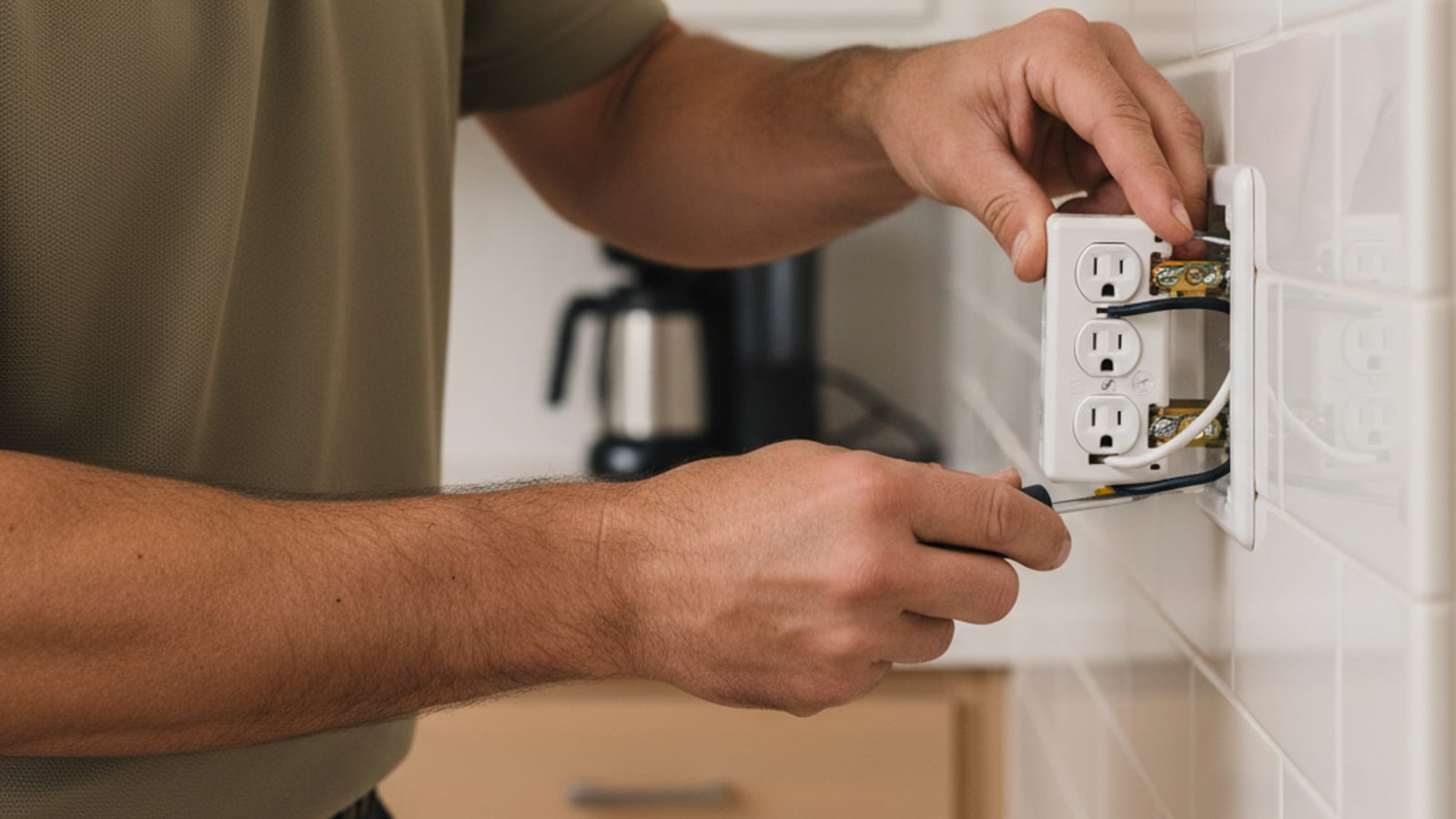
GFCI outlets, the ones with the TEST and RESET buttons, are one of the most effective electrical safety devices in a home. They respond to a ground fault (a small current leak) in about 1/40th of a second, cutting power before that current can cause injury or fire. In wet areas where electrical shock risk is highest, they’re not optional. They’re code-required.
This guide covers where you need them, what they cost, and why “just replace it myself” works out less often than people think.
What is a GFCI outlet and how does it work?
GFCI stands for Ground Fault Circuit Interrupter.
A standard outlet sends power out and returns it through the circuit. A GFCI continuously compares the outgoing and returning current. If the difference exceeds 5 milliamps, meaning current is taking an unintended path, like through a person or water, the GFCI trips and cuts power within 25–40 milliseconds.
For context: 10 milliamps causes intense muscle contractions. 100 milliamps for two seconds is potentially fatal. The 5 milliamp threshold catches ground faults before they become dangerous.
GFCI protection can be provided by:
- A GFCI outlet installed at the first outlet in a circuit, with downstream outlets protected through the LOAD terminals
- A GFCI breaker in the panel that protects all outlets on the circuit
- A GFCI circuit breaker with AFCI combination (AFCI/GFCI breakers protect against both arc faults and ground faults)
GFCI outlets and GFCI breakers both provide code-compliant protection. GFCI breakers cost more but protect everything on the circuit without requiring multiple device upgrades.
Where does adopted California code require GFCI protection?
San Diego jurisdictions enforce the California Electrical Code in effect for that permit, not a blog’s count of rooms. As of the 2025 CEC (NEC 2023 with California amendments), GFCI rules live mainly in CEC 210.8. Confirm the section that applies to the receptacle you are changing. Location and circuit type both matter.
Examples that often apply in dwellings, each still checked against the adopted text and the inspector:
- Bathrooms. 125-volt, 15- and 20-amp receptacles in bathrooms typically need GFCI.
- Garages and accessory structures. Dwelling-unit garage receptacles are commonly GFCI.
- Outdoors. Exterior receptacles accessible from grade are commonly GFCI, with height and in-use cover details from the listing and the code.
- Crawl spaces and unfinished basements. Where the home has them.
- Kitchens. CEC §210.8(A)(6) covers receptacles serving countertop surfaces. CEC §210.8(A)(7) covers 125V, 15- or 20-amp receptacles within 6 feet of a sink’s top inside edge, which can include a receptacle that does not serve the counter. Dishwashers rated 150V or less to ground and 60A or less also sit under CEC §210.8. Do not treat a refrigerator or dishwasher as “exempt” without reading the current section for that circuit.
- Pools, spas, and similar. Distance, listing, and equipment type are in the pool articles plus 210.8. Adding a compliant outdoor receptacle is covered in outdoor outlet installation. Pump or filter failures after the receptacle tests good are usually pool equipment work.
- Laundry, rooftops, boathouses, and other damp locations. Apply the adopted 210.8 list for that occupancy, not a ten-item mnemonic.
Living rooms, bedrooms, and hallways in dry interior areas often do not take receptacle GFCI the way wet rooms do, while AFCI rules for those rooms are a separate article. That split is still code-edition specific.
What’s not a substitute for the code book:
- A “10 locations” checklist
- Assuming dedicated appliance circuits skip GFCI
- Copying another state’s NEC adoption date
What does GFCI installation cost in San Diego?
Professional installation by a licensed electrician runs $125–$200 per like-for-like replacement in San Diego. New additions or outdoor weatherproof work uses the $175–$350 published band on this page.
| Scope | Typical cost range | Notes |
|---|---|---|
| Single GFCI outlet replacement | $125–$200 | Like-for-like. Confirm with the AHJ whether a permit applies. |
| New GFCI outlet addition (existing circuit) | $175–$350 | New device or outdoor weatherproof. Confirm permit with the AHJ. |
| GFCI outlet wired to protect downstream outlets | $150–$200 | Saves money vs. replacing each individually |
| GFCI breaker (panel-level protection) | $200–$350 per circuit | Protects everything on that circuit |
| Whole-home GFCI retrofit (8–12 locations) | $800–$1,800 | Common in older San Diego homes |
| Outdoor weatherproof GFCI outlet addition | $200–$350 | Includes in-use cover, conduit if needed |
The range within each category reflects conduit requirements, access difficulty, and whether any panel or circuit work is needed.
Why 8–12 locations is the typical retrofit number for San Diego homes:
A standard 3-bedroom, 2-bathroom San Diego home may need GFCI at bathrooms, garage, outdoor locations, and kitchen countertop or sink-adjacent receptacles. Count the actual locations and circuits. If the home has a pool or spa, add those receptacles after reading the adopted pool and 210.8 rules. 8–12 locations is a parked retrofit example, not a code count.
Why DIY GFCI installation fails more than people expect
A GFCI can be installed so the receptacle still supplies power while the trip function does not work. That is a wiring or listing problem, not a statistic this page can source.
Common wiring errors:
Error 1: LINE and LOAD terminals reversed. GFCI outlets have two sets of screw terminals: LINE (incoming power from the panel) and LOAD (outgoing to protect downstream outlets). Wiring the incoming power to the LOAD terminals and the downstream to the LINE terminals produces an outlet that works but cannot trip. The TEST button won’t test properly when wired this way.
Error 2: Neutral not connected. The GFCI’s sensing mechanism requires both the hot and neutral wires to run through the device’s sensing coil. If the neutral is connected to the junction box ground rather than the GFCI’s neutral terminal, the GFCI cannot sense a current imbalance.
Error 3: No ground in an ungrounded circuit, wired incorrectly. The NEC allows GFCI outlets to be used in ungrounded circuits (two-prong circuit without a ground wire). This is the code-compliant way to update two-prong outlets without rewiring. However, in ungrounded circuits, the outlet’s ground terminal must not be connected to anything. Some DIY installers add a pigtail from the ground terminal to the neutral, which creates a fault condition.
Error 4: Not testing after installation. Every GFCI installation should be tested with the TEST button after wiring. If the TEST button doesn’t cut power to the outlet, the device is miswired. Testing takes 10 seconds. Most DIY installers skip it.
The practical problem: an incorrectly wired GFCI looks exactly like a correctly wired one from the outside. Both have TEST and RESET buttons. Both work as outlets. The failure mode is invisible until a ground fault occurs and the device fails to trip.
Older San Diego homes and ungrounded circuits
San Diego has a significant percentage of pre-1975 homes with two-wire (ungrounded) branch circuits. These homes have two-prong outlets, with no third hole for the grounding pin.
Options for updating two-prong outlets to three-prong:
Option 1: Run new ground wires. The most correct approach electrically, but the most expensive. Running a ground wire through existing walls to every outlet in the house is labor-intensive; most of the cost is opening walls and running conduit. For whole-house updates, this can run $5,000–$15,000 depending on construction.
Option 2: GFCI outlet replacement. The adopted code has a path (NEC/CEC 406.4(D)(2) in recent editions) for a GFCI on an ungrounded circuit, with required labeling such as “GFCI Protected, No Equipment Ground.” Confirm the exact labeling and wiring limits in the edition the inspector is using. Downstream three-prong replacements through LOAD terminals follow that same section.
This doesn’t provide a ground path for equipment that needs it (computers, audio equipment, sensitive electronics). But it provides ground fault protection, which is the safety function that matters in wet-area locations.
Option 3: GFCI breaker. Install a GFCI breaker at the panel for the circuit. All outlets on the circuit become GFCI-protected and can be replaced with three-prong devices. Same NEC section applies: label all outlets “GFCI Protected, No Equipment Ground.”
For San Diego’s older housing stock, Option 2 (GFCI outlet replacement) is the most common cost-effective path for bathroom, kitchen, and outdoor upgrades. Option 3 (GFCI breaker) is worth considering when the panel is being touched anyway.
Permits and San Diego DSD requirements
In the City of San Diego, like-for-like replacement of a GFCI outlet (same location, no new circuit) typically does not require a permit. However:
- Adding a new outlet where one didn’t exist requires a permit
- Adding a new circuit at the panel requires a permit
- Any work in an unincorporated area follows San Diego County DPW permit requirements, which are similar
For whole-home GFCI retrofits that involve new outlet locations or circuit modifications, permit fees run $100–$250 for simple residential projects. A C-10 licensed electrician handles permit application as part of the job.
Permitted work gets inspected, which catches wiring errors before they become fire or shock hazards. For a whole-home retrofit on a pre-1975 San Diego home, inspection is particularly valuable given the likelihood of encountering older wiring conditions.
Frequently asked questions
How much does GFCI outlet installation cost in San Diego?
Professional installation by a licensed electrician runs $125–$200 per outlet for like-for-like replacements, and $175–$350 for new outlet additions or outdoor weatherproof installs. Whole-home retrofits covering 8–12 locations typically run $800–$1,800 total. GFCI breakers, installed at the panel to protect an entire circuit, run $200–$350 per circuit.
Can I replace GFCI outlets myself?
Technically yes, with the power off at the breaker. LINE and LOAD mix-ups can leave a device that still powers a lamp but will not trip on a fault. If you do install one yourself, test it immediately: plug in a lamp, press TEST, and the lamp should go off. Press RESET, and the lamp should come back on. If TEST doesn’t cut power, the device is miswired. Kitchen, bathroom, and exterior locations are licensed electrician work when you are not sure.
Do I need GFCI outlets in my kitchen?
The California Electrical Code requires GFCI protection for receptacles serving kitchen countertop surfaces and for 125V 15- and 20-amp receptacles within 6 feet of a sink. Most kitchen layouts place countertop outlets in that set. If your San Diego kitchen has standard outlets with no TEST/RESET buttons, they likely don’t meet the currently adopted code for those locations. Updating them is a like-for-like replacement on this page ($125–$200 per outlet installed) and worth doing before any kitchen renovation that triggers an inspection.
For bathroom-specific GFCI placement rules including the 3-foot sink rule and dedicated 20-amp circuit requirement, see our guide on bathroom GFCI outlet requirements in San Diego. If you have an existing GFCI that’s failing to trip or won’t hold reset, see our guide on when a GFCI outlet needs replacing.
Bright Pro Electric matches San Diego County homeowners with licensed electricians for GFCI replacement and retrofit. It does not install outlets. See the outlet and switch installation matching page or browse electrician service areas by city. Hours are Monday through Saturday, 7am to 7pm. After hours, leave a message. Use the contact page to get matched.