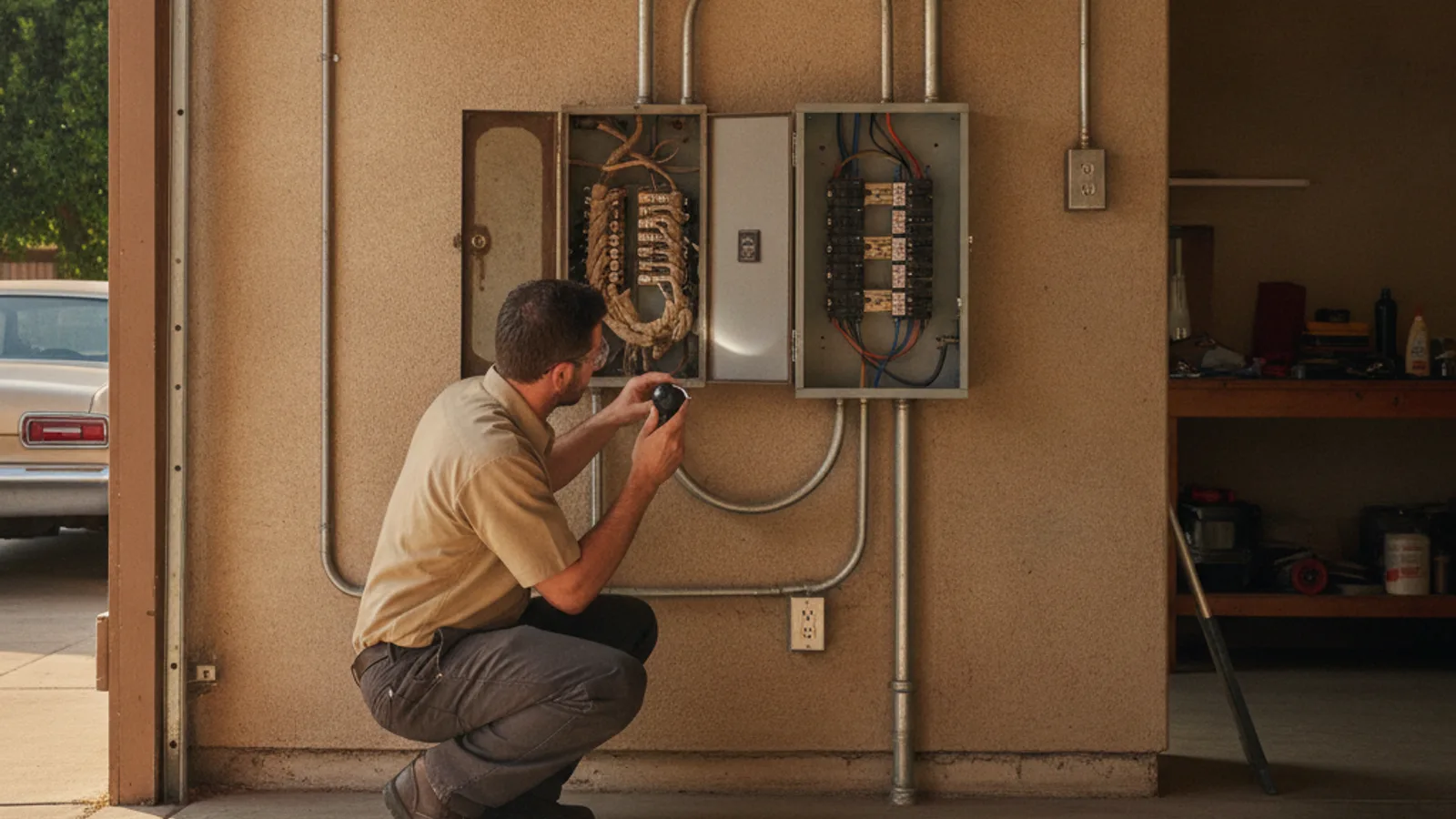
A fuse box that still holds glass or cartridge fuses is a different product from a breaker panel. When a fuse opens, you replace the fuse. When the box itself is undersized, damaged, or cannot take AFCI/GFCI breakers, the work is a service-equipment change, not a trip to the hardware aisle.
What a fuse box is, and why some San Diego homes still have one
A fuse box protects circuits with screw-in or cartridge fuses. Each fuse has a fusible link sized to an ampacity. Excess current melts the link. A breaker does the same interrupting job and can be reset. Fuse equipment generally cannot host the AFCI and GFCI devices that current adopted code expects on many dwelling circuits.
Fuse panels show up in older county housing. The only way to know a property’s service size is the label and a licensed evaluation. Modern loads can include central air, cooking equipment, office gear, and a Level 2 charger. You cannot keep adding fuses the way you add breaker spaces. When the box is out of room or capacity, the conversation is a new panel, not a new fuse.
Signs it is time to have the equipment evaluated
These are categories, not a remote diagnosis:
- The same fuse opens repeatedly. That is overload or a fault on the circuit, not a “bad fuse” as the only story.
- A drawer of spare fuses. Stocking fuses like lamps means the circuits are working hard. It does not by itself prove the box must come out tomorrow.
- An oversized fuse in a smaller socket. A 30-amp fuse in a 15-amp holder can leave the wire unprotected. That is a reason to stop using that circuit and have it inspected.
- You want to add real capacity (EV, heat pump, addition). A fuse box has no spare breaker spaces.
- A lender or insurer asked about the panel type. That is their underwriting question. This page does not claim every carrier requires replacement before renewal.
Federal Pacific and Zinsco are different product lines. A fuse box is not an FPE or Zinsco diagnosis. See Federal Pacific and Zinsco if those names are on the dead front. Inspection, not a photo from this article, settles brand and condition.
What the changeover actually involves
Replacing a fuse box is a panel replacement: disconnect (often with the utility), remove the fuse equipment, install a breaker panel sized from a load calculation, and update grounding and bonding to the code edition on the permit. Existing circuits land on new breakers. AFCI and GFCI land where that permit’s code requires them.
California Business and Professions Code §7048 is the minor work contractor-license threshold ($1,000 as of January 1, 2026, AB 1170). It is not a sentence that “all electrical work must be C-10.” Work that needs a building permit still needs a licensed contractor at any dollar amount, and most panel changes need a permit. The City of San Diego can issue electrical permits to authorized California-licensed contractors or to a property owner/lessee. Do not write that only a C-10 can obtain every permit. CSLB’s C-10 classification is the specialty license for electrical contracting. A Class B prime contractor can be in the picture when the statute’s two-unrelated-trades (or C-10 / subcontract) tests are met. Verify any license at CSLB lookup.
This is a different scope than circuit breaker replacement. It is closer to a 200-amp panel upgrade, except the starting equipment is fuses. If branch wiring is knob-and-tube, the scope can grow. See knob-and-tube rewire.
Permits and who pulls them
Permit jurisdiction is the house address, not “San Diego” as one counter.
- City of San Diego (including many neighborhoods such as Scripps Ranch): Development Services. Confirm the current simple/no-plan electrical fee on the city’s bulletin. This page does not publish a dollar fee. No-plan is still a permit.
- Unincorporated county (Ramona and similar): County PDS. Confirm the current electrical-only fee on the PDS schedule. This page does not publish a dollar fee.
- Poway: its own building division and fee schedule. Do not publish a Poway dollar fee from this article.
Bright Pro Electric does not pull permits, stamp forms, or schedule SDG&E. The licensed contractor (or owner/lessee, where allowed) does. SDG&E disconnect/reconnect is on the utility’s calendar, not a contractor guarantee.
What it actually costs
No government or verified industry source publishes a flat price for a fuse box replacement. The number depends on service size, meter-to-panel distance, grounding, and how many circuits transfer. A written itemized quote from the licensed business that will contract the work should separate permit, materials, labor, and utility coordination. A quote that treats the permit as optional is a quote to walk away from.
Older housing stock is not one percentage for the whole county
Fuse equipment clusters in older stock, and that stock is not evenly spread.
Ramona: ACS 2023 5-year (B25034) 41.6% of housing units in the 1990-99 cohort. Rural lots sometimes still have well equipment on original service. That percent is housing age, not “most Ramona jobs are fuse boxes.”
Poway: 49.2% in the 1980-89 cohort. Older pockets around Old Poway differ from later tracts that never had fuses.
Scripps Ranch is a San Diego neighborhood without a Census place-level row in this site’s housing table. Describe it qualitatively only: later tracts are often 1980s-2000s breaker panels under EV and solar load, and a fuse box there is uncommon, not a percent.
When to call
If you are still on screw-in fuses, or someone installed an oversized fuse to stop openings, have a licensed electrician look at the equipment, the wiring, and the service size before anyone writes a number.
Bright Pro Electric matches San Diego County homeowners with independent licensed electricians. It does not replace panels. Hours are Monday through Saturday, 7am to 7pm. Use the contact form.