TL;DR
- Federal Pacific Stab-Lok and Zinsco labels on the outer cover are inspection flags. Whether a given breaker fails to trip is an inspection finding. Challenger is a different line.
- Insurers sometimes ask about these brands. Replacement windows and non-renewals are carrier decisions, not a 30-60 day rule from this page.
- Replacement costs $2,800-$4,200 for a typical 100A-to-200A upgrade, including permit, new meter socket, and SDG&E coordination. Duration is not a same-day promise.
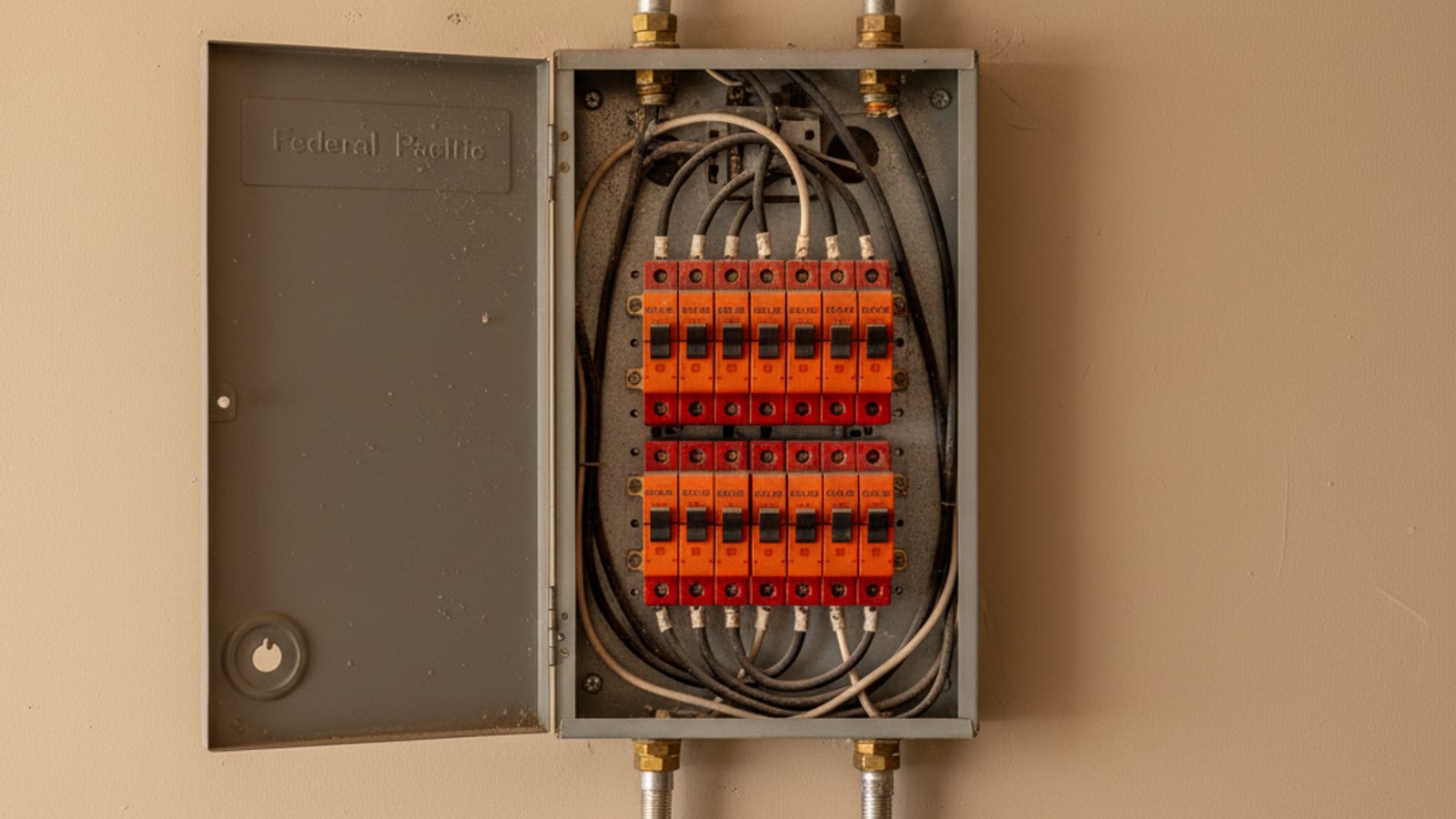
- Identify FPE from the outer cover and label: “Federal Pacific,” “Stab-Lok.” Identify Zinsco from the cover branding. Do not remove the inner dead front.
If you bought an older San Diego County home in the last few years, your insurance agent may have already mentioned this. Two electrical panel brands, Federal Pacific Electric (FPE) Stab-Lok and Zinsco / Sylvania, get flagged by some carriers. Some refuse to write policies on homes with them. Others raise rates. Some send a replacement window. Those letters are carrier decisions. This page does not set a 30-60 day rule and does not diagnose replacement from the cover label.
Here’s why, and what to do if your home has one.
What’s wrong with these panels?
Both panels were installed broadly from the late 1950s through the early 1980s. Independent testing and field reports going back decades have shown that a meaningful percentage of their breakers fail to trip during a short circuit or overload event, the exact failure mode breakers are supposed to prevent.
When a breaker doesn’t trip on a fault, the wiring stays energized. Insulation melts. Conductors arc. Fires start in walls behind the panel where homeowners can’t see them.
The Consumer Product Safety Commission investigated FPE in the early 1980s. The investigation didn’t lead to a recall (resource and statutory limits at the time), but the documented failure rate is what insurance underwriters now act on.
How do you identify a Federal Pacific or Zinsco panel?
Federal Pacific Stab-Lok
Look at the outer door and the label only. Do not remove the inner dead front.
- The brand name “Federal Pacific” or “FPE” on the cover
- A “Stab-Lok” mark you can read with the outer door open
- Handle color is not a diagnosis. Challenger is a different line.
Zinsco (sometimes branded Sylvania)
Zinsco panels are slightly less common in San Diego than FPE but show up in homes from the 1970s era:
- Brand names “Zinsco” or “Sylvania” on the cover
- Do not open the inner cover to inspect the bus
If you are not sure, photograph the closed cover and send it to a licensed electrician. Bright Pro does not identify panels from photos.
Why are insurance companies flagging these panels now?
Three things changed in the last decade:
- Underwriting data caught up. Insurance carriers have decades of claims data linking these panels to fire incidents. The actuarial signal is strong enough to flag.
- Reinsurance pressure. Reinsurance companies (the carriers behind your carrier) raised exclusions and capital requirements for properties with documented hazards.
- Inspection visibility increased. Pre-purchase inspectors are now trained to spot and report these panels. The information makes it back to underwriting.
Practically: if you have a Federal Pacific or Zinsco panel and your homeowner policy is up for renewal, ask the carrier what they will do. Some send a non-renewal, a rate change, or a replacement window. Some do not. Identification flags inspection. It does not close the replacement decision.
Should you worry about Challenger panels too?
There’s a third brand worth mentioning: Challenger electrical panels, made through the 1980s and into the early 1990s. Challenger isn’t as widely flagged as FPE or Zinsco, but the brand has documented issues with bus bar overheating and breaker reliability. Some carriers are starting to flag them in 2025–2026.
If you have a Challenger panel and you’re up for insurance renewal, ask your carrier directly whether they still cover it.
What does a panel replacement involve?
A panel replacement is licensed work. Duration depends on the utility disconnect window and the inspector, not a same-day promise.
- Permit through the city or county that reviews that address
- SDG&E disconnect and reconnect when the utility schedules it
- A licensed electrician replaces the equipment. Bright Pro does not.
- AFCI/GFCI as required by the adopted edition
- Inspection documentation for the homeowner’s file and, if asked, the insurer
Cost: $2,800 to $4,200 for a typical 100A → 200A upgrade. Panel upgrade cost.
Should you DIY it?
No.
Even if you have electrical experience, three things make panel replacement different from anything else in a home:
- The service entrance conductors are always live until SDG&E pulls the meter. There is no breaker upstream of the main breaker. Working on energized service entrance conductors is how electricians die.
- The permit and inspection process requires a licensed contractor in California. Homeowners can’t pull electrical service permits in most jurisdictions for main panel work.
- Insurance. Unpermitted work can affect a claim. Ask the carrier. It is not automatically gone.
When should you replace it?
If you’re unsure whether your panel needs replacement or just a voluntary upgrade, see our guide on 7 signs your San Diego home needs a panel upgrade, it covers both forced and voluntary scenarios side by side.
If your insurance carrier flags it, you have a deadline. If they haven’t yet but your panel is an FPE or Zinsco:
- Before listing the home for sale. Buyer inspectors will catch it and the negotiation goes harder than the cost of doing it yourself
- Before adding major loads such as an EV charger. Coordinate the load calculation with the electrician, not a Bright Pro spec.
- Before a known insurance renewal date. Avoid the surprise non-renewal letter
Frequently asked questions
How do I know if I have a Federal Pacific panel?
Look for the words “Federal Pacific” or “FPE” on the outer cover or the inner side of the outer door. A “Stab-Lok” mark you can read without removing the dead front is the usual cue. Handle color is not a diagnosis. Do not remove the inner dead front to chase model numbers.
Will my homeowner’s insurance drop me if I have a Zinsco panel?
Ask your carrier. Some will not write or renew. Some will. A 30- to 60-day window is a policy letter, not a Bright Pro rule.
How long does a panel replacement take?
Power-off windows depend on SDG&E. They are often several hours. They are not a same-day Bright Pro schedule.
Can I just replace the breakers instead of the whole panel?
Aftermarket or counterfeit breakers do not turn an FPE or Zinsco enclosure into a new listed panel. A licensed electrician inspects the bus and breakers. Replacement of the panel is an inspection finding, not a brand-name verdict from this page.
Related guides
For full panel upgrade pricing beyond the FPE/Zinsco context, our panel upgrade cost guide covers the complete breakdown including SDG&E coordination, permits, and brand options. Homes with FPE or Zinsco panels often have other legacy wiring issues. Our knob-and-tube and aluminum wiring guide covers identification, insurance implications, and remediation options.
Service area
Bright Pro Electric matches homeowners with independent licensed electricians. Bright Pro does not replace panels and does not have a weekly FPE job count. Use contact. Leave a message any time.
Ask for a written quote before work starts. See our panel upgrade service page or use contact.