You love the house. Coverage letters, if they arrive, are from the carrier, not from the wiring type by itself. Knob-and-tube in a Kensington or North Park bungalow is a screening clue. Confirm the conductors, their condition, and what the insurer actually asked for before treating a full rewire as the only path. Cost ranges below stay parked.
TL;DR
- A full knob-and-tube rewire in San Diego costs $10,000 to $35,000 depending on home size; a small North Park bungalow runs $10,000 to $18,000, a larger Mission Hills home runs $22,000 to $35,000+.
- Lead with the documented wiring and the insurer’s written requirement, then a field-verified scope. This page does not require a full rewire for every policy.
- Plaster wall patching and painting after the rewire is a separate cost ($1,500 to $4,000), typically handled by a drywall contractor, not the electrician.
- A permit with inspections is typical for a rewire. Ask whether the closed permit is the document the insurer wants.
- You can often remain in the home during a phased rewire. Cutover duration is proposal-specific, not a 4-to-8-hour rule.
What knob-and-tube actually is, and why it gets inspected
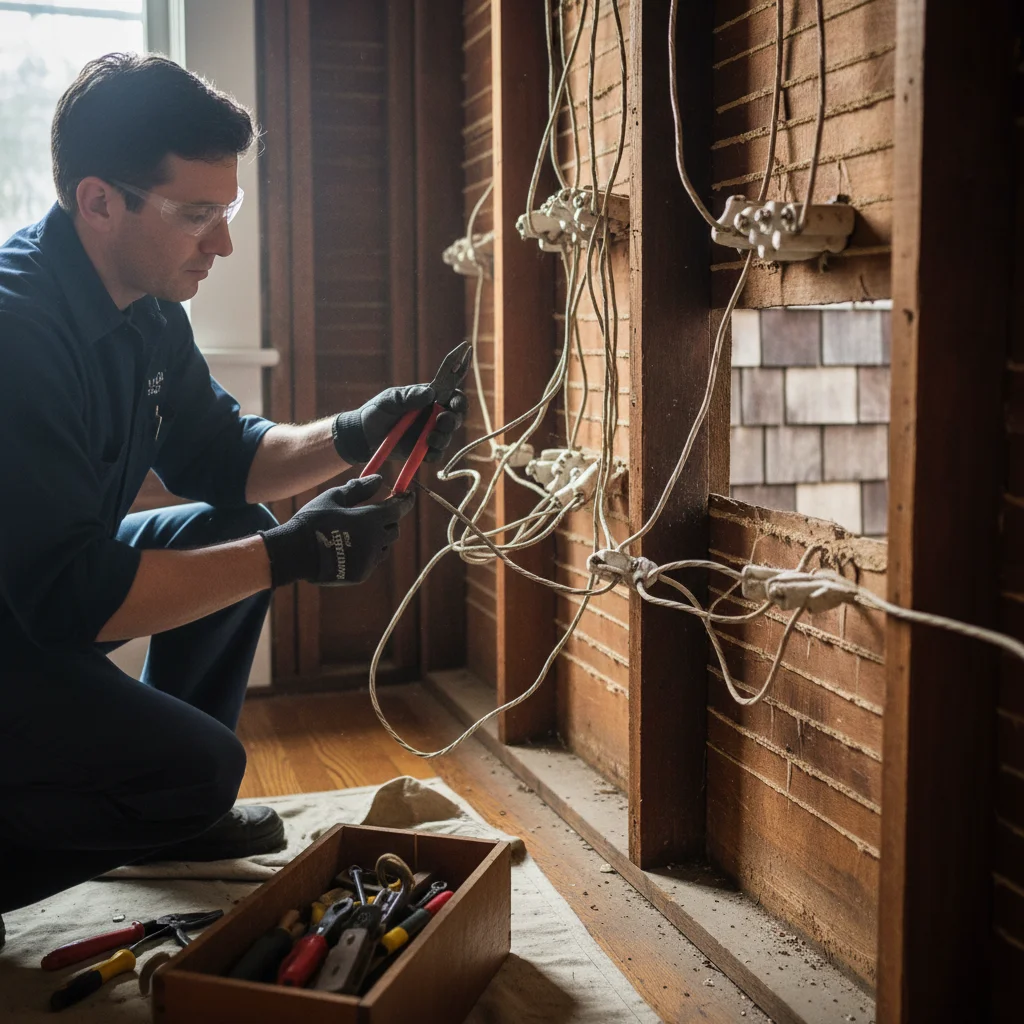
Knob-and-tube (K&T) was a standard wiring method. If a North Park, Mission Hills, or South Park house was built in that era, look. Do not assume. Ceramic knobs suspend individual conductors; ceramic tubes pass them through framing. Condition (insulation cover, damaged cloth, overloaded additions) is the inspection, not the decade on the permit.
For its time, it was a clever design. The air gap around the wires helped dissipate heat. But the system has several critical flaws by today’s safety standards:
- No equipment ground in the original two-wire run: K&T is hot and neutral. It does not supply an equipment ground. A three-prong device on that circuit is not grounded unless a new ground or a listed GFCI replacement path is used. Adopted code can allow a labeled GFCI receptacle without a new ground. That is not the same as a grounded three-prong outlet. Confirm the method with the electrician and the inspector.
- Brittle insulation: The original rubberized cloth insulation becomes incredibly brittle over 80+ years. It can flake off with the slightest disturbance, exposing live wires and creating a serious fire hazard.
- Improper modifications: Over the decades, many K&T systems have been dangerously modified. Homeowners or handymen may have spliced in modern wiring, overloaded circuits, or covered the wiring with attic insulation, which prevents heat from escaping as designed.
These issues are why some carriers ask about energized K&T. Ask yours, in writing, what they will write or keep. This page does not refuse a policy or predict a fire. For identification, see knob-and-tube and other outdated wiring in San Diego.
Cost ranges by home size in San Diego
The cost to rewire a house with knob-and-tube wiring is a significant investment, but it’s one that preserves your home’s value and ensures your family’s safety. In San Diego County, the price is primarily driven by the home’s square footage, accessibility, and the complexity of the existing structure.
Here are some realistic ballpark ranges for a full whole-home rewiring project in San Diego’s older neighborhoods. Remember, these are for planning purposes only; a firm quote requires an in-person inspection.
- Small Bungalow (1,000–1,500 sq. ft.): $10,000–$18,000. This typically covers a two-bedroom, one-bath home common in areas like North Park. Accessibility is key here; a home with good attic and crawlspace access will be on the lower end of the range.
- Medium Craftsman (1,500–2,200 sq. ft.): $16,000–$25,000. For a classic three-bedroom, two-bath Craftsman or Spanish-style home in Kensington or University Heights, the project scope increases. More rooms mean more outlets, switches, and lighting circuits to run.
- Large Historic Home (2,200–3,000+ sq. ft.): $22,000–$35,000+. Larger homes in Mission Hills or Coronado, especially those with two stories, require more labor and materials. Limited access between floors can also increase the complexity and cost.
These ranges typically include pulling all new copper wiring (Romex), installing new outlets and switches, adding dedicated circuits for modern appliances, and installing a new, safe electrical panel. Often, homes with K&T also have outdated and dangerous panels like Federal Pacific or Zinsco panels, which must be replaced as part of the project.
Partial vs. full rewire: when each makes sense
When faced with the cost, many homeowners ask if they can just replace some of the wiring. A partial rewire is technically possible. Whether a full rewire is required is a field scope plus the insurer’s written letter, not a Bright Pro rule.
A full rewire is the path that removes the remaining energized K&T system. Ask the insurer whether a closed permit is the document they want. This page does not require a full rewire for every policy.
A partial rewire can apply when a later addition already has modern wiring and the original K&T is limited to named rooms. The electrician scopes that after inspection. Another path is staging with a remodel: kitchen and baths first, bedrooms later, if the written proposal and the insurer’s letter both allow it.
A partial approach can leave ungrounded K&T in other walls. That mix is a field finding, not an automatic insurance outcome. For K&T still serving living space, many homeowners still choose a complete replacement. Confirm against the carrier letter and the inspection.

Plaster walls, fish-tape access, and patch costs
One of the biggest anxieties for owners of historic homes is wall damage. The lath-and-plaster walls common in pre-war homes are more delicate and difficult to work with than modern drywall. The good news is that a skilled electrician can rewire a plaster-walled home with surprisingly minimal disruption.
The licensed electrician who takes the job fishes new wires through wall cavities where the structure allows it. That typically involves:
- Strategic access points: The least intrusive cuts are often inside a closet, behind where an appliance will go, or in a high corner that’s easy to patch.
- Fishing wires: Long, flexible drill bits and fish tapes can route modern Romex from attic or crawlspace to each new outlet, switch, and light fixture box.
- Minimizing cuts: A small rectangular hole for each new electrical box plus a few access holes is common. Gutting every room is not the default method.
An electrician’s quote covers the electrical work: running wires, installing boxes, and connecting devices. Plaster or drywall repair is a separate line. Budget a drywall or plaster contractor after the electrical inspection. That can add $1,500 to $4,000 depending on home size and the extent of openings. Bright Pro Electric does not patch walls.
Permits, inspections, and the temp-power phase
A whole-home rewire is a major alteration to your property’s infrastructure, and it requires an electrical permit from the AHJ, whether that’s the City of San Diego or another municipality in the county. Knob-and-tube and aluminum branch circuits are different products and different eras. Do not treat a 1965–1973 aluminum screening window as typical original K&T. If both show up in the same house, the electrician scopes each system. Confirm insurance questions with your carrier. The aluminum wiring insurance page is the related topic, not a named-carrier checklist.
The permit process is how the adopted electrical code gets inspected. A licensed electrician pulls the permit and schedules inspections when that is in their scope. Bright Pro Electric does not pull permits and is not the C-10 on the job.
There are typically two main inspections:
- Rough-in Inspection: This happens after all the old wire is removed and the new wires and boxes are installed, but before the walls are patched up. The city inspector verifies that the wiring methods, box placements, and circuit layouts meet code.
- Final Inspection: After the walls are repaired and all devices (outlets, switches, fixtures) are installed and connected, the inspector returns for a final check to approve the completed work and close the permit.
The closed permit is documentation that the inspected work met the adopted code at that visit. Ask your insurer whether that is the document they want. This page does not decide a claim.
During the project, occupancy follows the written proposal. Power can stay on for much of a phased rewire. The cutover, when the old system is disconnected and the new panel and circuits are energized, is a planned outage. Duration is proposal-specific, not a single-day 4-to-8-hour rule. Temporary power for named loads, if offered, belongs in that proposal.
How to stage the work to keep living in the home
The thought of electricians in every room is fair. A professional rewire is usually sequenced so most of the house stays usable. Bright Pro Electric matches you with that electrician. It does not staff the crew.
The electrician should map circuits and sequence rooms with you, protect floors, and use dust barriers around the work area. Work is often done in zones: attic and upstairs bedrooms, then main living areas, then kitchen and service spaces. Cleanup at the end of each day is a proposal item, not a Bright Pro guarantee.
Ask which rooms lose power and when the planned cutover happens. Staying in the home is possible on many jobs. It is not automatic.
Frequently asked questions
Will my home insurance be cancelled if I have knob-and-tube wiring?
Ask your carrier. Some send non-renewal notices for energized K&T; some do not. A full rewire with a closed permit is often what they ask to see. A partial rewire may not satisfy that letter. This page does not cancel or reinstate coverage.
Do my walls have to be demolished to rewire a historic San Diego home?
No. Skilled electricians use flexible drill bits and fish tape to route new wire through existing wall cavities, accessing them through small, strategically placed cuts, usually inside closets or behind appliances. The plaster or drywall is repaired afterward by a separate contractor. You won’t lose your walls. The rewire is staged by zone so most of the house remains livable at any given time.
How long does a knob-and-tube rewire take in San Diego?
A typical 1,500 to 2,200 square foot home takes one to two weeks for the electrical work itself. After the rough-in inspection, you wait for the city inspector’s sign-off before patching walls. The final electrical inspection follows once devices are installed. Budget two to four weeks total from start to closed permit, depending on how quickly inspections are scheduled in your jurisdiction.
My house has some modern wiring mixed with old knob-and-tube. Do I still need a full rewire?
If the original system still serves any circuits in the living area, ask the insurer what they want deactivated. A partial rewire of remaining K&T can fit when a prior owner already rewired an addition or named rooms. An in-person inspection is the only way to set scope.
When to call us
Rewiring a knob-and-tube system is not a DIY project. It needs a licensed electrician who has done historic-home wiring and current code. Bright Pro Electric matches San Diego homeowners with that electrician. It does not pull permits or perform the rewire.
Use the contact page. Hours are Monday through Saturday, 7am to 7pm. After hours, leave a message.