TL;DR
- Published industry Level 2 install ranges on this site remain $850–$1,800, with panel upgrades $2,800–$4,200. Those are parked figures, not a Bright Pro quote and not a survey.
- City of San Diego EVSE permitting follows Information Bulletin 187. Fees live on the city’s bulletins, not as a countywide $250–$450 rule.
- Registration counts, home-charger shares, and zip-code density tables are not republished here. Read CARB and CEC primary releases for current adoption numbers.
- Bright Pro Electric matches homeowners with independent licensed electricians. We do not have a referral work-volume statistic.
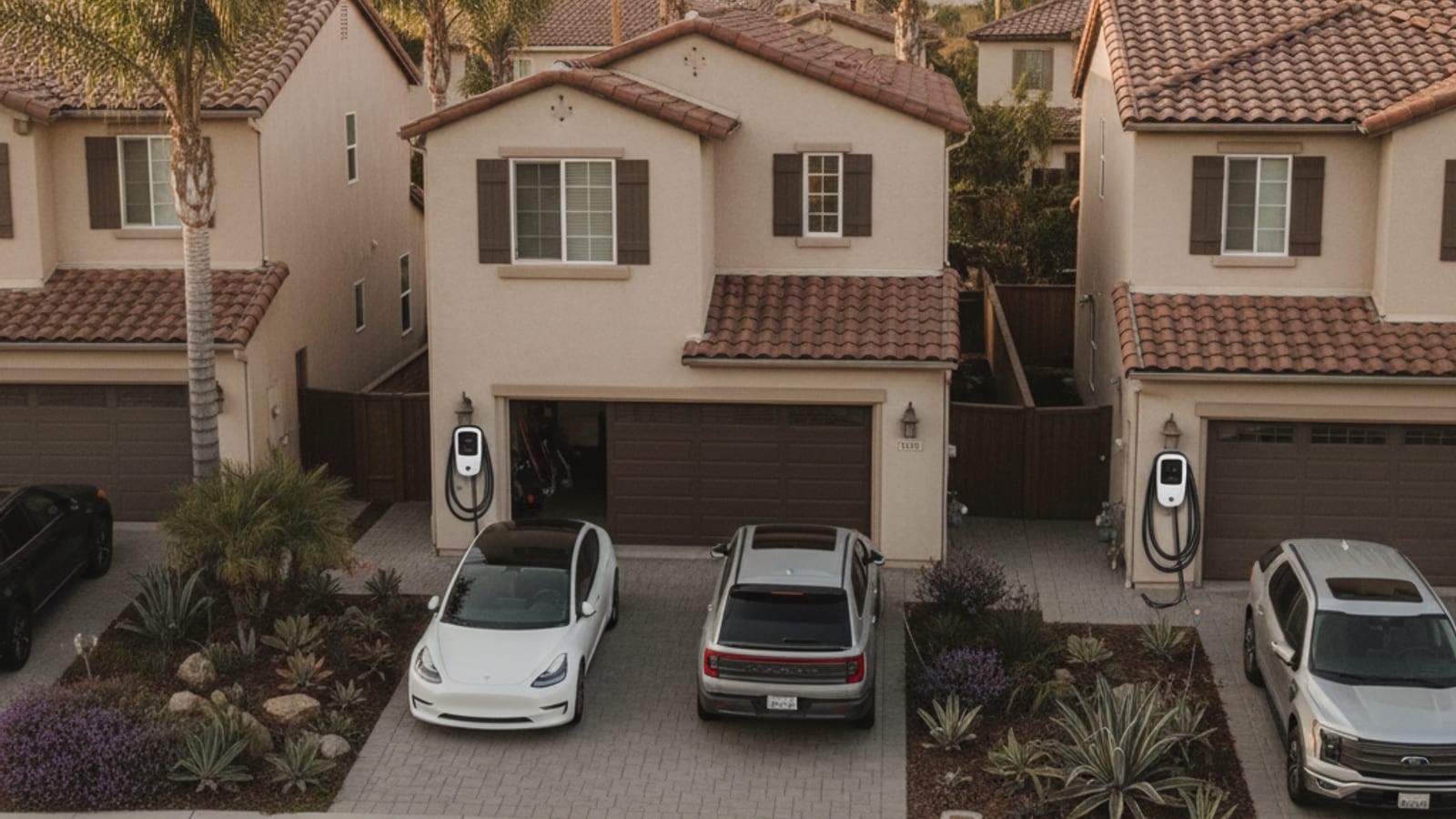
San Diego is one of the most EV-saturated markets in the United States. But there’s a growing gap between how many EVs are on the road here and how many have a proper home charging setup. This post digs into the data: adoption rates, installation costs, permit requirements, and what the numbers reveal about the charger infrastructure lag.
Where to read current EV counts
County registration totals change with each release. This page does not republish an invented 2026 county total or a zip-code density map. Read CARB and the CEC ZEV statistics for the dated tables.
Home-charger share among EV owners is also a survey figure. It is not restated here. What still applies as planning categories: some owners control a garage panel, some need HOA or landlord approval, and some panels cannot take a 40A circuit until a load calculation is done.
What does a Level 2 charger installation actually cost in San Diego?
These are this site’s published ranges, not a Bright Pro job-volume survey.
What does a Level 2 charger installation actually cost in San Diego?
Published industry ranges on this site:
Level 2 charger installation cost table:
| Scenario | Install cost | Notes |
|---|---|---|
| Garage adjacent to panel, simple run | $850–$1,200 | Hardwired 48A, 25-ft conduit max |
| Garage with conduit run 30–60 feet | $1,200–$1,800 | Additional material + labor |
| Outdoor mount, weather-rated, moderate run | $1,500–$2,400 | NEMA 3R enclosure, longer conduit |
| Panel upgrade needed (100A → 200A) | +$2,800–$4,200 | Separate electrical scope |
| Load management device (no panel upgrade) | +$400–$700 | Avoids panel upgrade in some scenarios |
| Full install with panel upgrade | $3,600–$6,000 | Total combined project |
The Level 1 vs. Level 2 vs. DCFC cost comparison:
| Charger type | Install cost | Charging rate | Cost per added mile |
|---|---|---|---|
| Level 1 (120V, 12A) | $0 (uses existing outlet) | ~4 miles/hour | ~$0.04–$0.06 |
| Level 2 (240V, 40–48A) | $850–$1,800 | ~25–35 miles/hour | ~$0.03–$0.05 |
| DCFC (commercial, 50–350 kW) | $25,000–$150,000+ (commercial install) | 150–350+ miles/hour | ~$0.25–$0.50 (per-use pricing) |
For a homeowner, Level 2 is the clear target. Level 1 charging is impractical for a daily driver with a long commute. Adding 40 miles of range takes 10 hours. DCFC is for en-route charging, not daily home use. Level 2 fills a 250-mile battery overnight.
What does San Diego DSD charge for EV charger permits?
The City of San Diego publishes EV charging-system rules in Information Bulletin 187. Fees are in Information Bulletin 103. Do not treat a $250–$450 blended figure as the city’s current line item. Unincorporated parcels use County PDS. Other cities use their own departments.
Unpermitted work can complicate a sale. Insurance outcomes are a policy question. See EV charger permits.
What utility incentives are available?
Confirm current SDG&E EV charger incentives on sdge.com. Do not treat a $200 / $1,000 pair as still open without that check.
Federal 30C: personal-use property generally 30% up to $1,000 per item, eligible census tract, placed in service on or before June 30, 2026. Most of San Diego County is urban. Tract eligibility is not “most of the county qualifies.” Use the IRS/DOE locator. 30C page.
Illustrative stack using this site’s parked $1,400 install figure (not a tax return):
| Cost/incentive | Amount |
|---|---|
| Level 2 install (garage, simple run) | $1,400 |
| SDG&E standard rebate | -$200 |
| Federal 30C credit (30% of $1,400) | -$420 |
| Net out-of-pocket | $780 |
Details on both programs, including how to stack them, are in our EV charger rebates guide for San Diego.
Stacked example, income-qualifying household:
| Cost/incentive | Amount |
|---|---|
| Level 2 install (garage, simple run) | $1,400 |
| SDG&E income-qualifying rebate | -$1,000 |
| Federal 30C credit | -$420 |
| Net out-of-pocket | -$20 (net-positive) |
What does NEM tariff interaction look like?
If you have solar and a Level 2 charger on SDG&E’s NEM tariff, there’s an additional layer worth understanding.
Under NEM 3.0 (effective for new solar interconnections since April 2023), exported solar energy earns significantly lower credits than NEM 2.0, incentivizing EV owners to self-consume solar production during peak hours rather than export it. A Level 2 charger configured to charge during mid-day hours (when solar production peaks) captures solar energy at full value rather than exporting it at NEM 3.0’s reduced credit rate.
This is a meaningful financial variable for homeowners with existing solar or planning combined solar + EV charger installations. A smart charger (ChargePoint Home Flex, Tesla Wall Connector) with scheduling capability and solar integration can be configured to prioritize solar self-consumption automatically.
What does the data reveal about San Diego’s charger gap?
The numbers point to a specific infrastructure bottleneck: San Diego has strong EV adoption in newer suburban communities with modern panels and garages, and a growing installation deficit in older urban neighborhoods and multi-unit housing.
The Chula Vista / Eastlake / Otay Ranch corridor is one example of rapidly growing demand. This area has seen significant EV adoption among newer homeowners but also has a meaningful percentage of homes approaching the panel capacity threshold for charger installations without load management.
East County (El Cajon, Santee) has older housing stock with a higher percentage of 100-amp panels that may need upgrades before a Level 2 charger can be installed.
Urban neighborhoods (North Park, Normal Heights, City Heights) have the highest renter percentage and therefore the most friction: residents who want home charging but don’t control their electrical infrastructure.
Frequently asked questions
How much does a Level 2 EV charger installation cost in San Diego?
Most Level 2 installs in San Diego run $850–$1,800, depending on conduit run length, charger type, and whether any panel work is needed. If the home’s electrical panel needs an upgrade from 100A to 200A service, add $2,800–$4,200 to the project. The $780 net figure earlier on this page is an illustration using a $1,400 install plus a $200 SDG&E line and 30C. It is not a typical net cost, and it only applies if those programs still cover that address. Confirm sdge.com and the IRS/DOE 30C locator.
Does San Diego require a permit to install a Level 2 EV charger?
Yes. City of San Diego Development Services and County PDS (unincorporated) both require electrical permits for typical Level 2 installs. Other cities use their own departments. Fees are on the current bulletin for that office, not a countywide $250–$450 rule. Unpermitted work can complicate a sale. Insurance outcomes are a policy question, not an automatic void.
Can I install an EV charger with a 100-amp panel?
Sometimes. A load calculation is required to determine whether the existing panel has capacity for a dedicated 40–48A charger circuit alongside existing loads. Homes with electric stoves, dryers, water heaters, and HVAC can run out of capacity on a 100A panel. Load management devices can reduce the charger’s draw dynamically when other large loads are running, in some cases eliminating the need for a panel upgrade. A licensed electrician typically runs a load calculation before quoting a charger install. Bright Pro does not.
Bright Pro Electric matches homeowners with independent licensed electricians. Those electricians handle load calc, permit, and install. Bright Pro does not. There is no Bright Pro install-volume ranking by neighborhood. Use contact. Bright Pro does not quote the install.
See the EV charger installation service page, the installation guide, or the rebate and tax credit breakdown. Use contact. Bright Pro does not quote the install.