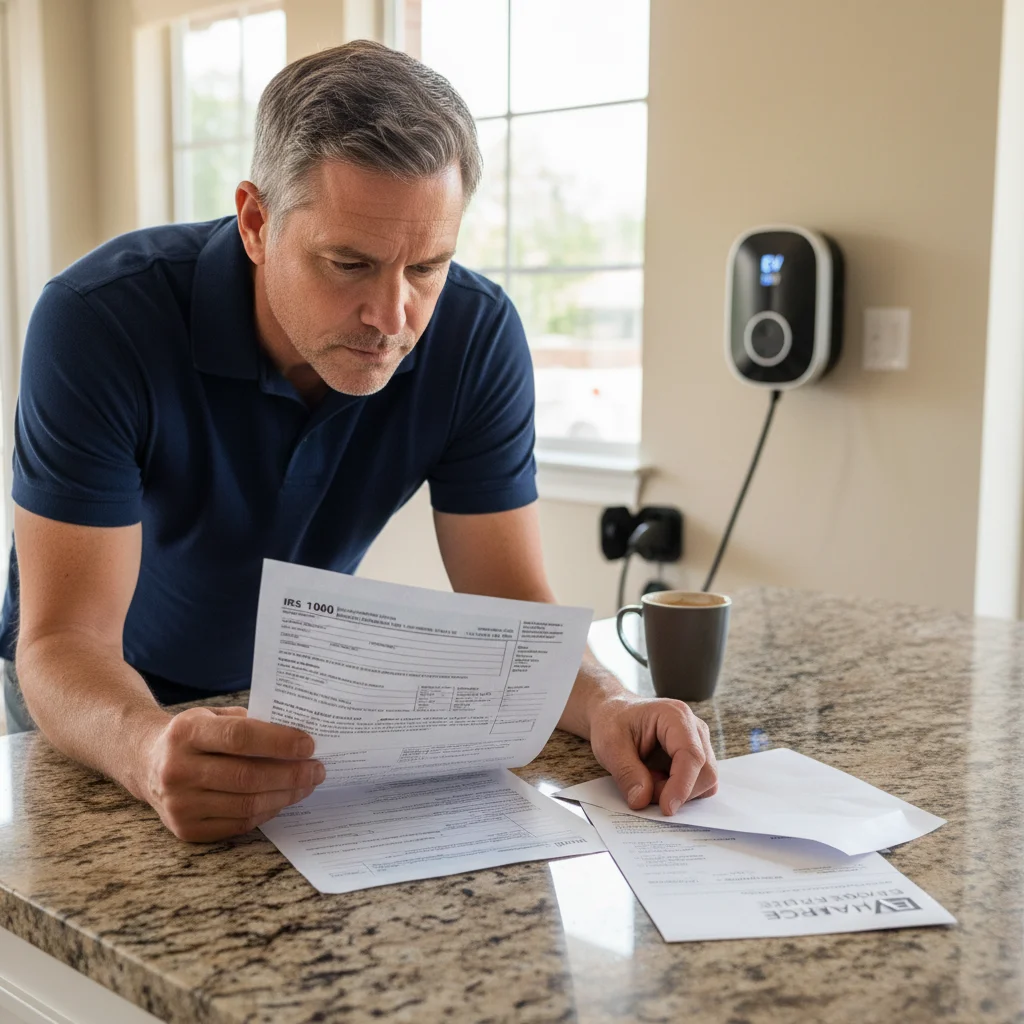
You’ve decided to get an EV, and now you’re planning for the home charger. You’ve probably heard about a federal tax credit that can help offset the cost, but the rules have changed, and they’re more complicated than they used to be. For San Diego homeowners, qualifying for the federal 30C tax credit now depends entirely on your street address.
TL;DR
- IRS §30C is the Alternative Fuel Vehicle Refueling Property Credit. For property placed in service after December 31, 2022, and on or before June 30, 2026, personal-use property at a main home is generally 30% of eligible cost, up to $1,000 per item. See IRS 30C.
- P.L. 119-21 moved the end date to June 30, 2026. Property placed in service after that date does not qualify. Placed in service means ready and available for use, not merely ordered.
- Location must be an eligible census tract. Confirm with the DOE/Argonne locator and IRS Appendix B. Bright Pro does not determine eligibility.
- Do not use the arithmetic on this page as a tax return. A tax professional applies Form 8911 and your own invoices.
- Utility rebates, if any, can change the cost basis. Confirm current SDG&E terms on sdge.com. Do not stack numbers from this page onto a return.
What the 30C alternative fuel refueling property credit covers
The federal government offers a tax credit to encourage homeowners to install alternative fuel equipment, including electric vehicle chargers. This incentive is officially known as the Alternative Fuel Vehicle Refueling Property Credit, or IRS Form 8911. Most people just call it the 30C tax credit.
For personal-use property at a main home, IRS materials current as of the Form 8911 December 2025 instructions describe a 30% credit, capped at $1,000 per item, for qualifying property placed in service from January 1, 2023 through June 30, 2026. Business/investment property uses different percentages and a $100,000 cap. Eligible costs are those the IRS treats as qualified alternative fuel vehicle refueling property. Do not treat panel upgrades as automatically included. Ask a tax professional which invoice lines count.
This page does not compute a sample credit. If a project costs $3,000, 30% of that figure is $900 only if every dollar is eligible cost and the tract qualifies. That is not a filing instruction.
Census-tract eligibility: who qualifies in San Diego County
Here’s the most important change to the ev charger installation tax credit. Prior to 2023, any homeowner could claim this credit regardless of where they lived. The Inflation Reduction Act of 2022 revised the rules. Now, to qualify for the 30C tax credit, your home must be located in an “eligible census tract.”
This new geographic restriction is designed to direct the incentive toward specific communities. For your San Diego home to be eligible, it must be in a census tract that is either:
- Not an urban area.
- A low-income community.
For a highly developed region like San Diego County, the “not an urban area” rule rarely applies. Most of our communities, from Chula Vista to Oceanside, are considered urban. Therefore, for nearly all San Diego residents, eligibility hinges on whether your home is in a federally designated low-income community census tract.
This means your neighbor across the street could qualify while you don’t, simply because of a line on a census map. It has nothing to do with your personal income, only the location of your property. This makes it critical for every San Diego homeowner considering an EV charger to verify their specific address before assuming they can claim the credit. It’s a frustrating but essential step in planning your budget.
How to check if your address is in a qualifying tract
You can’t guess your eligibility based on your neighborhood or zip code. The census tract boundaries are very specific and often don’t align with traditional neighborhood lines. Thankfully, the federal government has created an easy-to-use online tool to give you a clear yes-or-no answer.
The Department of Energy and Argonne National Laboratory host a mapping tool specifically for the 30C credit. Here’s exactly how to use it:
- Go to the mapping website. You can find the “30C Tax Credit Eligibility Locator” on the anl.gov website. It’s the official source.
- Enter your address. Type your full home address into the search bar, including your street, city (e.g., San Diego), state (CA), and zip code.
- Check eligibility. The map will pinpoint your location. A box will appear with a definitive answer: “This location is in an eligible census tract” or “This location is not in an eligible census tract.”
That’s it. This tool provides the official determination you need. We strongly recommend every homeowner perform this check before banking on the tax credit. It only takes a minute and provides the certainty you need to properly budget for your installation.

Documentation your electrician needs to provide
If your address is eligible, the next step is ensuring you have the correct paperwork to file with your tax return. The IRS requires clear proof of your expenses. When you hire an independent licensed electrician, ask for an itemized invoice. Bright Pro Electric does not install chargers or prepare tax documents.
You will need a detailed, itemized invoice from your installer. This document is your primary record for the IRS. It should clearly show:
- Your name and the full installation address. This must match the eligible property.
- The date the installation was completed. The credit is claimed for the tax year the charger was “placed in service.”
- A breakdown of costs. The invoice should separate the cost of the EV charger (the hardware), all materials (wire, conduit, breakers), and the labor for installation.
- The total cost of the project. This is the number you’ll use to calculate your 30% credit.
Having a complete invoice is the homeowner’s record. Bright Pro does not provide tax documentation. See EV charger installation cost and EV charger permits.
Stacking with SDG&E rebates
One of the best financial strategies for San Diego homeowners is to “stack” incentives. This means combining the federal 30C tax credit with local rebates, like those offered by San Diego Gas & Electric (SDG&E). Doing this can dramatically lower your out-of-pocket cost.
Utility rebates, if still open, can change the amount you treat as cost. Confirm the current SDG&E program on sdge.com. Do not subtract a sample $600 on this page and file it. See EV charger rebates 2026.
Filing the credit on your 2026 return
Once the installation is complete and you have your invoice, the final step is claiming the credit when you file your taxes. You’ll be doing this for the tax year in which the charger was installed and put into service.
To claim the ev charger tax credit 2026, you or your tax preparer will need to complete and file IRS Form 8911, the “Alternative Fuel Vehicle Refueling Property Credit.” This one-page form is relatively straightforward. You’ll need to provide information about the property, including its address, and report the total qualifying costs from your electrician’s invoice.
The form will then guide you through calculating the 30% credit and applying the $1,000 cap. The final credit amount will transfer to your Form 1040, reducing your overall tax liability.
Bright Pro matches homeowners with licensed electricians. Bright Pro is not a tax preparer and is not the installing contractor. Take the electrician’s invoice and the closed permit to a tax professional. Bright Pro does not supply that packet.
Frequently asked questions
Who qualifies for the 30C EV charger tax credit in San Diego?
Eligibility is based on property location, not income. Your home must be in a census tract that is either non-urban or a federally designated low-income community. Most of San Diego County is considered urban, so eligibility is limited to specific areas. Check your address at the DOE’s 30C Tax Credit Eligibility Locator before counting on this credit when budgeting.
What costs does the 30C credit cover for an EV charger installation?
Eligible cost is whatever Form 8911 treats as qualified alternative fuel vehicle refueling property. That can include charger hardware, labor, wiring, conduit, and a new breaker when those lines qualify. Do not treat panel upgrades as automatically included. This page does not compute a sample credit. Keep the electrician’s invoices for your tax preparer.
Is the 30C credit refundable?
IRS materials describe 30C as nonrefundable: it can reduce federal tax liability, it does not write a refund check. Carryforward rules belong on the current Form 8911 instructions, not on this page. Ask a tax professional before you budget unused credit.
How do I stack the SDG&E rebate with the 30C tax credit?
When a utility rebate still applies, it usually comes off the cost basis before 30C. Do not file a $3,000 / $500 / $750 sample from this page. Confirm sdge.com and Form 8911.
Next step
A licensed electrician does the install and provides documentation for rebates and tax credits. Bright Pro does not. Use contact.