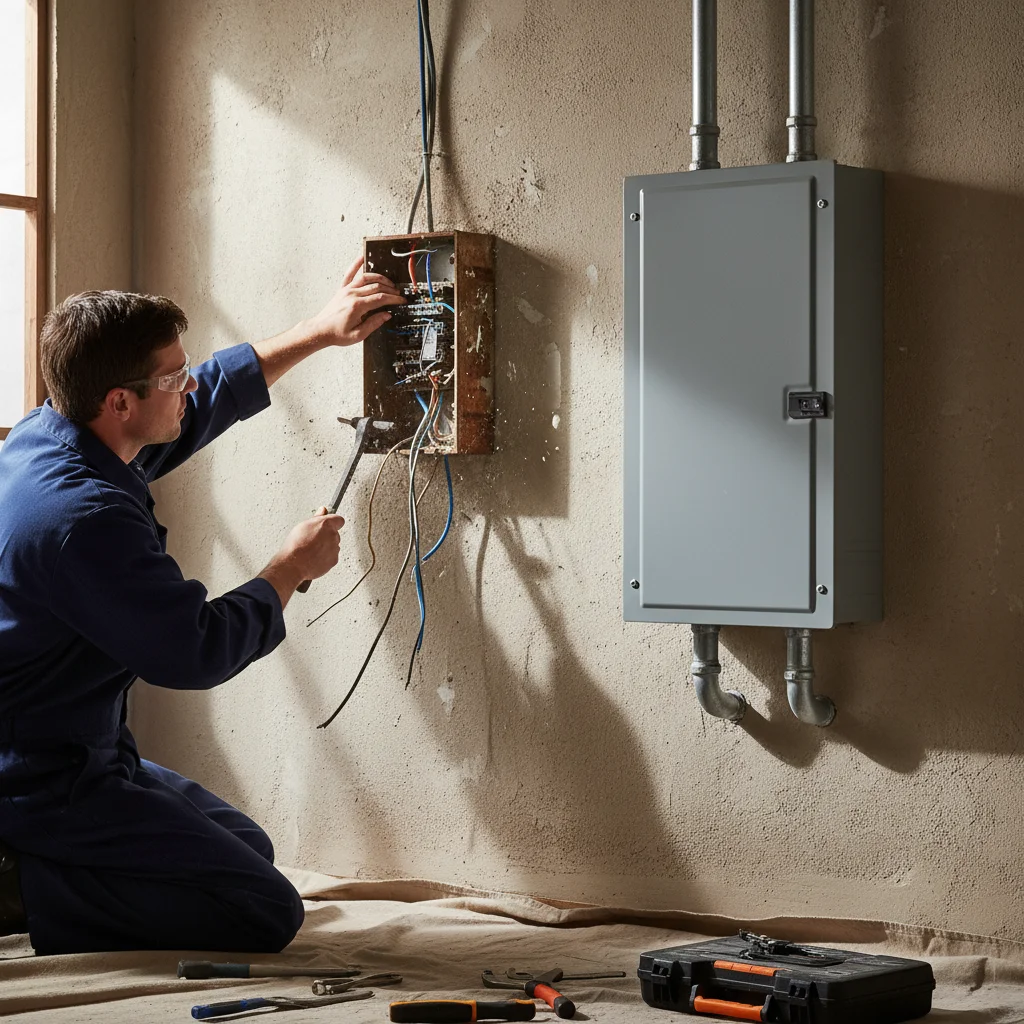
You’ve been told your electrical panel needs to be replaced, not just upgraded. This often happens because of age, damage, or the discovery of a dangerous, obsolete brand. Now you’re facing an unexpected project and trying to figure out what the final bill will actually look like here in San Diego.
TL;DR
- Panel replacement in San Diego typically costs $3,000–$8,000, with complex projects or high-amperage services reaching $12,000 or more.
- A 200-amp replacement, the most common project, generally runs $4,500–$7,500 including labor, permits, and SDG&E coordination.
- Finding an FPE or Zinsco panel is a reason to inspect. Replacement after that inspection can cost more because old breakers are not reusable in a modern panel and code corrections become mandatory.
- Your home will be without power for roughly 4–8 hours on installation day while the panel is swapped and SDG&E reconnects service.
- A sub-panel ($1,200–$2,500) can solve the problem of running out of breaker slots without a full main panel replacement, but only if the main panel itself is in good condition.
The distinction between a forced replacement and a voluntary upgrade is the most important thing to establish first. Understanding which situation you’re in changes how you budget, how quickly you need to act, and what your options are. If you’re in the voluntary upgrade camp and just want cost ranges by amperage, our panel upgrade cost guide for San Diego has all the numbers. This post focuses on forced replacements: what triggers them, what they cost, and how they differ from a routine upgrade.
What ‘replacement’ actually means vs. an upgrade
In the electrical world, words matter. While “replacement” and “upgrade” are often used interchangeably, they describe two different scenarios with distinct cost drivers. Knowing which one you need helps set realistic budget expectations.
A panel replacement is typically a like-for-like swap driven by necessity. The primary goal is to remove a failing, damaged, or unsafe panel and install a new, modern equivalent of the same amperage. Common triggers for a forced replacement include:
- Fire or water damage: A panel compromised by heat or moisture is a serious hazard and must be replaced immediately.
- Physical damage: Corrosion, rust, or impact damage can make a panel unsafe.
- Obsolete technology: Old fuse boxes, and some Federal Pacific or Zinsco installs after inspection, may not meet modern safety standards. Brand name alone is not the replacement verdict.
- Internal failure: A burnt-out main breaker or damaged bus bars can necessitate a full replacement.
An electrical panel upgrade, on the other hand, is usually a voluntary project to increase your home’s electrical capacity. You’re not just replacing the box; you’re increasing the total amount of power available. You might pursue an upgrade if you’re:
- Installing an EV charger
- Adding central air conditioning
- Remodeling your kitchen with new, powerful appliances
- Building an addition or an ADU
- Switching from gas to electric appliances
Of course, the two often overlap. If you’re forced to replace a 100-amp panel that’s failing, it almost always makes sense to upgrade to 200 amps at the same time. The incremental cost is much lower than doing two separate projects. The key difference is the starting point: a replacement is about fixing a problem, while an upgrade is about adding capacity. Both are core electrical panel services that require a licensed professional.
Cost ranges by amperage and panel brand
The cost to replace an electrical panel in San Diego County typically ranges from $3,000 to $8,000, but can exceed $12,000 for complex projects or high-amperage services. This price includes labor, materials, permits, and coordination with SDG&E. The two biggest factors influencing this range are the amperage of the service and the condition of your existing system.
100-amp panel replacement
A 100-amp panel is the minimum size allowed for most new homes but is common in older, smaller houses in neighborhoods like North Park or La Mesa. If your 100-amp panel has failed but your power needs haven’t grown, a direct replacement might cost $3,000 to $5,000. However, licensed electricians often recommend upgrading to 200 amps if you need a replacement, because the extra capacity is usually worth the marginal extra cost. Bright Pro does not.
200-amp panel replacement
This is the modern standard for the vast majority of San Diego homes. A 200-amp service can comfortably handle an EV charger, air conditioning, and a full suite of electric appliances. Replacing an existing 200-amp panel, or upgrading from 100 amps to 200 amps, generally falls in the $4,500 to $7,500 range. Among licensed electricians in this market, that 100-to-200-amp job is a common panel project. Bright Pro does not perform it.
400-amp+ panel replacement
For very large homes (over 3,500 sq. ft.) in areas like Rancho Santa Fe or those with extensive electrical demands like on-demand water heaters, multiple EV chargers, or large workshops, a 400-amp service may be necessary. These are more complex installations involving larger service conduits and equipment, with costs often starting at $9,000 and going up significantly based on site conditions.
The brand of the panel itself (like Square D, Siemens, or Eaton) has a smaller impact on the total cost than labor and permits. Electricians in our network use these top-tier brands because their reliability is worth the small premium over builder-grade equipment. The cost difference between them is usually only a couple of hundred dollars on a multi-thousand-dollar project.
Why FPE and Zinsco replacements cost more
If a licensed electrician finds a Federal Pacific Electric (FPE) or Zinsco panel, that is a reason to inspect the installed equipment. It is not a replacement verdict from the brand name alone. Those brands have a documented history of breaker problems in some installs. The electrician tests whether breakers trip as required and whether the panel is damaged, overheated, or otherwise unsafe. Replacement is a licensed call after that inspection.
Because of the extreme risk, a Federal Pacific and Zinsco panel replacement is often more involved and costly than a standard swap-out. Here’s why:
- Full Breaker Replacement: The breakers from FPE and Zinsco panels are not compatible with any modern panel. This means every single circuit breaker must be replaced with a new, high-quality arc-fault (AFCI) or ground-fault (GFCI) breaker, as required by today’s electrical code. This adds several hundred dollars to the material cost.
- Code Corrections are Mandatory: Installations from the FPE/Zinsco era (roughly 1950-1980) often have other systemic issues. When the electrician replaces the panel, the entire service must be brought up to current code. This frequently involves upgrading the home’s grounding and bonding system, installing new ground rods and bonding water and gas pipes, which adds labor and material.
- Potential Service Wire Issues: The main service entrance conductors that feed the panel may be undersized for a modern load or have deteriorating insulation. If these need to be replaced, it can add significant cost, especially if they run through a long or inaccessible conduit.
Replacing one of these panels isn’t just an upgrade; it’s a critical safety correction. The higher cost reflects the additional labor and materials required to undo decades of outdated electrical practices and make your home safe according to modern standards defined by the National Electrical Code (NEC).
SDG&E coordination, meter pulls, and downtime
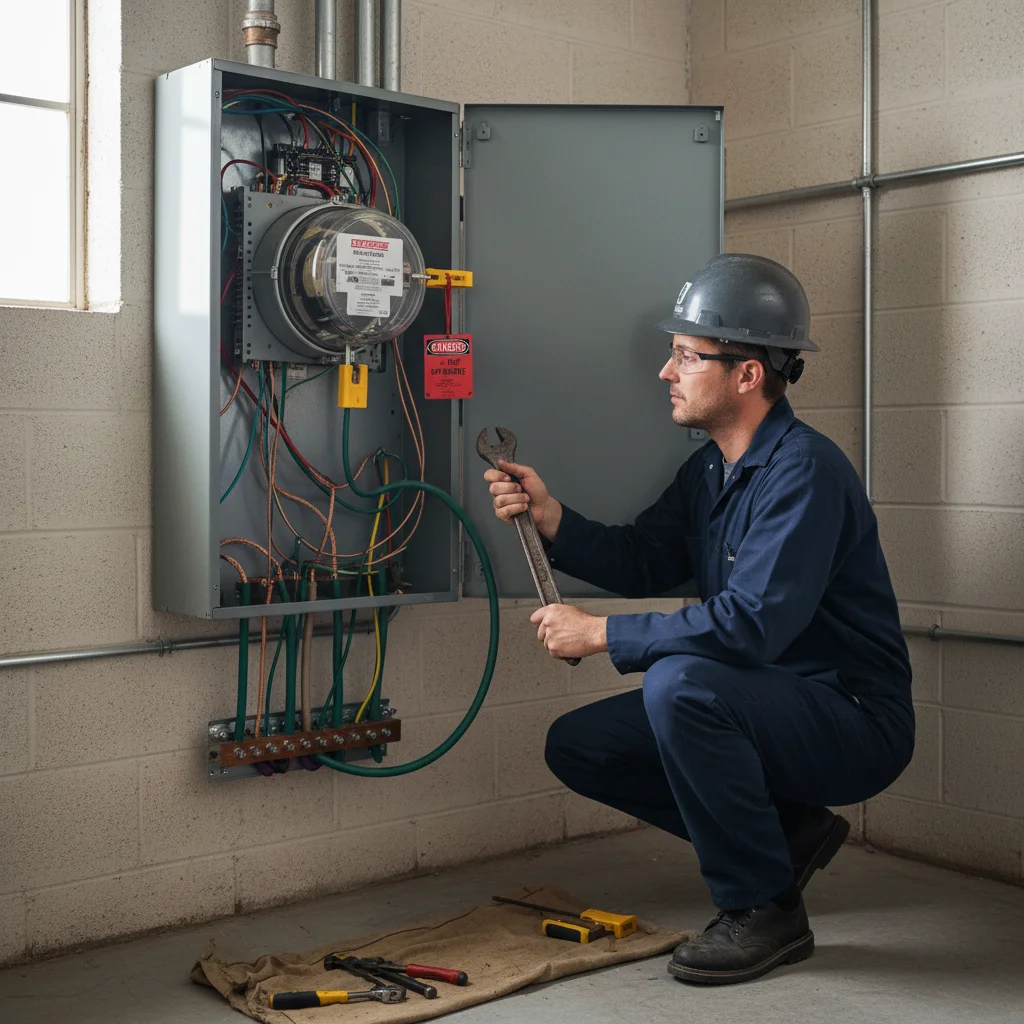
Replacing your main electrical panel isn’t like changing a light fixture. It involves disconnecting your entire home from the power grid, a process that requires direct coordination with San Diego Gas & Electric (SDG&E). That coordination is part of the licensed electrician’s job and a factor in the project’s timeline and cost.
The critical step is the meter pull. SDG&E de-energizes the service by pulling the meter on a scheduled visit. A licensed electrician does not cut the utility tag or pull the meter as a standalone authorization. Once the new panel is installed, that electrician coordinates with SDG&E and the city inspector for a reconnect.
This process means your home will be without power for a significant period, typically 4 to 8 hours on the day of the replacement. The licensed electrician on site works to keep that window as short as the job allows, but it’s an unavoidable part of the process. You’ll need to plan for this outage, especially if you work from home or have sensitive electronics or medical equipment.
Sometimes, the project involves more than just the panel. SDG&E has specific rules about the location, height, and clearance around their meters and service equipment. If your old panel is in a location that’s no longer code-compliant (like a closet or bathroom), that electrician may need to relocate the entire service to an exterior wall. This can add to the cost, as it requires new conduit, wiring, and stucco or siding repair. You can find more information about utility service requirements on the SDG&E website.
Permits and inspection fees in San Diego County
Anytime you replace a main electrical service panel in San Diego County, an electrical permit is required by law. This is not optional paperwork; it’s a fundamental consumer protection that ensures the work is performed safely and to the current standards of the National Electrical Code (NFPA 70).
A licensed electrician on the job handles permits. Bright Pro does not pull permits or issue quotes. Permit work typically includes:
- Submitting Plans: That electrician prepares and submits the necessary load calculations and plans to your local jurisdiction, whether it’s the City of San Diego, Chula Vista, Oceanside, or the County for unincorporated areas.
- Paying Fees: The permit fees themselves vary by municipality but generally cost a few hundred dollars. This fee goes to the city or county building department to cover the cost of the inspection.
- Scheduling the Inspection: After the new panel is installed and before SDG&E permanently reconnects power, a city or county inspector must visit the site. They visually inspect the installation, checking everything from wire gauges and breaker types to proper grounding and labeling.
- Final Approval: Once the inspector “signs off” on the permit, the job is officially complete and code-compliant.
Attempting to do this work without a permit is a bad idea. It can create major problems when you try to sell your home, can void your homeowner’s insurance policy in the event of a fire, and is simply unsafe. The inspection process provides a crucial third-party verification that this critical component of your home’s electrical system was installed correctly.
When a sub-panel is the cheaper answer
Sometimes, a full main panel replacement isn’t necessary. If your core problem is simply that you’ve run out of physical breaker spaces for new circuits, but your main panel is modern, in good condition, and has sufficient amperage, a sub-panel can be a more cost-effective solution.
A sub-panel is essentially a smaller, secondary breaker box that is fed from a large, two-pole breaker in your main panel. It acts as a distribution point for a specific area or a group of new circuits. It’s an excellent option for:
- A new workshop or garage that needs multiple outlets and lighting circuits.
- A major kitchen remodel with several new dedicated appliance circuits.
- An ADU (Accessory Dwelling Unit) that requires its own set of circuits.
- Finishing a basement or adding a room.
Installing a sub-panel is significantly less expensive than a main panel replacement, often costing between $1,200 and $2,500. The reason for the savings is that it doesn’t typically require a full service shutdown, coordination with SDG&E, or replacing the main service entrance conductors. It’s a self-contained project within your home’s existing electrical system.
However, a sub-panel is not a solution for an undersized or failing main panel. If your 100-amp panel is already struggling with daily loads, adding a sub-panel won’t fix the core problem. You still only have 100 amps of total capacity. It only solves the issue of running out of physical slots.
Frequently asked questions
How much does it cost to replace an electrical panel in San Diego?
Most San Diego homeowners pay $3,000–$8,000 for a panel replacement, with the most common project (100-amp to 200-amp) landing at $4,500–$7,500. That range includes the new panel, labor, permit fees, and SDG&E coordination. Very large homes or projects involving a 400-amp service, panel relocation, or extensive service entrance work can exceed $12,000.
Do I need SDG&E involved to replace my panel?
Yes. A licensed electrician must coordinate with SDG&E to de-energize the main service wires that feed your panel. This is done through a scheduled “meter pull.” Your electrician requests the cutoff, SDG&E pulls the meter, the panel is replaced, and then SDG&E returns for the reconnect. This process is why panel replacements typically take 4–8 hours and require you to be without power for that period.
What’s the difference between replacing and upgrading an electrical panel?
A replacement is typically a forced swap driven by a failing, damaged, or dangerous panel. The goal is to remove the bad panel and install a functional one of the same or similar amperage. An upgrade is a voluntary project to increase your home’s electrical capacity, usually moving from 100 amps to 200 amps to support EV chargers, HVAC, or added appliances. These often overlap: when you’re forced to replace a 100-amp panel, it almost always makes sense to upgrade to 200 amps at the same time since the incremental cost is small.
Why does replacing a Federal Pacific or Zinsco panel cost more?
Some FPE and Zinsco installs have a history of breaker problems, including failure to trip on overload. That is a reason to inspect, not a replacement verdict from the name. If a licensed electrician recommends replacement after inspection, the old breakers are not reusable in a modern panel. New AFCI or GFCI breakers compatible with the new panel replace them. Code corrections also become mandatory at the time of replacement, including grounding and bonding updates that might have been grandfathered on the old installation. That additional material and labor is what pushes the cost higher.
Related guides
For voluntary upgrades where you’re choosing to add capacity rather than fix a failed panel, see our complete panel upgrade cost guide for San Diego, which covers pricing across all amperage levels. For the most common scenario specifically, the 100-amp-to-200-amp voluntary upgrade, our 200-amp panel upgrade cost breakdown has the full line-item detail of what’s in a legitimate San Diego quote. If you’re specifically looking at FPE or Zinsco panels, the Federal Pacific and Zinsco replacement guide goes deeper on the failure modes and insurance implications.
When to call us
Replacing an electrical panel is a complex job that directly involves your home’s main power supply and coordination with the utility and city inspectors. This is not a DIY project. For your safety and to ensure your home is compliant with all local codes, this work must be performed by a licensed and insured electrician.
If you have an FPE or Zinsco panel, frequent breaker trips, flickering lights, or rust or corrosion on the panel, hire a licensed electrician to inspect it. The 7-signs guide to when to upgrade your panel walks through warning signals. You can verify that electrician’s C-10 on the CSLB website.
Bright Pro Electric matches San Diego County homeowners and property managers with independent licensed electricians. It does not hold a C-10, pull permits, or guarantee dispatch. Hours are Monday through Saturday, 7am to 7pm. After hours, leave a message. Use the contact form.