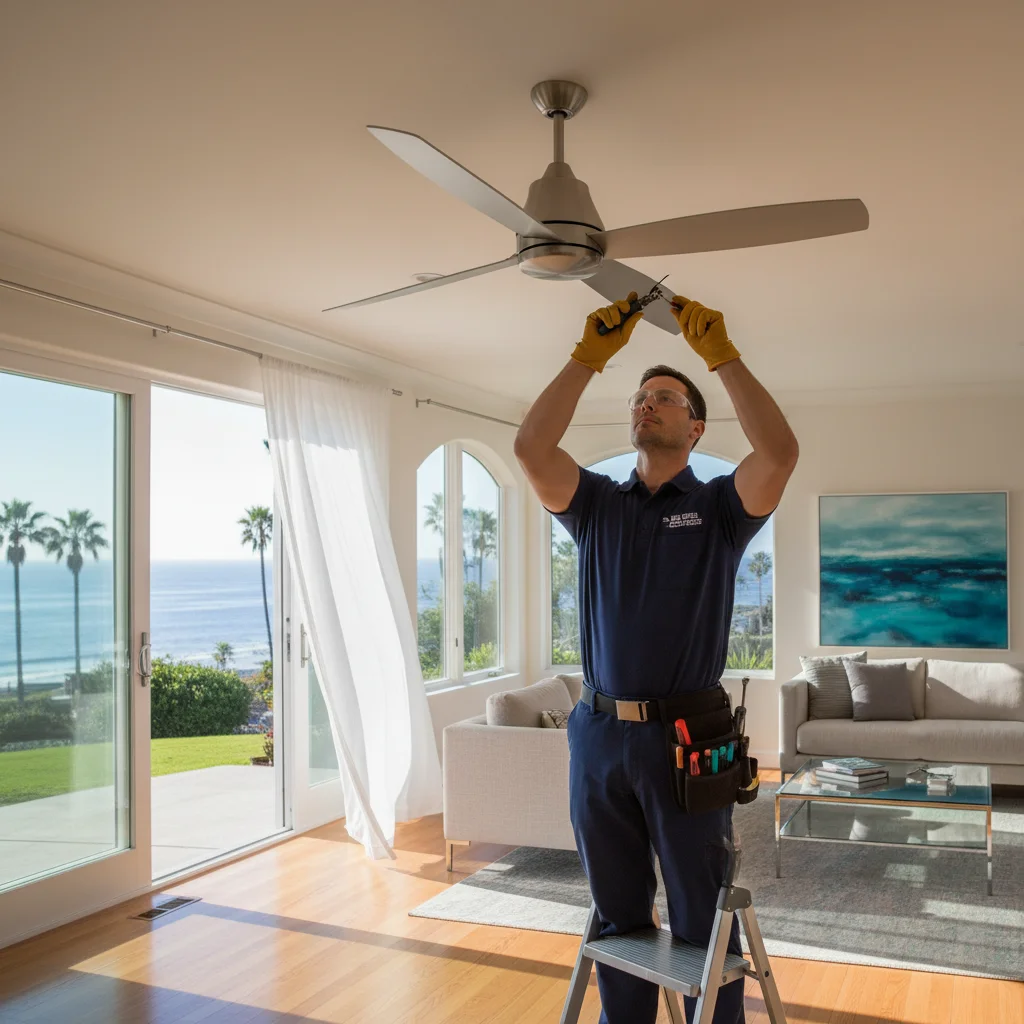
Summer in San Diego doesn’t get the press of a Phoenix August, but when June gloom lifts and inland temps climb into the 90s, your AC works harder than you’d expect. A ceiling fan sounds like the obvious fix, but a lot of homeowners aren’t sure whether fans actually do anything, or whether they’re just moving hot air around.
TL;DR
- Ceiling fans cool people, not rooms. Moving air can make a higher thermostat setting feel similar. Do not treat “4°F” or a percent-per-degree as a bill guarantee.
- Fan motors draw far less than a central compressor. Exact watts are on the fan nameplate. This page does not publish a live SDG&E TOU-DR1 rate.
- Confirm summer vs winter direction with the manufacturer’s control and an airflow test. Blade pitch can reverse the usual clockwise story.
- Match blade span to room size using the manufacturer’s table, not a countywide CFM rule.
- Turn fans off when the room is empty. An empty room does not get cooler.
How ceiling fans cool people, not rooms
This is the most important thing to understand: a ceiling fan does not lower the air temperature in a room. It creates a wind chill effect on your skin. Moving air accelerates sweat evaporation, which makes 78°F feel closer to 72°F.
That distinction matters for how you use fans. If you leave a ceiling fan running in an empty room, you’re burning electricity and getting nothing in return. The fan isn’t making the air cooler. It’s only making people cooler. The rule is simple: fan on when the room is occupied, fan off when you leave.
The comfort effect is real for a person in the air stream. Industry and DOE consumer pages often talk about raising a cooling setpoint a few degrees when fans are on. Treat “about 4°F” as that kind of rule of thumb, not a measurement of your living room. Inland El Cajon or Santee heat is a different load than a coastal breeze in Encinitas. A fan complements AC. It does not replace an undersized system.
One more thing worth knowing: fans work best when there’s already reasonable airflow in the space. San Diego’s coastal neighborhoods, like Ocean Beach, Encinitas, and Carlsbad, often get a natural sea breeze that a ceiling fan can amplify. Inland areas like El Cajon or Santee run hotter and drier, so a fan there complements AC rather than replacing it.
Energy use vs. AC, without fake bill math
Do not copy a TOU-DR1 dollar-per-kWh from this article. SDG&E schedules change. The ledger on this site verifies EV-TOU-5 residential figures against sdge.com, not a generic cooling rate. Read your bill or sdge.com for the plan you are on.
A compressor uses thousands of watts while it runs. A ceiling-fan motor uses tens of watts. That comparison is directionally true. It does not yield an 8-10% savings per degree, a 30-40% runtime cut, or $60-$80 a month. Those percents were unsourced and are removed.
If you raise the cooling setpoint and the house still feels fine with fans on, the compressor may run less. How much less is a function of insulation, setpoints, occupancy, and the HVAC equipment, not a Bright Pro formula.
Direction by season: test airflow first
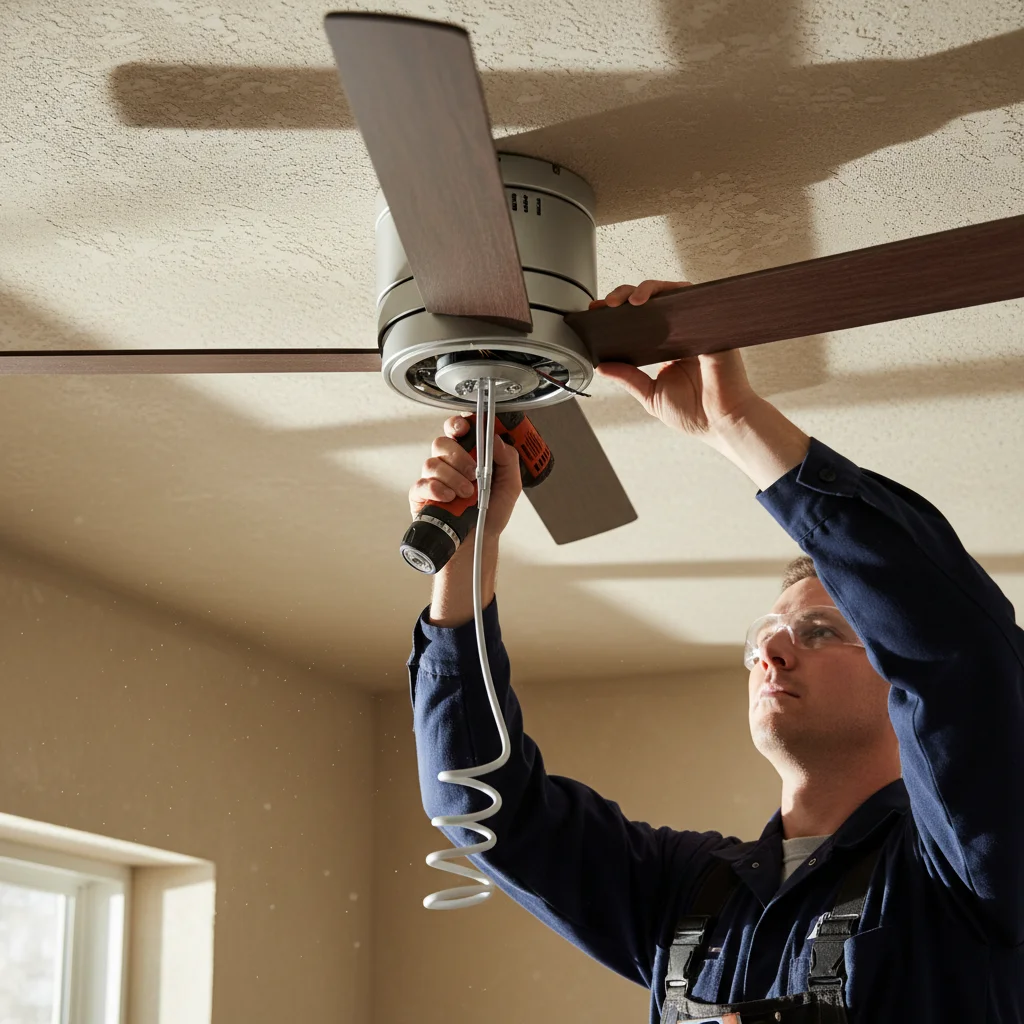
Most manuals describe counter-clockwise (from below) as summer downdraft and clockwise-on-low as winter. Blade pitch can reverse that convention. Use the manufacturer’s reverse control, then stand under the fan: a downward breeze on your skin is cooling mode; little draft with air washing the walls is the other mode. Details: ceiling fan direction.
San Diego winters are mild. High ceilings still stratify heat. This page does not claim you will be in summer mode nine months a year.
DC motors vs. AC motors: what matters in 2026
If you’re buying a new ceiling fan, this is the spec that matters most for long-term energy cost.
AC motors are the traditional type. They’re reliable, less expensive upfront, and draw 60–80 watts at high speed. They have fewer speed settings (usually 3) and generate more heat during operation.
DC motors are now the standard choice in mid-range and higher-end fans. This page lists them at 5–30 watts at high speed, against 60–80 watts for AC motors. Compare nameplates; do not treat those bands as a single percent cut. DC fans typically run quieter and offer 6 speeds instead of 3. They also start and stop more smoothly, which matters when you’re using a remote or smart home integration.
The ENERGY STAR certification program sets minimum efficiency thresholds for ceiling fans. An ENERGY STAR-certified fan with a DC motor will move more air per watt than an uncertified AC-motor fan at a similar price point. For a fan that runs 8–12 hours a day during San Diego summers, the efficiency gap adds up over three to five years.
Smart DC fans, the ones that integrate with Google Home, Apple HomeKit, or Amazon Alexa, add another layer of savings. You can set schedules so fans automatically turn off when you leave a room, eliminating the wasted runtime that kills the economics for a lot of households.
Sizing and CFM by room
CFM stands for cubic feet per minute. It’s how much air a fan moves. Bigger rooms need higher CFM. Matching fan size to room size is how you get actual comfort, not just noise.
Here’s a practical guide:
Blade span to room size
- Up to 75 sq ft (small bedroom, home office): 29–36 inch fan, 1,000–2,000 CFM
- 76–144 sq ft (standard bedroom, dining room): 42–48 inch fan, 2,000–3,500 CFM
- 145–225 sq ft (primary bedroom, open kitchen): 52–56 inch fan, 3,500–5,000 CFM
- 225+ sq ft (great room, open floor plan): 60–72 inch fan, or multiple fans, 5,000+ CFM
For rooms with ceilings above 9 feet, you’ll need a downrod to lower the fan to the 7–9 foot sweet spot for air movement. Flush-mount (hugger) fans work in rooms with 8-foot ceilings but lose some efficiency because the blade clearance is tighter.
San Diego homes built in the 1960s–1980s often have 8-foot ceilings throughout. Homes in newer developments in Chula Vista or Escondido tend toward 9–10 foot ceilings, which calls for a downrod extension.
If you’re adding a fan to a room that doesn’t have an existing ceiling box rated for fan support, that’s an electrical rough-in job, not something to skip. A standard light fixture box isn’t rated for the lateral stress a spinning fan puts on it. Our ceiling fan installation guide for San Diego homes covers what that rough-in work involves and what to expect from the process.
When to add a fan vs. upgrade your AC
Ceiling fans make the most sense when your AC system is already doing its job and you want to lower runtime costs. They’re an excellent investment if:
- Your home has rooms you spend significant time in during summer afternoons
- Your AC is 10 years old or newer and sized correctly for your home
- You’re on a TOU rate plan and want to cut peak-hour consumption
Fans are the wrong solution if:
- Your AC can’t keep the house below 80°F on a hot day even without fans running
- Your home has ductwork issues or an undersized system
- You’re cooling a room with no ceiling box and no convenient circuit nearby
In those cases, the conversation shifts to HVAC service, load calculations, or potentially panel capacity if you’re adding mini-splits. The California Energy Commission publishes guidance on home cooling efficiency that’s worth a read if you’re making a bigger system decision.
Fans complement a working AC system. They don’t rescue a broken one.
Frequently asked questions
Do ceiling fans actually lower the room temperature in San Diego?
No. A ceiling fan doesn’t change the air temperature at all. It creates a wind chill effect by moving air across your skin, which helps sweat evaporate faster. The result is that you feel cooler at the same thermostat setting, typically by about 4 degrees. That’s why the rule is to turn fans off when you leave the room. They’re cooling people, not the air.
How much can I save on my SDG&E bill by running ceiling fans instead of AC?
The savings depend on setpoint, occupancy, and the HVAC system. This page does not publish 8-10% per degree, 30-40% runtime, or $60-$80 monthly. Fans themselves use little energy compared with a compressor. Read your SDG&E plan for the rate that applies.
What size ceiling fan does my San Diego room need?
A standard bedroom (76 to 144 sq ft) needs a 42 to 48 inch fan. A larger primary bedroom or open kitchen (145 to 225 sq ft) needs a 52 to 56 inch fan. Great rooms and open floor plans over 225 sq ft need a 60 to 72 inch fan or multiple smaller fans. Undersizing a fan for the room means it won’t create enough airflow to feel the benefit.
Is an ENERGY STAR ceiling fan worth the extra cost?
Yes, especially for fans running 8 to 12 hours a day in San Diego summers. An ENERGY STAR-certified DC motor fan moves more air per watt than an older AC motor fan. The efficiency gap between an AC motor (60 to 80 watts) and a DC motor (5 to 30 watts) adds up meaningfully over three to five years of daily use during warm months.
When to call us
Ceiling fan installation is licensed work when you need a fan-rated box or new wiring. Bright Pro Electric matches homeowners with independent licensed electricians. It does not install fans. Hours are Monday through Saturday, 7am to 7pm. Use the contact form.