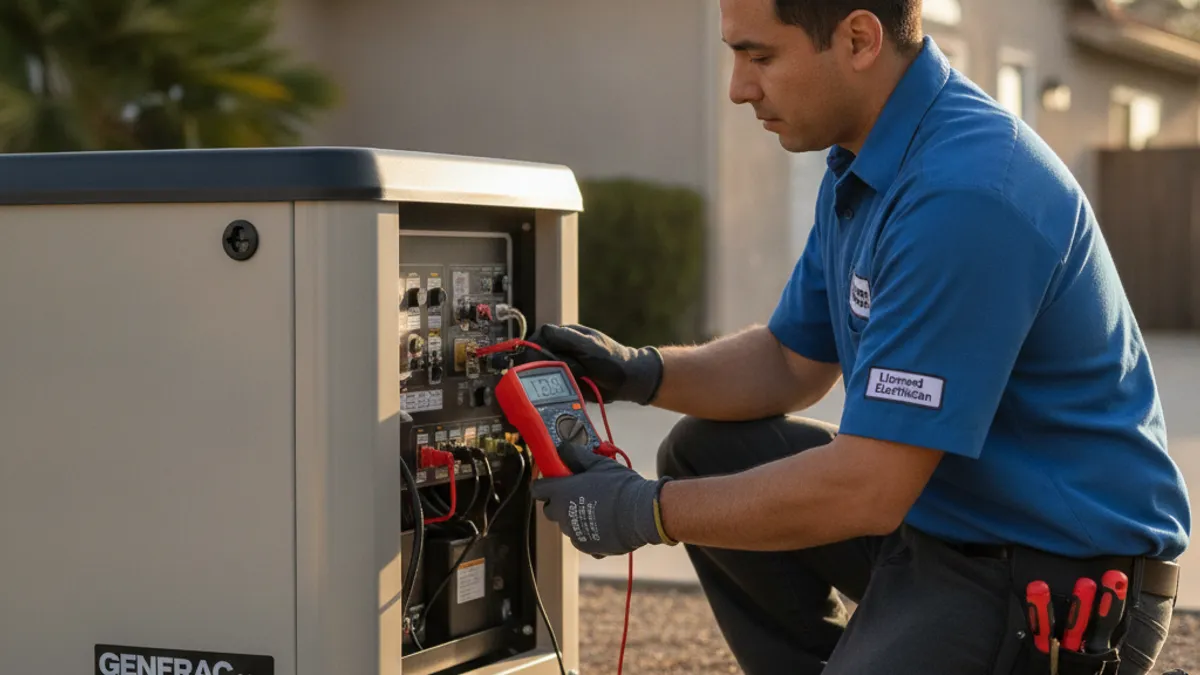
When a home generator won’t start, diagnosis starts with categories: starting battery, fuel and controls, transfer equipment, then engine or controller work. A weak battery is a frequent first check on idle standby units, not a count of San Diego calls. Home generator repair starts with a diagnosis, not a parts swap. A licensed electrician or an authorized dealer, depending on warranty and what failed, tells you whether you are looking at a $250 battery or a control board.
TL;DR
- A dead or weak starting battery is a frequent no-start category; replacement runs roughly $200 to $400 installed. Treat that as a parked example, not a diagnosis.
- Stale fuel, a closed gas valve, a controller left off “AUTO,” and a tripped generator or transfer breaker are the next categories. Some of those you can see without opening an enclosure.
- A diagnostic service call in San Diego typically runs $100 to $200. Bright Pro Electric does not credit that fee. Whether a contractor applies it to later work is only in their written quote.
- Control-board and transfer-switch repairs are the pricier failures, often $400 to $1,500 depending on the part.
- Coastal San Diego salt air can corrode battery terminals and connections faster. Units in La Jolla, Coronado, and Encinitas need that check on the service interval in the manual.
Why won’t my home generator start?
A weak or dead battery is a frequent first check, not the answer most of the time. Standby generators sit idle between outages. When the grid drops, a unit that clicks or does nothing still needs measurement. Manufacturers publish battery care in the owner manual. They do not publish a ranked San Diego failure list. If yours is a Generac, Generac generator repair covers matching controller alarms to that model and routing warranty work through an authorized dealer.
After the battery, the usual categories are fuel and controls. A natural-gas or propane unit needs its supply valve fully open, and a controller has to be set to “AUTO” to start on its own during an outage. If someone left it in “OFF” after the last service, it will not start. A tripped breaker on the generator or transfer equipment can also block startup when the engine is fine.
The most common generator failures, in order
Here is a screening order, not a diagnosis of your unit:
- Starting battery. Weak, discharged, or corroded. A frequent no-start category. Batteries should be tested on the interval in the owner manual. Replacement every two to four years is a parked example.
- Fuel supply. A closed gas valve, low propane tank, or stale gasoline in a portable unit.
- Oil and air filters. A clogged air filter or a protective oil shutdown, when the manual uses those sensors.
- Controller setting. Left on “OFF” or “MANUAL” instead of “AUTO.”
- Transfer switch or generator breaker. A tripped breaker or a failed transfer switch can leave the house dark even when the engine runs.
- Corrosion and rodents. Salt-air corrosion on terminals and chewed wiring on outdoor pads.
- Control board. Dealer or electrician scope depending on warranty.
Regular generator maintenance follows the owner manual. Skipping that interval is a risk category, not proof of the next outage failure.
What you can safely check before calling for repair
A few checks are safe for any homeowner, and they’ll often get a unit running or at least tell the electrician where to start:
- Confirm the controller is on “AUTO.” This is the single most common oversight after a service visit.
- Check the breaker on the generator and the transfer equipment. If a breaker is tripped, stop after one look. Do not keep resetting it. If it trips again, call.
- Make sure the fuel valve is open. For natural gas, the supply valve should be in line with the pipe. For propane, check the tank gauge.
- Look at the control panel for a fault or error code. Write it down before you clear it. Codes like “low oil” or “overcrank” tell the technician a lot.
- Inspect the battery terminals for white or green corrosion. You can see it, but don’t start disconnecting cables.
Then stop. Never open the generator’s electrical enclosure, work on the transfer switch, or attempt internal engine or wiring repair yourself. Those carry a real shock and backfeed risk, and DIY work will void the manufacturer’s warranty. Anything past the checks above is a job for a licensed electrician or, for in-warranty engine and controller work, an authorized dealer. If the power is out and the generator still won’t run, use the contact page. Hours are Monday through Saturday, 7am to 7pm. After hours, leave a message. There is no staffed 24-hour desk. See emergency electrical for how matching works on those calls.
What home generator repair costs in San Diego
Repair cost depends entirely on which part failed. These are typical San Diego ranges for residential standby units:
- Diagnostic service call: $100 to $200. Bright Pro Electric does not credit diagnostics. Whether a contractor applies the fee to later work is only in their written quote.
- Battery replacement: $200 to $400 installed, the most common repair by far.
- Fuel system cleaning or valve repair: $150 to $500.
- Oil, filter, and spark plug service: $150 to $400, often bundled into an annual visit.
- Automatic transfer switch repair or replacement: $400 to $1,500 depending on the model.
- Control board replacement: $500 to $1,500, the priciest common failure.
This is different from a maintenance contract, which runs $300 to $600 a year and is meant to prevent these repairs in the first place. Bright Pro Electric matches you with a licensed electrician or points you to dealer routing when the unit is in warranty. Ask for a written repair price before work starts. Bright Pro does not credit a diagnostic fee.
Repair vs. replace: when a generator isn’t worth fixing
Age and repair cost decide this in the field. Published 15-to-20-year or 10-to-15-year life bands are examples, not a meter on your unit. If a quote is a control board plus a battery plus fuel work on an old machine, compare it to a replacement proposal. There is no half-price rule that settles that. If you land on replacement, our guide to whole-house generator installation walks through sizing, fuel, and permit questions.
Coastal San Diego: why salt air shortens generator life
Generators installed near the coast fail sooner, and corrosion is why. Salt-laden air attacks battery terminals, control connections, and enclosure hardware on units in La Jolla, Coronado, Del Mar, and Encinitas. A connection that would last years inland can corrode enough to cause a no-start in a fraction of that time on the coast.
That’s the practical reason coastal homeowners should have terminals inspected: salt air can degrade the battery connections, and the battery is already a frequent first check. Follow the owner manual for cleaning interval. It’s also why PSPS-season readiness is an address-and-circuit question. The outage arrives when SDG&E de-energizes that line.
Frequently asked questions
Why does my home generator crank but not start?
Cranking means the battery is fine and the starter works, so the problem is usually fuel or ignition. Check that the gas or propane supply valve is fully open and the tank isn’t empty. Stale fuel in a portable unit, a clogged fuel line, or a fouled spark plug are the common culprits. If the fuel supply is confirmed and it still won’t fire, a licensed electrician should look at the ignition and fuel systems.
How much does home generator repair cost in San Diego?
Most repairs land between $200 and $600, with the battery being a frequent and more affordable category at roughly $200 to $400 installed. A diagnostic service call runs $100 to $200. Larger jobs like a control board or transfer switch can reach $1,500. Ask the matched electrician for a written price before work starts. Bright Pro Electric does not credit diagnostics.
Can I repair my standby generator myself?
You can safely check the battery terminals, the fuel valve, the controller setting, and the generator breaker position. Beyond that, no. Opening the electrical enclosure or working on the transfer switch carries a shock and backfeed risk, and DIY repairs void the manufacturer’s warranty. Anything internal should go to a licensed electrician or, for in-warranty engine and controller work, an authorized dealer.
How often should a generator be serviced to avoid repairs?
Follow the owner manual. Once a year plus a battery test is a common published interval, not a county rule. Coastal San Diego units often get a corrosion look on that same visit.
My generator won’t start during an outage. What do I do first?
Confirm the controller is set to “AUTO,” check that the fuel valve is open, and look at the generator breaker without resetting it repeatedly. If it still won’t run and your power is out, use the contact page. Do not open the unit. Hours are Monday through Saturday, 7am to 7pm. After hours, leave a message.
Bright Pro Electric matches San Diego County homeowners with licensed electricians for generator repair. Warranty engine and controller work still routes through the manufacturer’s dealer network. If your standby won’t start, use the contact page to get matched for diagnosis, or learn how generator installation and service is scoped.