TL;DR
- Overload, a short, a ground fault, a tired breaker, or an AFCI seeing noise can all trip a breaker. This page does not name one cause from a symptom.
- Stop-reset: one clean reset only if there is no smell, heat, spark, or smoke. If it trips again, leave it off and call.
- If the breaker trips with everything unplugged, stop. That is licensed electrician work.
- Never force repeated resets. If you smell burning, see sparks, or feel heat, leave. Call 911 for flame or heavy smoke. Then call. Do not operate the main.
- Single-breaker replacement is typically $185 to $325 depending on breaker type and panel.
A breaker that trips once can be overload, a short, a ground fault, a failing breaker, or an AFCI responding to noise. A breaker that trips repeatedly always means stop guessing. Forcing repeated resets can make the wiring hotter. Do not treat this list as a 15-minute diagnosis that names the cause.
Stop. Leave. Call 911 if there is flame or heavy smoke. Then call a licensed electrician if any of these are happening:
- Burning smell from the panel, an outlet, a switch, or a wire
- Sparks or arcing
- Smoke
- A breaker, switch, or outlet that is hot
- Visible scorch or melted insulation
Do not operate the main. Leave the inner panel cover closed. Use contact and leave a message any time. Bright Pro Electric matches you with an independent licensed electrician. Same-night availability is not guaranteed. Emergency electrical is the service path, not a staffed 24-hour desk.
For trips with no smell, heat, or smoke, use the stop-reset tree below. It does not diagnose the fault.
For everything else, read on.
Step 1: Identify which breaker is tripping
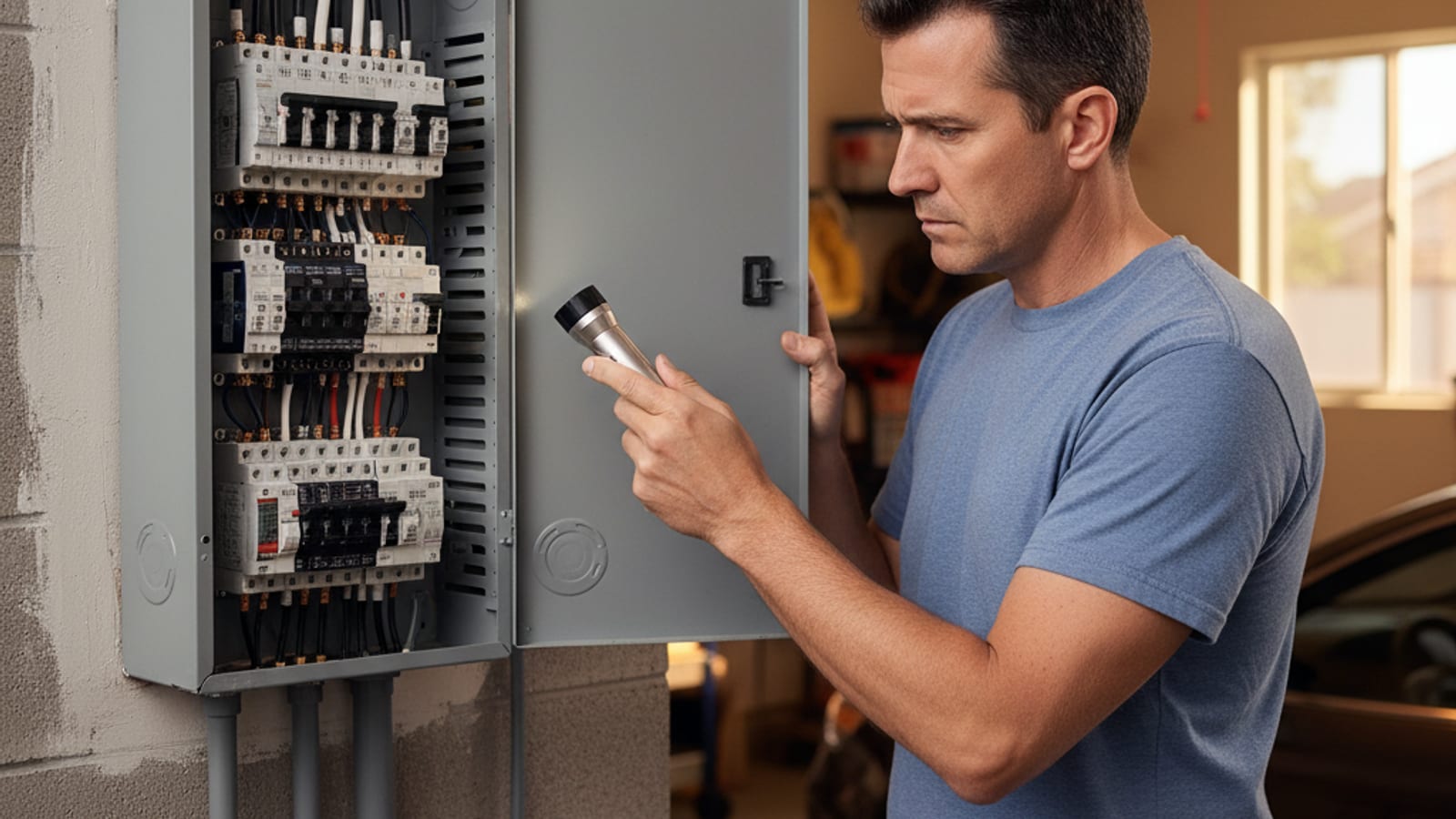
Open only the outer door. Find the breaker that is not fully ON. Tripped breakers often sit in a middle position. Do not remove the inner dead front.
Make a note of which breaker it is and what’s labeled (panel directories are often wrong, but it’s a starting point).
Step 2: Try a clean reset
To reset a tripped breaker correctly:
- Flip it fully OFF first (push the handle all the way toward OFF, you’ll feel a click)
- Wait 5 seconds
- Flip it fully ON (push fully toward ON)
If the breaker holds, watch what you turn back on. If it trips again, stop. That is not a diagnosis of overload versus short. Leave it off and call.
Step 3: If it trips again, stop
If the breaker trips again, stop after that one extra reset. Leave it off and use contact. Do not unplug in a sequence to name overload versus short. Do not plug devices back in one at a time as a home test.
Step 4: Overload is one category, not the ranked cause
Overload is one category, not the only cause. A 15-amp breaker is often planned around 12 amps continuous. A 20-amp breaker around 16 amps. Space heaters, hair dryers, and window AC units are common heavy loads. Redistributing loads can stop an overload. If you cannot, you may need a new circuit. That is still a licensed job. An HVAC contractor diagnoses the compressor. The electrician checks the circuit. Bright Pro does not do either.
Common scenarios that overload circuits:
- Space heater + microwave on the same kitchen circuit. Space heaters draw 12.5 amps on their own. Add anything else and you’re over.
- Hair dryer + curling iron on a bathroom GFCI. Some hair dryers pull 15 amps by themselves.
- Holiday string lights + a few accent lamps on a bedroom circuit. LED strings are fine; older incandescent strings draw real current.
- Window AC unit on a circuit shared with other rooms. Window ACs need their own dedicated circuit, period. If the breaker serving your AC keeps tripping, the problem may be the compressor rather than the circuit. An HVAC contractor can diagnose the equipment side while the electricians we connect you with check the wiring.
If you can identify an overload, the fix is to redistribute loads. If you can’t avoid the overload (e.g., your bathroom GFCI just won’t hold a hair dryer), you need a dedicated 20-amp circuit added. That’s a real electrical job.
Step 5: Could it be a short circuit or ground fault?
If a device trips the breaker the moment it is used, stop using that device. Leave the breaker off if it will not hold. What causes an electrical short covers the mechanism. Do not keep plugging it in to confirm.
- Old extension cords with damaged insulation
- Lamps with frayed cords at the base
- Power strips that have been overheated
- Appliances with internal motor or heating element shorts (toasters and coffee makers are common)
Stop using the device and replace it. If the device is expensive (a refrigerator, a washing machine), have it diagnosed by an appliance repair tech rather than throwing it out.
Step 6: Is your AFCI breaker nuisance-tripping?
If your home was built or rewired after 2014, many of your circuits are protected by AFCI breakers (Arc Fault Circuit Interrupters). AFCIs are designed to detect arcing, the kind of sparking that happens at a damaged wire connection, and trip before a fire can start. AFCI trips have their own diagnosis path: nuisance trips from vacuum motors or incompatible dimmers behave differently than a real arc fault. See our AFCI breaker tripping guide for that specific path.
The problem: AFCIs sometimes trip on what’s called a “nuisance trip” from electronic noise that mimics arcing. Examples:
- Older treadmills and exercise equipment
- Some vacuum cleaners (especially older bagless models)
- Certain LED bulbs from cheap manufacturers
- Window AC units with worn capacitors
- Some space heaters
If your AFCI trips with a specific device but holds otherwise, don’t disable the AFCI. AFCIs catch real arc faults, and replacing one with a non-AFCI breaker leaves you exposed. The fix is to replace the device, or to have an electrician test the AFCI for genuine vs. nuisance trip behavior.
What if the breaker itself is failing?
Breakers wear out. After 20–30 years of use (or after a major fault event), the internal mechanism can weaken. A worn breaker trips at lower current than it’s rated for, or fails to trip when it should.
A licensed electrician may test a breaker under load. If it trips below its rating, replacement is one option. Single-breaker replacement is typically $185 to $325 depending on breaker type and panel.
When should you stop troubleshooting and call?
Call if:
- The breaker will not hold after one reset
- The same breaker trips on more than one device
- An AFCI trips repeatedly
- You see any of the safety signs above
Bright Pro Electric does not credit diagnostics or finish repairs. Leave a message any time via contact. Hours are Monday through Saturday, 7am to 7pm. After hours, a matched electrician may or may not be available the same night.
Frequently asked questions
Is it safe to keep resetting a tripping breaker?
No. If a breaker trips again after one clean reset, leave it off. Forcing repeated resets can overheat the wiring. Diagnose the cause with a licensed electrician, not by stacking resets.
How much does it cost to replace a bad breaker?
Single-breaker replacement is typically $185 to $325 depending on breaker type and panel. Diagnostic credit is the electrician’s policy, not Bright Pro’s.
What’s the difference between a tripped breaker and a bad breaker?
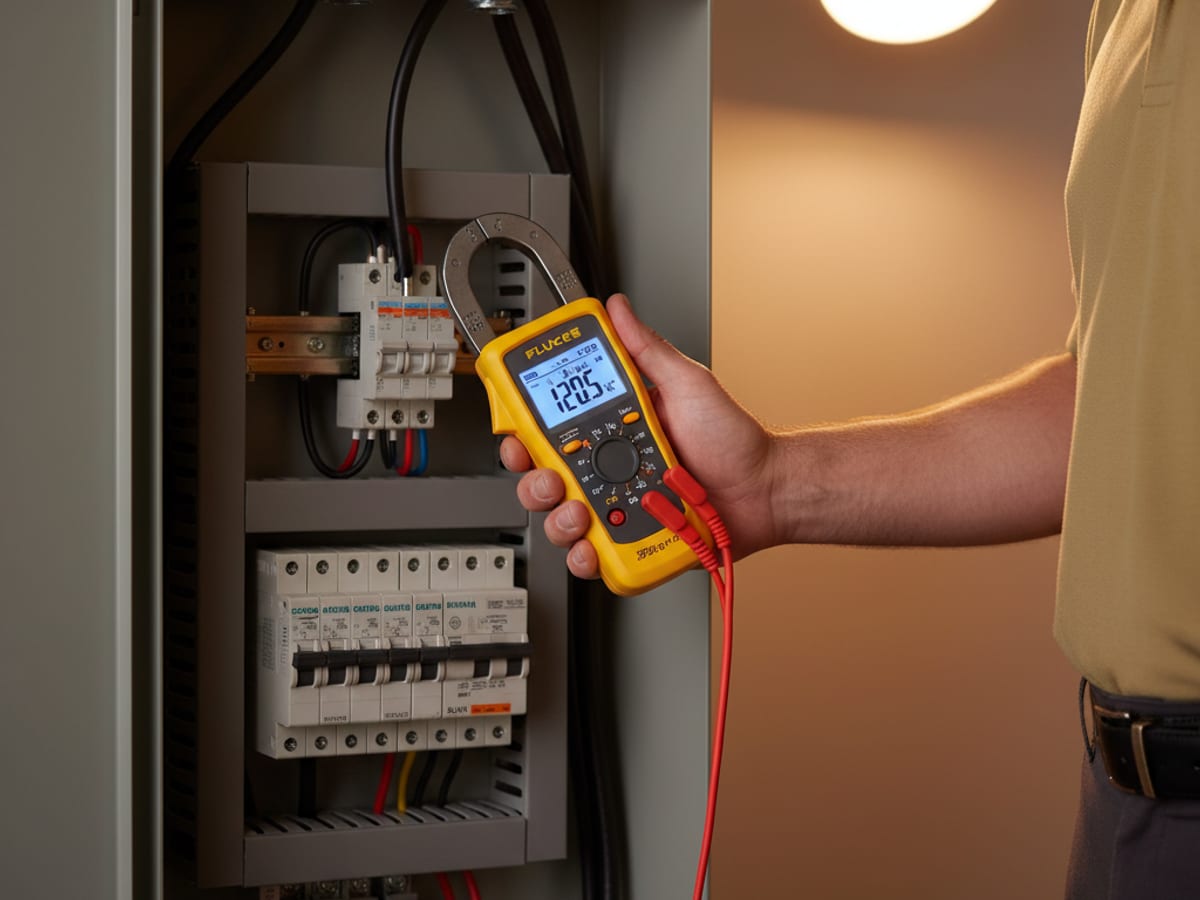
A tripped breaker that resets once and holds is not a diagnosis. A breaker that will not reset, trips immediately, or trips again is stop-use for DIY. Electricians may test with a clamp meter under load. Bright Pro does not.
Can a space heater trip a 15-amp breaker?
Yes. Most space heaters draw 12.5 amps on their own. That’s already at 83% of a 15-amp breaker’s capacity. Add anything else on the same circuit and you’re over the 12-amp sustained limit. Space heaters should run on a dedicated circuit.
Related guides
If tripping breakers are a recurring pattern, the panel itself may need attention. Our panel upgrade cost guide covers pricing, timeline, and when a 200-amp upgrade makes sense. A burning smell alongside repeated trips is a different level of urgency. See our electrical burning smell emergency guide for what to do immediately. If your area is prone to PSPS shutoffs, our generator and backup power guide covers whole-home vs. portable options. And for a broader look at what electrical repairs cost in San Diego, check our electrician pricing guide.
See electrical troubleshooting. Use contact and leave a message any time.
Service across San Diego County, from coastal communities through the mountain backcountry.