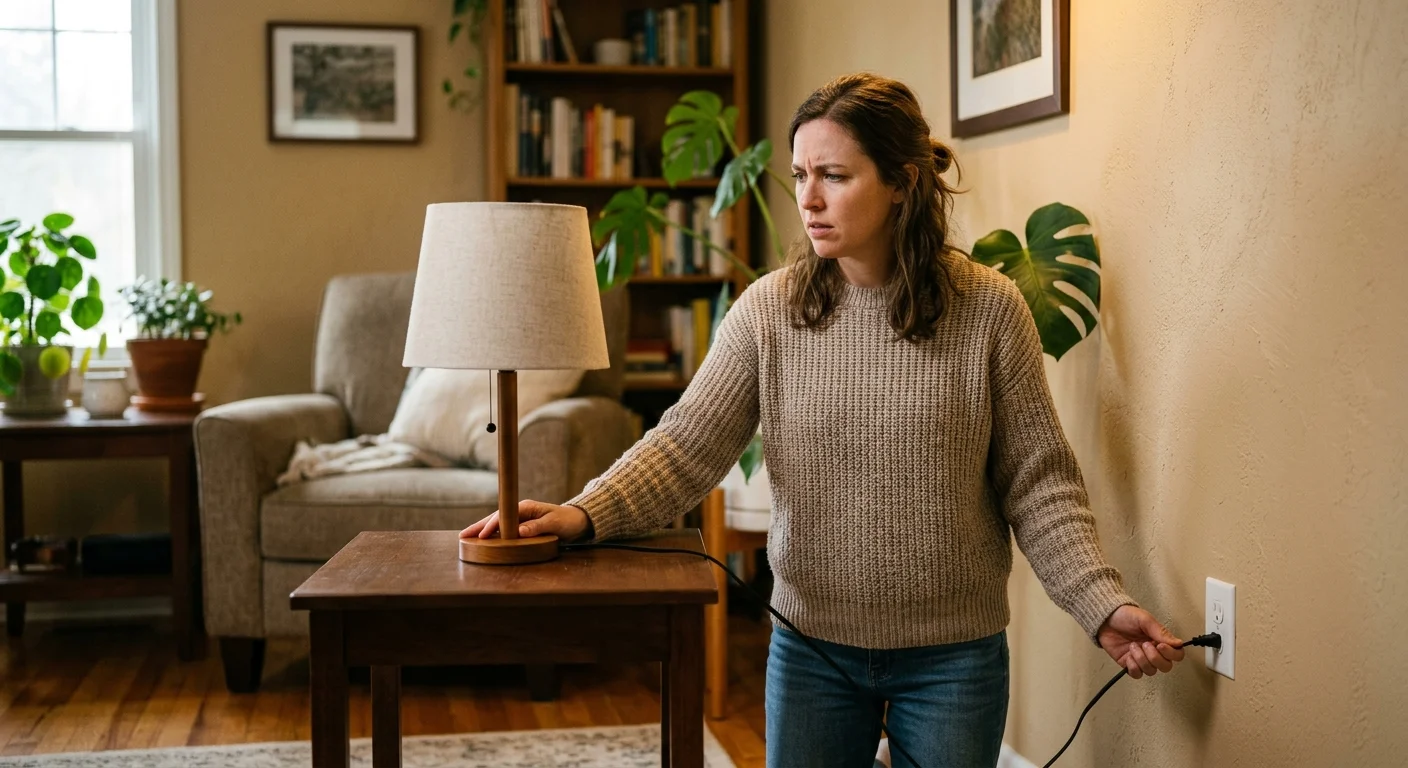
Smoke, fire, sparks, burning odor, visible damage, or water mean stop. Keep away from the affected area. For active smoke or fire, leave and call 911 from a safe location. Don’t touch an outlet or switch to check whether it feels warm.
Outlets not working in one room may share a tripped breaker or upstream GFCI. They may also have a device or wiring problem. The pattern alone doesn’t identify the cause.
You can make a few noninvasive observations when everything is dry and undamaged. Don’t remove covers, touch wiring, insert a tester, or repeatedly reset anything.
Most common reasons one room’s outlets go dead
These are the usual patterns licensed electricians see. They are not a diagnosis of your house.
- A GFCI upstream tripped. A bathroom, garage, kitchen, or outdoor GFCI can protect receptacles in another room. Lights in the dead room may still work because lighting is often on a different circuit.
- The breaker did trip. A handle that looks ON can sit between ON and OFF. One reset of an identified breaker is the limit. If it trips again, stop.
- A daisy-chained receptacle failed. Outlets on one wall are often wired through each other. A loose backstab or a failed device can drop everything downstream. That inspection is behind the faceplate, which is electrician work.
- A shared neutral or a loose connection in a box. Less common than a GFCI or a breaker, and not something to chase with the cover off.
Write down which of those four matches what you see. Then do only the checks below.
Before checking any control
Write down what lost power. Include the outlets, lights, switches, and nearby rooms. Note whether one appliance was operating when the outage began.
If you can reach them safely, switch off or unplug intact appliances and lamps connected to the affected area. Don’t reconnect them one by one to provoke another trip.
Also record:
- Whether the room’s lights still work
- Whether every outlet is affected
- What one device, if any, preceded the outage
- Any visible breaker or GFCI status
- Any electrical work completed recently
These details help an electrician trace the affected circuit. Lights working while outlets remain dead doesn’t prove a particular wiring failure. One wall losing power doesn’t confirm a loose connection or failed outlet.
Check only an identified breaker
A tripped breaker may appear OFF or between ON and OFF. Before considering a reset, appliances on the affected circuit should be off or unplugged. ESFI’s circuit-breaker guidance describes moving an identified tripped breaker fully OFF and then ON.
Try this only when all these conditions apply:
- There’s no smoke, odor, water, heat, sparking, or visible damage.
- You know which breaker controls the affected area.
- The panel and floor around it are dry and undamaged.
- You’re comfortable operating the breaker handle.
- You can follow the panel and breaker manufacturer’s instructions.
Make one reset attempt. If the breaker trips again, won’t remain on, or behaves unexpectedly, leave it alone and contact an electrician. A successful reset doesn’t prove the underlying issue is resolved.
Don’t cycle every breaker looking for the right one. Never remove the panel’s screwed-on cover.
Reset directions can vary by equipment. For example, Schneider Electric’s instructions for QO branch breakers say to move that breaker’s handle fully OFF before moving it ON. That guidance applies to those breakers, not every manufacturer or model.
Check a known GFCI
A GFCI can protect other outlets farther along the circuit. The controlling GFCI may be outside the affected room.
You may use the external RESET button on a dry, undamaged, safely accessible GFCI. Follow the instructions printed on the device or provided by its manufacturer. Don’t move heavy appliances, enter a wet area, or disassemble anything to reach one.
If the GFCI won’t reset, don’t force it or keep trying. Don’t bypass it or remove its faceplate. According to Leviton’s GFCI reset guidance, possible reasons include missing incoming power, a continuing ground fault, incorrect wiring, or device damage. Those are possibilities, not a diagnosis of your outlet.
When to stop and call an electrician
Arrange professional troubleshooting when:
- The identified breaker trips again or won’t stay on.
- The GFCI won’t reset or trips again.
- No identified breaker or GFCI explains the outage.
- Power returns but fails again during normal use.
- You notice discoloration, damage, burning odor, smoke, or sparks.
- Water reached an outlet, switch, appliance, or electrical panel.
- The outage followed recent electrical work.
- You aren’t certain which control serves the room.
A dead lamp or appliance doesn’t prove the outlet’s wiring is de-energized. Leave faceplates, panel covers, wiring, and electrical testing to a licensed electrician.
The electrician can use your notes to trace the circuit and inspect the affected equipment safely. Whether lights and outlets failed together can narrow the investigation, but it doesn’t establish the cause by itself.
Frequently asked questions
Why don’t my outlets work when the breaker isn’t tripped?
A breaker that looks on hasn’t necessarily stayed on. It may show OFF or sit between ON and OFF. A GFCI outside the room can protect these outlets and still refuse to reset. The pros we send will investigate, since that pattern doesn’t identify the cause.
Several outlets stopped working at once. What does that mean?
Several dead outlets at once still don’t name the failed part. A GFCI can protect downstream outlets, even from another room. It may lack incoming power, still detect a ground fault, be wired incorrectly, or be damaged. Failure to reset doesn’t prove it needs replacement, so get a licensed electrician in our network.
All the outlets on one wall are dead. Is that different?
No, it’s a different pattern, not a different diagnosis. The GFCI that feeds those outlets may sit outside the affected room. Never remove a panel’s screwed-on cover or an outlet faceplate. A licensed electrician in our network will check that path.
When should I stop checking and call an electrician?
Skip resets and keep away from water, visible damage, burning odor, smoke, or sparks. Leave and call emergency services from safety if you see fire or smoke. Don’t assume a dead load is de-energized, and don’t touch suspect equipment to test it. Bright Pro Electric matches San Diego County homeowners with independent licensed local electricians.
Get local troubleshooting help
Bright Pro Electric matches San Diego County homeowners with independent licensed local electricians. Share the room, affected devices, visible control status, and any recent work when requesting help.
Request an electrician through our contact page or review our electrical troubleshooting service. Diagnosis, availability, and response time aren’t guaranteed.