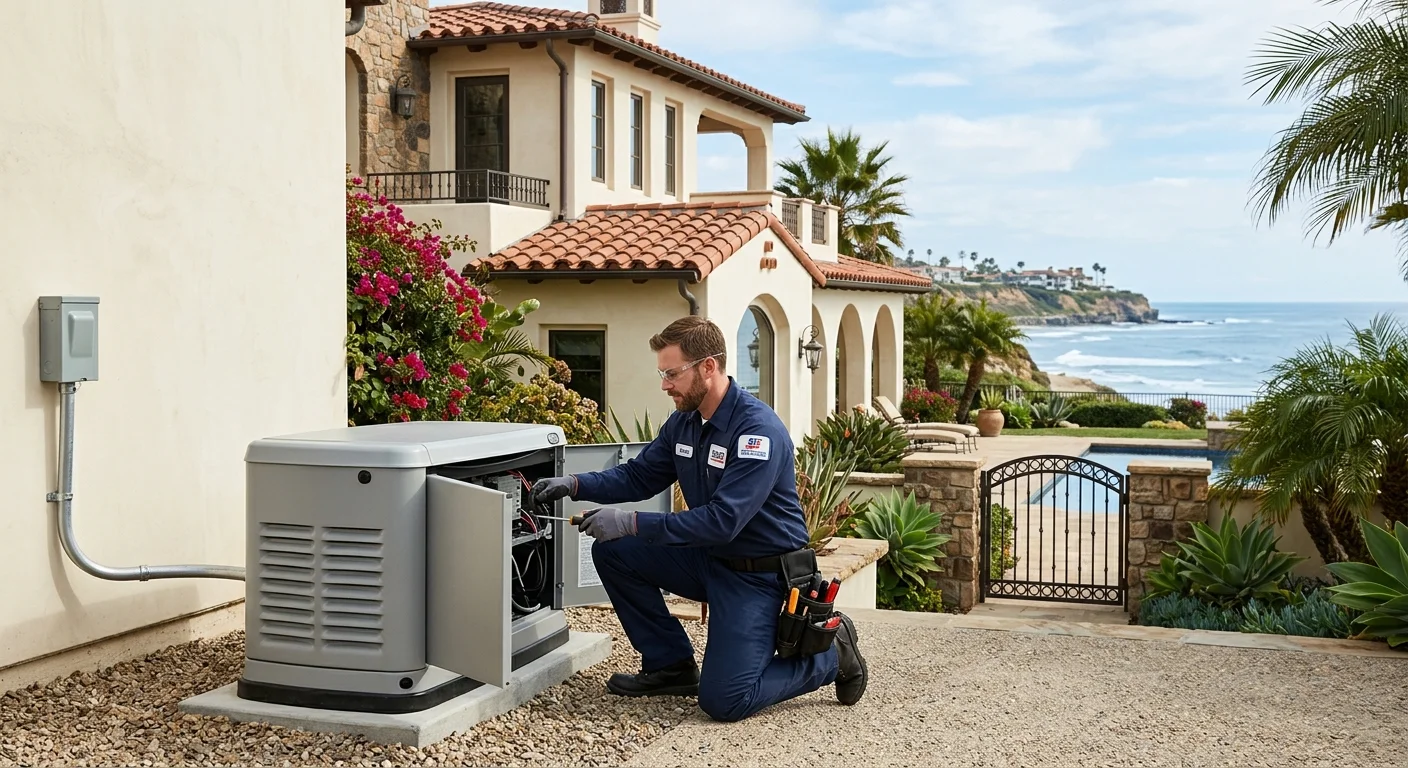
A Carlsbad standby generator is sized from a load calculation, listed equipment, and the City of Carlsbad plus SDG&E and HOA checks for that address. The city has both coastal storm outages and inland circuits that SDG&E may include in a Public Safety Power Shutoff. Confirm the current outage map and your circuit, rather than treating a zip code as a zone class. Published installed ranges on this page stay as parked examples.
TL;DR
- Size the unit from protected loads and a field load calculation, not a 16 to 22 kW default. Parked total installed examples on this page run $8,500 to $16,000.
- Match enclosure listing to actual salt-air exposure and the manufacturer’s coastal or marine guidance. West of I-5 is a screening clue, not a rating by itself.
- Check your address on SDG&E’s outage tools instead of assuming east-of-El-Camino PSPS exposure.
- Confirm permits with the City of Carlsbad Building Division, HOA CC&Rs where they apply, SoCalGas meter capacity, and SDG&E notification before energizing. Timelines are jurisdiction-specific.
- Follow the service interval and documentation in the owner manual. Manufacturers typically require documented maintenance for warranty claims.
Check your Carlsbad address, not a citywide PSPS map
SDG&E’s Public Safety Power Shutoff program de-energizes lines when the utility decides fire risk on those circuits is too high. Whether a Carlsbad home is included is an address and circuit question. Use SDG&E’s current outage and PSPS tools for that meter. Eastern Carlsbad and hillier terrain east of El Camino Real have been included in past events, and coastal west-side homes more often see storm damage, but those are history, not a fire-zone class for your lot.
Outage length is set by the event, not a published hours-to-days rule. Households with medical devices, infants, or elderly residents should plan from the loads they cannot lose, then size equipment to those loads.
A listed standby generator with a listed transfer method monitors utility power, starts on an outage per its controller settings, and isolates the home from the grid when that equipment is installed to the manufacturer’s instructions. Transfer timing is model-specific.
For more background on PSPS events and generator options, see our guide on PSPS shutoffs and generator solutions.
Why Carlsbad homeowners invest in backup power
Beyond PSPS events, Carlsbad has the normal utility vulnerabilities of any coastal Southern California city: Pacific storms between November and April that can knock lines down, Santa Ana winds, and the occasional equipment failure that affects a neighborhood or a feeder line.
A listed whole-home standby generator can cover storm outages and PSPS events when the protected-load list, fuel, and transfer equipment match the site. For fuel options, sizing method, and permit questions across the county, see our whole-house generator installation guide for San Diego. Many Carlsbad lots have SoCalGas service. Confirm meter capacity and whether a generator load needs a utility meter change before treating natural gas as unlimited runtime. Portable units are limited by tank size and the manufacturer’s runtime rating, not a universal eight-hour figure.
Common reasons Carlsbad homeowners look at generators: medical equipment that cannot lose power, home-based work, households with young children or elderly family members, and past outages on their circuit.
Choosing the right generator size for your home
Generator sizing starts with a load calculation and the circuits you want protected, not square footage. A licensed electrician measures demand, lists essential versus optional loads, and matches a listed generator and transfer method to that list.
Kilowatt bands below are starting examples, not a Carlsbad default:
A 10 kW unit may cover a short essential list: refrigerator, a few lights, selected heating or water-heating loads, and a couple of living-area circuits. It will not run central air unless that is the only large load on the protected list and the nameplate allows it.
A 16 to 20 kW unit is an example range some 2,000 to 3,000 square foot homes land in after a load calc that includes AC, refrigeration, lighting, and selected plug loads. Confirm it against your actual loads.
A 24 to 28 kW unit is an example for larger protected-load lists, multiple AC units, or a homeowner who wants oven or spa circuits on generator power.
If you have a home EV charger, read the charger nameplate. Many Level 2 units are listed around 30 to 50 amps continuous. Treat charging as an optional load unless you size fuel and generator output for it.
Natural gas is often available in Carlsbad. Propane is a path where gas service is absent, with tank sizing from expected runtime and fire-code siting, not a rule of thumb.
Special considerations for coastal installations: salt air and corrosion
This is where Carlsbad stands apart from inland generator installations, and it’s the part of the conversation that sometimes surprises homeowners.
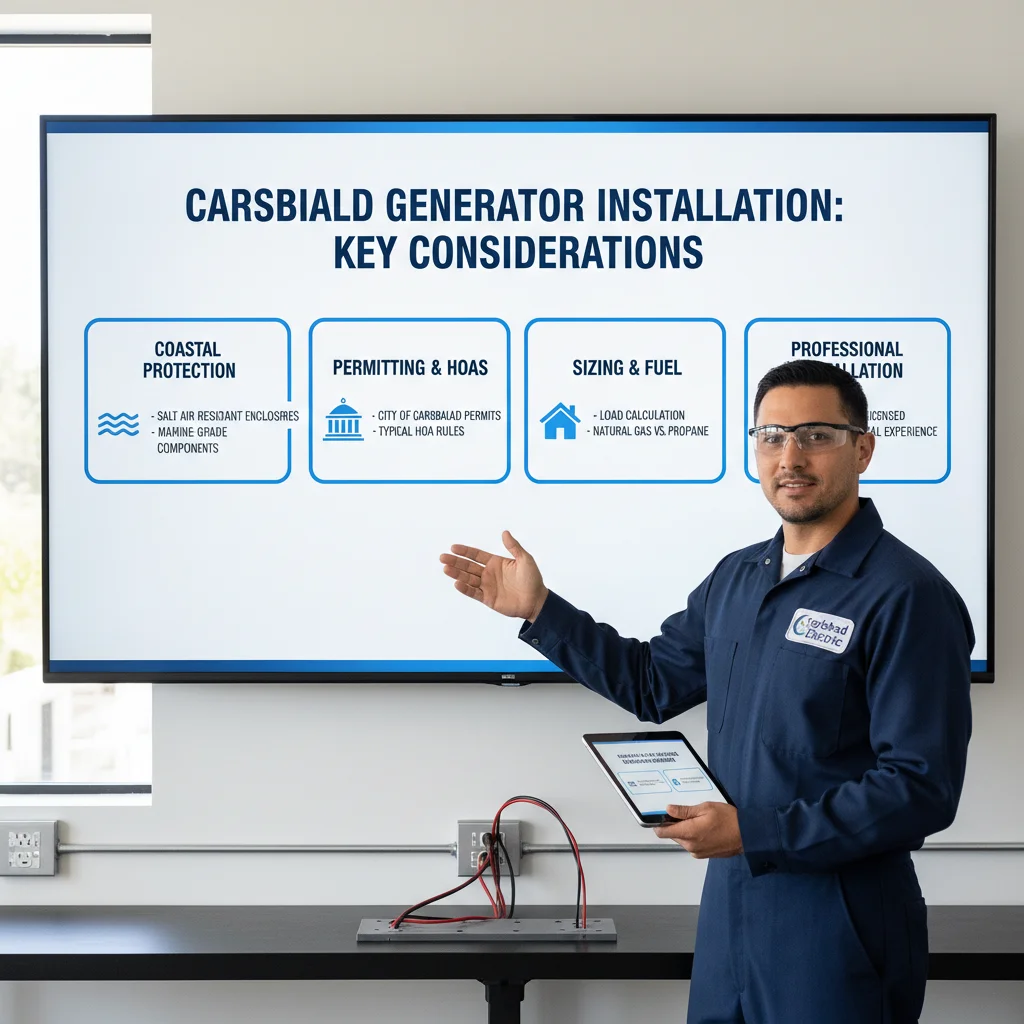
Salt air can accelerate corrosion on outdoor electrical and mechanical equipment. West of I-5 is a screening clue for exposure, not a guarantee of failure in a set number of years. Follow the manufacturer’s coastal or marine enclosure listing for the model you buy, and have connections inspected on the service interval in the owner manual.
Equipment and placement both matter.
For equipment, specify a generator whose enclosure listing matches salt-air or marine exposure when the site is actually coastal. Generac, Kohler, and Briggs & Stratton publish coastal or marine-rated enclosure options on some models. Those are not interchangeable with a standard inland enclosure. Extra cost on this page stays parked at $500 to $1,500 over a comparable standard unit.
For placement, use the manufacturer’s clearance drawing, pad spec, and drainage notes, plus City of Carlsbad setbacks. Prefer the less exposed side of the house when that still meets listing and access. Leave room for service.
HOA communities such as Bressi Ranch, Calavera Hills, and Robertson Ranch may add siting, screening, and noise rules in the CC&Rs. Review those documents before anyone sites the pad. Bright Pro Electric matches you with a licensed electrician. It does not pull permits or stamp HOA forms.
Transfer switch sizing and what it means for your panel
The automatic transfer switch (ATS) is the electrical component that connects the generator to your home. It monitors utility power, signals the generator to start during an outage, transfers your home’s load to generator power, and then transfers back and shuts the generator down when utility power returns. It’s a non-negotiable part of any legal, safe standby generator installation.
Transfer switches come in two main configurations for residential use.
A service entrance-rated transfer switch installs between the utility meter and your main panel when that configuration is listed for the equipment and the service. It can give the generator access to the full panel when the generator and load calc support that.
A load-center transfer switch installs as a sub-panel alongside the existing main panel. Selected circuits move to that sub-panel. That limits backup to the circuits that were moved.
The choice depends on generator capacity, listed compatibility with the panel, inlet or feeder location, and which loads you want protected. A 16 kW nameplate does not automatically mean a service-entrance switch. A smaller generator covering essentials often pairs with a load-center switch.
Transfer-switch installation generally requires a permit. SDG&E needs notification so crews are not exposed to backfed power. The electrician in the match handles that coordination when it is in their scope. Bright Pro Electric does not notify the utility itself.
Carlsbad’s permitting process for standby generators
A standby generator installation in Carlsbad typically needs permits from the City of Carlsbad Building Division for the electrical work (transfer switch, generator feeders, panel changes) and the mechanical or gas work (fuel connection, pad, clearances). Confirm the current application path for that address. Unincorporated parcels use the County, not the City.
The packet usually includes a site plan with property lines, openings, and the pad, plus electrical diagrams and the generator listing. Setbacks are not a universal 5-foot / 18-inch rule you can copy from this page. Use the manufacturer’s clearance drawing and the City’s adopted code for that permit. Some HOAs add screening or noise limits on top.
Review time is not a fixed one-to-three-week clock. Ask the Building Division for current turnaround. After approval, the installing contractor schedules the work and the inspection. SDG&E notification before energizing is a utility step, not a Bright Pro filing.
You can verify a contractor’s C-10 license at cslb.ca.gov.
Generator installation cost in Carlsbad: a realistic breakdown
Costs vary enough that a web range is not a quote. The figures below are parked published examples, not a Carlsbad price list:
The generator unit itself is the largest single cost. A 16 kW natural gas generator is one example size after a load calculation, not a mid-size Carlsbad default. That example unit runs approximately $3,500 to $5,000. A 20 to 22 kW unit runs $5,000 to $7,000. Coastal-rated units with corrosion-resistant enclosures run $500 to $1,500 more than standard units at the same capacity.
The automatic transfer switch adds $800 to $2,500 depending on whether it’s a load-center or service entrance configuration and the panel size.
Installation labor includes the concrete pad, gas line extension from the meter (cost depends heavily on distance and any trenching required), electrical conduit run from the panel to the transfer switch and to the generator, all connections and commissioning, the permit, and SDG&E coordination. Installation labor for a typical Carlsbad single-family home runs $2,500 to $5,000.
Total project cost for a complete 16 to 22 kW natural gas standby generator in Carlsbad, coastal spec, permitted and installed: $8,500 to $16,000 depending on site conditions. Treat that band as a parked example until a written proposal lists the unit, transfer method, gas work, and permit path.
Annual maintenance: what Carlsbad generators need
A standby generator that runs automatically once a week for a self-test cycle is not the same as a maintained generator. Self-test cycles verify that the engine starts and the automatic transfer switch works, but they don’t substitute for proper annual maintenance.
A weekly self-test confirms the engine can start and the transfer method can operate. It does not replace the service interval in the owner manual.
A generator service visit typically covers oil and filter, plugs and air filter, battery and charging, coolant where the engine uses it, electrical connections, transfer operation, and enclosure and exhaust inspection. Coastal Carlsbad visits should include a corrosion look at exposed connections. Follow the model’s manual for what is due this year.
Manufacturers typically require documented maintenance to honor warranty claims. Keep the records the owner manual asks for. A missed visit is not automatic denial, and this page cannot predict a claim.
Ask the installing contractor about a maintenance agreement. Bright Pro Electric does not sell or staff that contract.
Natural gas vs. propane in Carlsbad
The majority of Carlsbad homes have SoCalGas natural gas service. Confirm that the meter and service can take the generator’s listed gas load. A 20 kW unit that consumes roughly 200 to 300 cubic feet of natural gas per hour under load is an example, not your nameplate. SoCalGas decides whether a meter change is needed and on what schedule. Do not treat meter work as free or as a Bright Pro task.
For lots outside the gas network, propane is an alternative. Tank hours below are parked examples: a 500-gallon tank providing roughly 50 to 70 hours at moderate load, and a 1,000-gallon tank doubling that. Actual runtime follows tank size, load, and the generator’s fuel consumption chart. Fire-code siting is reviewed by the authority that covers the address.
Finding a qualified generator installer in North County
Ask whether the contractor has installed listed coastal-rated equipment, who files the City of Carlsbad permit, who notifies SDG&E and SoCalGas, and who prepares HOA submittals. Bright Pro Electric matches homeowners with licensed electricians. It does not pull permits, stamp forms, or guarantee those filings.
For other residential electrical needs in Carlsbad, see our post on electrician in Carlsbad. Our generator installation in San Diego service page covers how matching works.
Frequently asked questions
Do I need a permit to install a standby generator in Carlsbad?
Yes. Confirm the current path with the City of Carlsbad Building Division for electrical work (transfer switch, panel connections) and the mechanical or gas installation (fuel line, mounting). The packet typically includes a site plan, electrical diagrams, and generator specs. Review time is not a fixed one-to-three-week clock. SDG&E also requires notification before the unit is energized. A licensed C-10 electrician handles those steps when they are in the written scope.
What size generator do I need for a typical Carlsbad home?
There is no typical size. Start with a load calculation and the circuits you want protected. A 16 to 20 kW unit is only an example some 2,000 to 3,000 square foot homes land in when the list includes central AC, refrigeration, lighting, and selected plug loads. A 10 kW generator is an essentials example and often will not run central air. A 24 to 28 kW unit is an example for larger lists or multiple AC systems.
Why do coastal Carlsbad homes need special generator equipment?
Salt air can accelerate corrosion on outdoor electrical and mechanical equipment. Standard enclosures and terminals can oxidize faster near the ocean than inland. Homes with actual salt-air exposure should match the enclosure listing to the manufacturer’s coastal or marine guidance. West of I-5 is a screening clue. These listings cost $500 to $1,500 more than standard units on this page’s parked examples.
How long does a Carlsbad generator installation typically take?
Permit review, pad, gas, conduit, transfer switch, and commissioning follow the City’s queue and the site. Two to four weeks from approval to finish is a parked example, not a promise. HOA architectural review can add time before permit submission.
How to get matched
If you want a Carlsbad standby generator scoped from load, listing, jurisdiction, HOA, and utility checks, Bright Pro Electric matches you with a licensed electrician for a site visit and written scope. It does not install the unit, pull permits, or promise a same-day estimate. Hours are Monday through Saturday, 7am to 7pm. After hours, leave a message. Use the contact page. See the Carlsbad electrician service page for other residential electrical matching in the city.