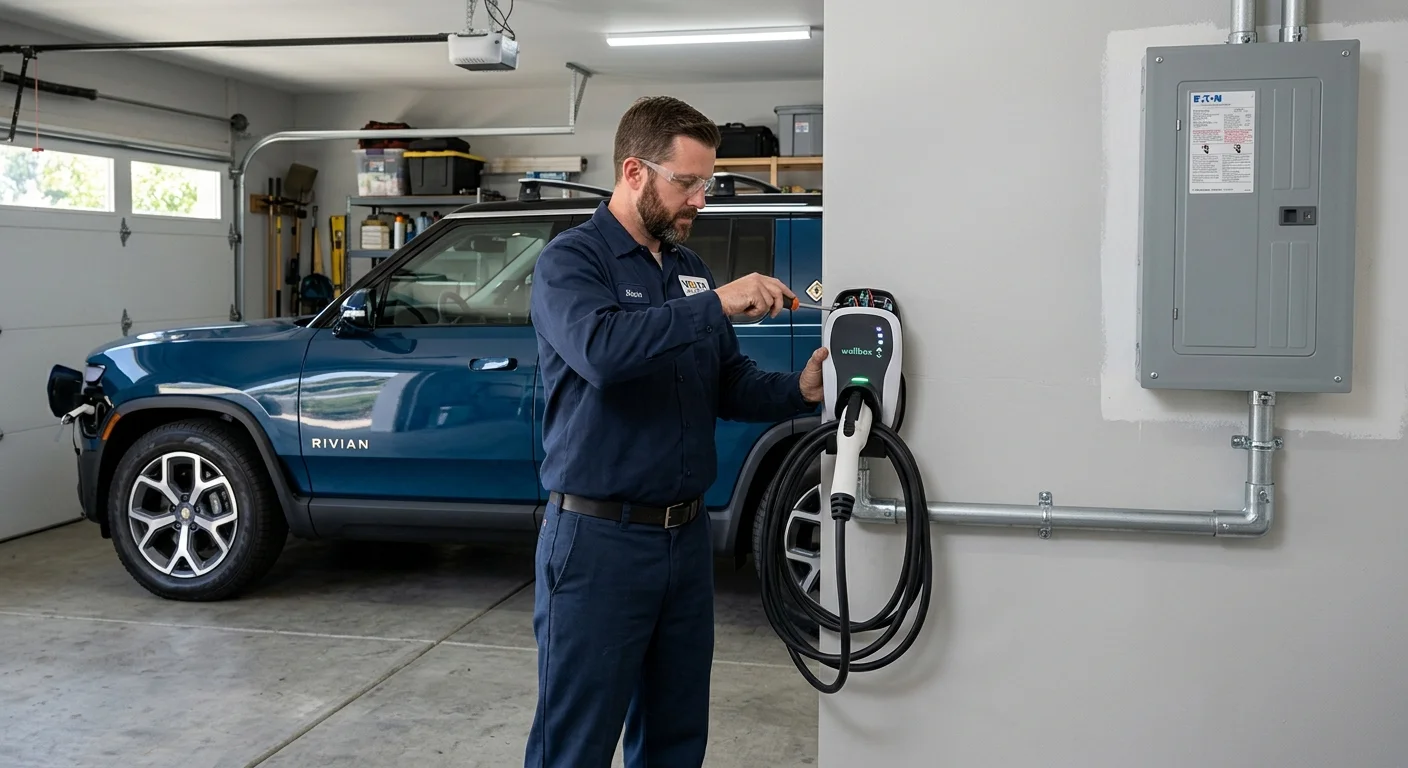
A Level 2 charger in Poway is a new 240-volt circuit, a City of Poway permit, and often a longer run to a detached garage. Published industry range on this page is $800 to $2,500. These are not Bright Pro prices.
TL;DR
- Level 2 EV charger installation in Poway typically runs $800 to $2,500; longer runs or panel upgrades push costs higher.
- Older Poway homes (pre-1980) often have 100-amp panels that need a load calculation before adding a 40 to 50-amp EV circuit.
- The City of Poway’s Building Division requires a permit for all EV charger circuits; A licensed electrician pulls the permit.
- SDG&E rebates and the federal 30C tax credit can be stacked to reduce out-of-pocket costs significantly.
- Poway’s larger lot sizes often mean detached garages with longer conduit runs, which is one of the key cost drivers for EV installs here.
Why Poway homes are a good fit for Level 2 charging
Many Poway lots have detached garages, longer driveways, or side-yard space. That usually means more room to place a Level 2 charger inside a garage or on an exterior wall. A Level 2 unit on a dedicated 240-volt circuit typically fills most EV batteries in about 4 to 8 hours, which matches overnight charging. Level 1 on a 120-volt outlet is slower. I-15 commutes make that overnight fill useful. Lot size does not replace a load calculation.
Many Poway trips run across the county. Public chargers help, but they can be occupied or slow. A Level 2 circuit at home is the usual overnight fill. Older Poway houses can still take a charger when the panel and conduit run support it. That starts with a load calculation, not with assuming the lot size will carry the circuit.
Checking whether your panel has the capacity
Before you purchase a new Level 2 EV charger, the most crucial assessment involves your home’s existing electrical panel. These powerful chargers demand a substantial amount of electricity, typically drawing anywhere from 30 to 80 amps, depending on the charger’s output. Your main electrical panel, the central hub of your home’s power, must have sufficient available capacity to safely support this additional, consistent electrical load. Many older Poway residences, especially those constructed decades ago, were often built with 100-amp electrical panels. While this was adequate for the electrical demands of their era, modern homes, even those built more recently, can quickly approach their panel’s limits with high-demand appliances like central air conditioning, electric water heaters, dryers, or large kitchen ranges.
To accurately determine your panel’s capacity, a licensed electrician performs a load calculation. This process involves meticulously adding up the peak amperage draw of all your home’s major electrical components and existing circuits. This total is then compared against your panel’s overall amperage rating. If a spare breaker slot exists and the calculation shows remaining capacity, a dedicated EV circuit may fit without an upgrade. A 200-amp panel is not automatic approval. Heavily loaded circuits, extra sub-panels, or older wiring can still limit capacity. NEC Article 220 load calculation is how that gets decided. Overloading the panel can trip breakers and raise fire risk.
When a panel upgrade or load calculation is needed
A professional load calculation often reveals that your current electrical panel simply doesn’t have the necessary surplus capacity to safely accommodate a Level 2 EV charger. When this happens, a full electrical panel upgrade becomes a necessary and prudent investment. This critical service involves replacing your existing, potentially outdated, electrical panel with a brand-new one that boasts a higher amperage rating, commonly 200 amps or even 400 amps for larger Poway homes with extensive electrical demands. Upgrading your panel is more than just about charging your EV; it’s a fundamental improvement that ensures your entire home’s electrical system can safely and efficiently handle the demands of modern living, from smart home technology to high-efficiency appliances. It significantly enhances your home’s safety, reliability, and increases its overall market value.
In some scenarios, a complete panel upgrade might not be the only pathway. If your home has adequate overall service capacity coming in, but simply lacks open breaker slots in the main panel, adding a sub-panel can be an efficient alternative. A sub-panel draws power from your main panel and provides a dedicated block of new breaker slots specifically for additional circuits, such as the one your EV charger will require. A licensed electrician evaluates the Poway panel, remaining capacity, and the preferred charger location, then writes a quote. Bright Pro matches you with that electrician. Bright Pro does not choose the equipment or own the install.
Poway permitting and inspection basics
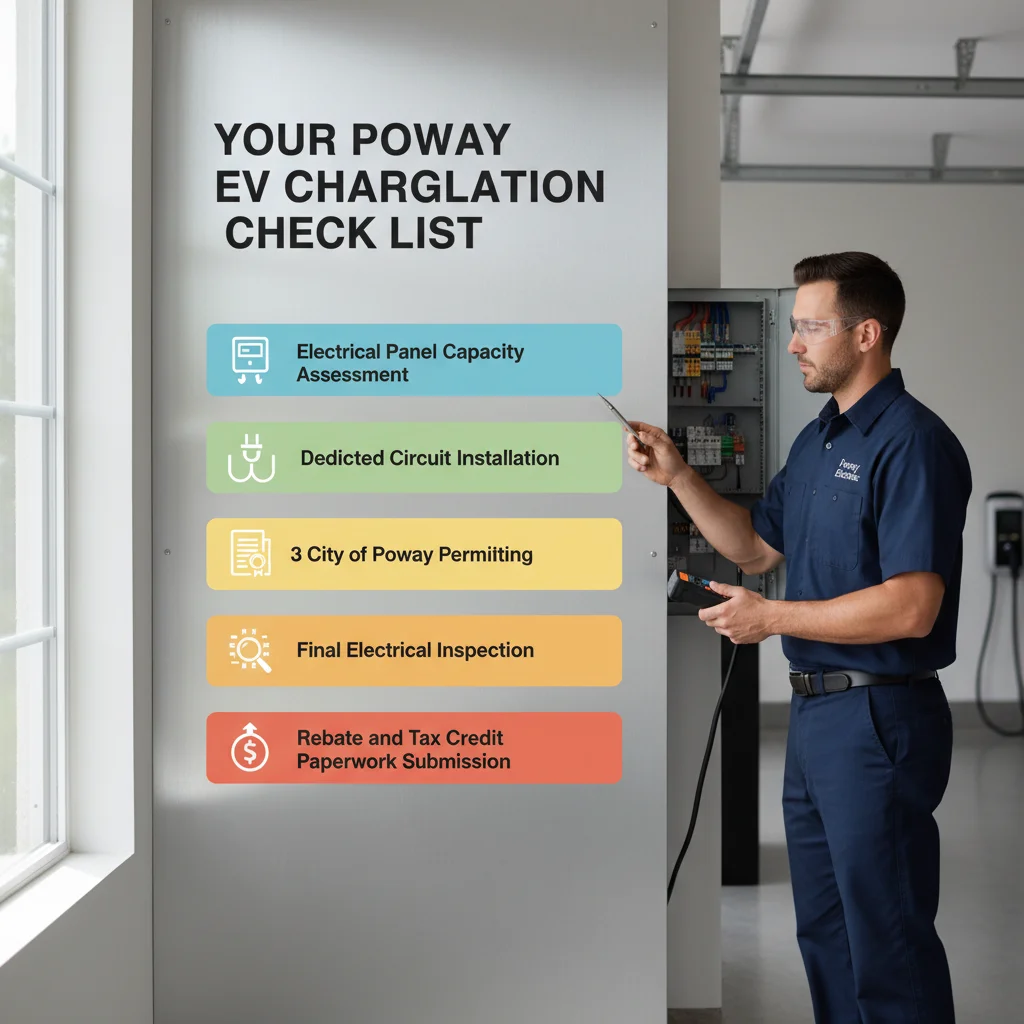
Embarking on an EV charger installation in Poway means navigating the necessary permitting and inspection processes. These steps, managed by the City of Poway’s Building Division, are not merely bureaucratic hurdles; they are fundamental safety protocols designed to protect you, your property, and ensure the electrical work adheres to the stringent standards of the California Electrical Code and local Poway ordinances. Attempting to bypass the permitting process can lead to significant problems, including serious safety hazards, potential voiding of home insurance policies in case of an incident, and complications when you eventually decide to sell your home. A licensed electrician handles the City of Poway permit application. Bright Pro does not.
The typical permitting journey involves several key stages: first, applying for an electrical permit specific to EV charger installations. Once the permit is secured, your electrician will complete the installation, adhering precisely to approved plans and current electrical codes. Finally, a crucial stage is scheduling a final inspection with a Poway city inspector. During this inspection, the official will meticulously verify that every aspect of the EV charger installation, including wiring gauges, conduit runs, proper grounding, correct breaker sizing, and secure mounting of the charging unit, meets all safety and code requirements. A successful final inspection results in the official closure of your permit, providing you with documented proof that your EV charger has been installed safely, legally, and to the highest professional standards. This thorough process is an integral part of a licensed electrician’s EV charger installation job, not a Bright Pro crew product. For permits in the region, see electrical permits in San Diego.
SDG&E rebates and the federal tax credit
SDG&E EV programs change. Confirm current home charger incentive terms on the official SDG&E EV page. The SDG&E EV Climate Credit is a bill credit for qualifying EV customers, not a rebate that pays for the wall unit or the 240-volt circuit. For the charger-program breakdown we keep on this site, see SDG&E EV charger rebates.
In addition to local utility programs, Poway homeowners may also qualify for a beneficial federal tax credit. The federal Qualified Alternative Fuel Vehicle Refueling Property Credit, widely known as the 30C tax credit, provides a non-refundable credit for a percentage of the cost of eligible EV charging equipment and its installation, up to a specified maximum amount. This credit applies to property placed in service during the tax year. Understanding your specific eligibility and the proper way to claim this credit on your federal income taxes is best done by consulting with a qualified tax professional. Combined, these state and federal incentives can significantly reduce your overall out-of-pocket costs, making your investment in a home EV charger in Poway even more financially attractive and accessible. Explore further details in our post dedicated to the EV charger tax credit.
What a typical Poway install costs
Pinpointing an exact cost for an EV charger installation in Poway is challenging without an on-site assessment, as prices fluctuate based on numerous home-specific factors. Generally, for a standard Level 2 EV charger installation, homeowners can anticipate a cost range from approximately $800 to $2,500. However, installations involving significant electrical upgrades can push the total investment higher. Here’s a breakdown of the primary elements influencing your final bill:
- The EV charger unit: The cost of the charger itself varies, typically from $300 to $700 or more, depending on the brand (e.g., Tesla Wall Connector, ChargePoint, JuiceBox), charging speed, smart features, and cable length.
- Electrical panel upgrades: This is often the most significant variable expense. If the electrician’s load calculation determines the Poway home needs a panel upgrade or a sub-panel, that is a separate cost. A full 200-amp panel upgrade on this page can range from $2,000 to $4,500+. See electrical panel upgrade costs.
- Distance and wiring path: The further your preferred charger location is from your main electrical panel, the more materials (conduit, wiring) and labor an electrician will need. Running wires through walls, under floors, or underground adds to the complexity and cost compared to surface-mounted conduit runs in a garage.
- Permitting and inspection fees: The City of Poway charges fees for the necessary electrical permits and inspections, which are included in your overall project cost.
Get a written estimate from a licensed electrician in Poway. That electrician assesses the panel and issues the quote. Bright Pro does not. County ranges: EV charger installation costs in San Diego. Level 1 vs Level 2: Level 1 vs. Level 2 EV charger guide.
Frequently asked questions
Do I need a permit for an EV charger in Poway?
Yes. The City of Poway Building Division requires a permit for any new 240-volt EV charger circuit. The permit process involves submitting plans, completing the installation, and passing a final inspection. A licensed electrician pulls the Poway permit. Unpermitted work can create problems with your homeowner’s insurance and will come up during a home sale.
What does EV charger installation typically cost in Poway?
For a standard attached garage installation with an adequate panel, expect $800 to $2,000 including the permit. Poway’s larger properties often mean detached garages or longer conduit runs, which can push costs toward $2,500 or more. If a panel upgrade is needed, that’s a separate cost, typically $2,000 to $4,500 depending on the scope.
My Poway home was built in the 1970s. Will my panel handle an EV charger?
Possibly, but you need a load calculation first. Pre-1980 Poway homes typically have 100-amp panels that are already running close to capacity with central AC, a water heater, and standard appliances. A 40-amp EV charger circuit adds significant load. If the calculation shows the panel can’t handle it safely, a load management device ($600 to $1,200) or a full panel upgrade is needed before install.
Can I stack SDG&E rebates and the federal tax credit for my Poway EV charger?
They can stack when both programs still apply to that address. Confirm current SDG&E Power Your Drive terms on sdge.com. The federal 30C credit can cover 30% up to $1,000 when the address is in a qualified census tract. Confirm the DOE map. This page does not publish a rebate dollar cap as a Bright Pro offer.
When to call us
Installing an EV charger is a significant electrical undertaking that requires the precision and expertise of a licensed and insured electrician. You should hire a licensed electrician when you are ready for an assessment of your Poway home’s electrical capacity. That electrician handles City of Poway permitting and the install. Bright Pro does not. Use contact.