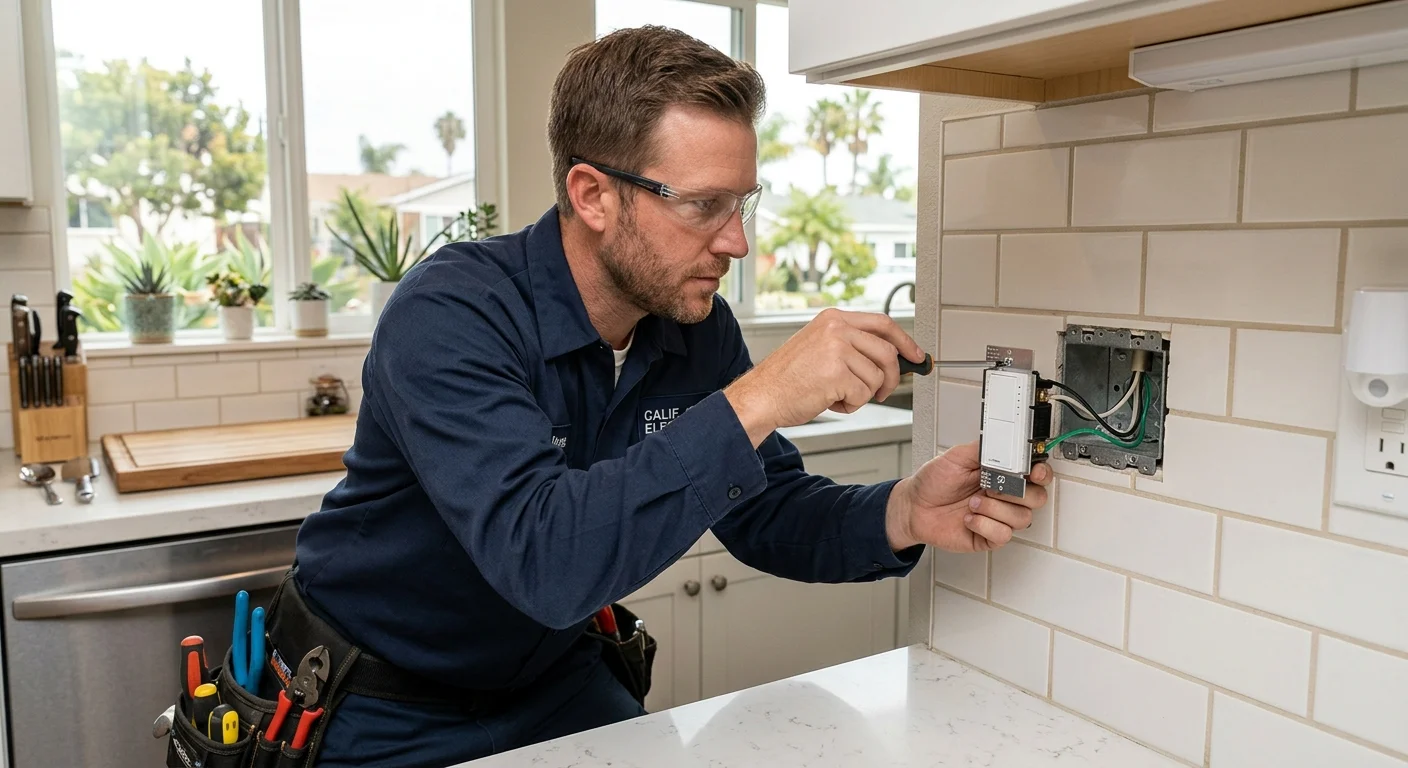
Dimmer switches are one of the most common lighting upgrades in San Diego County. They’re practical, they can save energy, and they change how a room feels. The installation is more nuanced than it looks, particularly in a market where almost everyone has switched to LED lighting and the old compatibility rules no longer apply.
TL;DR
- Single-pole dimmer replacement in San Diego is published here at $100–$200 for parts and labor. Bright Pro does not credit a diagnostic toward the work.
- Three-way dimmers (two switches controlling one light) run $150–$300 because wiring identification takes more time and companion switches cost more.
- Smart dimmers like Lutron Caseta or Leviton Decora Smart run $200–$450 per switch, including hub setup and programming.
- Old “leading-edge” dimmers cause LED flicker and buzz; modern trailing-edge dimmers solve this, but you must match the dimmer to the specific LED fixture or bulb.
- Many older San Diego homes (pre-1980s) have no neutral wire in switch boxes, making Lutron Caseta’s no-neutral option one of the most compatible choices.
What a dimmer switch installation typically costs in San Diego
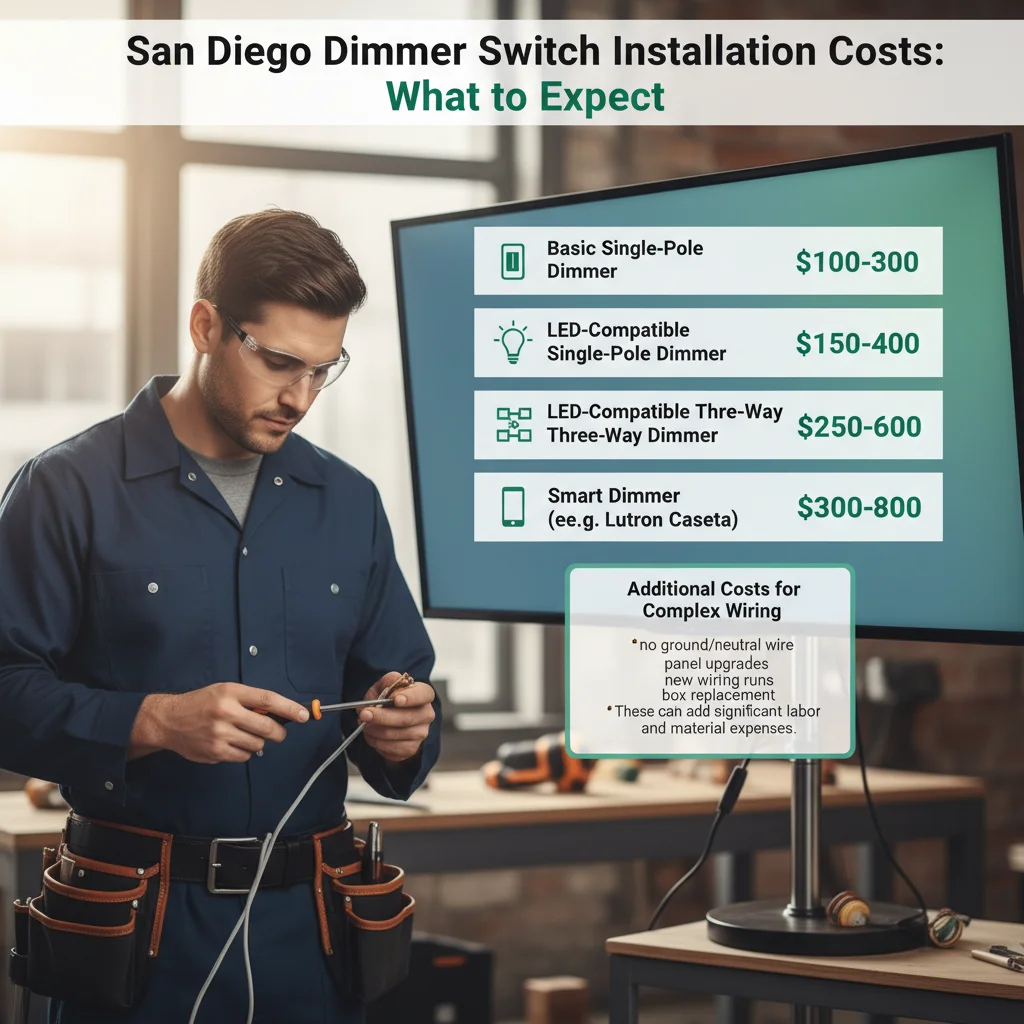
The honest range for a dimmer switch installation in San Diego is $100 to $450 per switch, depending on the type of dimmer, the wiring configuration, and what the electrician finds when the switch plate comes off.
A straightforward single-pole replacement, meaning one switch controlling one group of lights, with modern copper wiring and a ground wire present, is published here at $100 to $200 for parts and labor. That range is an industry figure on this page, not a Bright Pro price. Bright Pro does not set a diagnostic credit or a same-visit completion promise. The licensed electrician on the job quotes after seeing the box.
A three-way replacement, where two switches control the same light, runs $150 to $300. Three-way dimmers cost more than single-pole dimmers, and the wiring takes more time because traveler wires and common wires need to be correctly identified and connected.
A smart dimmer installation, using Lutron Caseta, Leviton Decora Smart, or a similar platform, runs $200 to $450 per switch once you include the device, hub setup, and programming. If multiple switches are being installed in the same home and the hub is already in place, the per-switch cost on subsequent devices drops.
Complications, covered below, push costs higher. For a broader look at published electrical work ranges in this market, see the guide on how much an electrician costs in San Diego.
LED compatibility: why old dimmers cause flickering
This is the most common issue homeowners run into when they try to save money by keeping old dimmers after switching to LED bulbs. LED lighting that flickers, buzzes, or refuses to dim below a certain level has several possible causes, not one. Categories include an incompatible dimmer, a failing LED driver, shared neutrals, or a loose connection. An incompatible dimmer is a common category after a bulb swap. A licensed electrician sorts which category applies.
Traditional incandescent bulbs are a resistive load. They dim smoothly when you reduce voltage because their filament responds proportionally. LEDs are completely different. They have an internal driver that converts AC power to the DC voltage the chip actually needs, and that driver does not behave like a resistive load. Older “leading-edge” or “forward-phase” dimmers were designed for resistive loads, and when they encounter an LED driver, the interaction produces exactly the symptoms homeowners complain about: flicker, buzz, and a usable dimming range of maybe 40% to 100% before the light just shuts off.
Modern “LED-compatible” dimmers use trailing-edge or reverse-phase technology. They sense the load type and communicate with the LED driver in a way the older dimmers can’t. The result is smooth, quiet dimming from close to zero to full brightness.
When the electricians we connect you with do a dimmer upgrade for a home that’s already on LED, they always specify a dimmer that’s on the LED manufacturer’s compatible list for that specific fixture or bulb. Lutron publishes a detailed compatibility list. So does Leviton. Using the wrong combination still causes problems even with a “new” dimmer.
The outlet and switch installation page covers that scope. A licensed electrician checks compatibility before a switch goes in a box. Bright Pro does not.
Single-pole vs. three-way dimmer replacement costs
Single-pole means one switch controls the fixture. The box has two hot wires (or one hot and one load) plus a ground. Straightforward to identify, straightforward to replace.
Three-way means two switches control the same fixture, common in hallways, staircases, bedrooms with multiple entry points, and large living rooms. The wiring includes “traveler” wires that carry signal between the two switch boxes and a “common” wire at each end. When you add a dimmer to a three-way circuit, one switch becomes the main dimmer and the other becomes a companion switch. They have to be matched: Lutron Caseta dimmers use Pico remotes as the companion, not a standard three-way dimmer. Leviton has its own companion switches.
The cost difference between single-pole and three-way installations is real. The three-way dimmer and its companion switch together cost more than a single-pole dimmer. The installation takes longer because both boxes need to be opened, wires need to be traced, and the companion switch needs to be configured. If you’re adding a smart three-way system, there’s also app setup and pairing involved.
Four-way circuits, where three or more switches control the same fixture, are less common in residential but do exist in large open-plan homes and great rooms. Each additional switch location adds cost.
Independent licensed electricians handle all of these configurations. See the outlet and switch installation page for that scope. That electrician identifies the wiring type before ordering materials so you’re not paying for the wrong switch. Bright Pro does not.
Smart dimmers: Lutron Caseta, Leviton, and what to know before you buy
Smart dimmers are a meaningful upgrade over standard dimmers because they add scheduling, remote control, and integration with voice assistants like Google Assistant, Amazon Alexa, and Apple HomeKit. For San Diego homeowners who spend time away from home or who want to automate lighting schedules for security, the added functionality is genuinely useful.
Lutron Caseta is the most popular platform in our market and for good reason. The Caseta system uses a proprietary radio frequency protocol called Clear Connect rather than Wi-Fi. That means it doesn’t slow down your home network, and it’s notably more reliable than Wi-Fi switches that drop off when the router hiccups. The Caseta Smart Bridge hub is required for remote control and smart home integration, but it’s a one-time purchase that works across all Caseta devices in the home.
One practical note for San Diego’s older housing stock: Caseta dimmers have a “no-neutral” option, which matters because older switches in pre-1980s homes often have switch boxes with only two wires, hot and load, and no neutral. Many smart dimmers require a neutral wire to power their internal electronics. Caseta’s no-neutral version works without it, making it one of the more compatible options for older San Diego homes in areas like University Heights, North Park, South Park, and similar neighborhoods.
Leviton Decora Smart is another solid option, especially if you’re already in the Google Home or Amazon Alexa ecosystem. The installation is similar to Caseta, and Leviton offers both Wi-Fi and Z-Wave versions depending on how your smart home is set up.
For homes with existing smart home infrastructure, a licensed electrician can match the dimmer platform to what’s already in place. For homes starting fresh, Caseta is a common pick for reliability and broad compatibility, including a no-neutral option. Bright Pro does not specify the platform.
Learn more about smart switch installation specifics in the post on smart switches without a neutral wire.
The smart home wiring page covers full dimmer installs including hub setup, device pairing, and app configuration.
When a simple swap becomes a bigger wiring job
This is the part of dimmer installation that homeowners don’t expect, and it’s worth knowing before you budget for the project. Some conditions turn a $150 swap into a $400 to $700 project.
No ground wire in the box. Homes built before the mid-1960s often have two-wire circuits with no equipment ground. Modern dimmers technically require a ground. In most cases, a licensed electrician can use an existing nearby ground or bonding point, but in some older homes, running a proper ground back to the panel is the right approach. That adds conduit, wire, and time.
No neutral wire for a smart dimmer. As mentioned above, older switch boxes sometimes have only two wires. A Caseta no-neutral dimmer handles this, but other smart platforms don’t. If the homeowner has their heart set on a specific platform that requires neutral, that electrician either runs a neutral to the box or discusses alternatives.
An undersized switch box. Older switch boxes are sometimes too shallow or too small to accommodate a modern dimmer’s body and all the wiring. Replacing the box adds about 30 to 45 minutes of labor and a few dollars in materials.
Aluminum wiring. Some San Diego homes built in the late 1960s and early 1970s have aluminum branch circuit wiring instead of copper. Aluminum wiring is still functional but requires specific devices rated for aluminum and anti-oxidant compound at all connections. A licensed electrician identifies this on-site and addresses it. Ignoring it creates a real fire risk.
An overloaded circuit. If the lighting circuit is already near its capacity and the dimmer installation reveals that, that electrician might recommend a dedicated circuit for the lighting load to keep everything running safely.
In any of these situations, you get told what they found and what it means before additional work starts. Bright Pro does not dispatch the crew.
San Diego permit notes for dimmer installations
Replacing a dimmer switch in an existing switch box is generally exempt from permit requirements in San Diego County jurisdictions. It’s considered a minor repair or replacement, not a new installation or circuit change.
Where permits come into play: adding a new switch location that doesn’t exist, running a new circuit to add dimmers where there were none, or making changes to the wiring configuration that go beyond a like-for-like replacement. In those cases, the licensed electrician pulls the permit. Bright Pro does not.
If you’re in an HOA or a condo building in San Diego, some associations have their own rules about work in electrical closets or common areas. Electricians in our network check before starting if there’s any question.
You can verify your electrician’s California license at cslb.ca.gov.
DIY dimmer replacement: when it’s reasonable and when it’s not
A homeowner who is comfortable with basic electrical work can swap a single-pole dimmer in a modern home with copper wiring, a ground wire, and a neutral wire. Turn off the breaker, verify the circuit is dead with a non-contact tester, pull the old switch, match the wires to the new device, and button it up. There are plenty of accurate tutorials for this specific task.
Where DIY creates real risk: three-way circuits (wiring identification errors cause failures and shock hazards), smart dimmers that require specific wiring configurations, any home with aluminum wiring, any box where the wiring looks unfamiliar or has been previously modified, and any circuit where you find more wires than you expected.
If you open the box and aren’t immediately confident about what you’re looking at, stop. Hire a licensed electrician. That is a better outcome than a misconnected dimmer that trips the breaker repeatedly or a wiring mistake that causes a more serious problem.
For lighting installation of any scope, Bright Pro matches you with a licensed electrician. That electrician handles assessment, material selection, and installation. Bright Pro does not.
How many dimmers can go on one circuit
This is a practical question that homeowners don’t always think about until they’ve already bought the switches.
A standard 15-amp lighting circuit supports a maximum wattage of 1,440 watts (80% of 1,800). For a room with LED bulbs, the load is so low that the circuit limit is almost never an issue. The constraint with multiple dimmers on the same circuit is actually thermal derating, not load.
When multiple dimmers are installed in a multi-gang box, the dimmers heat each other. Most dimmer manufacturers publish derating tables that specify how much the wattage capacity of each dimmer must be reduced when installed with adjacent dimmers. A Lutron Caseta dimmer rated for 600 watts in a single-gang box might derate to 400 watts per dimmer when installed in a three-gang box with two other dimmers.
For LED loads, this derating is rarely a real-world limitation because modern LED fixtures draw so little wattage. But if you’re controlling incandescent or halogen fixtures, which some San Diego homeowners still have in specific applications, the derating matters.
The electricians we connect you with check this when installing multiple dimmers in the same box and select devices that are appropriately rated for the actual configuration.
Dimmer switch warranties and what to expect long-term
Good dimmers last a long time. Lutron Caseta carries a limited lifetime warranty on the dimmer itself. Leviton offers a 2-year limited warranty on most of its smart dimmer products. Standard non-smart dimmers from reputable brands like Leviton or Lutron typically carry a 1-year limited warranty and will last many years in normal use.
The most common dimmer failure mode is heat damage from being installed in an undersized box or derated incorrectly. The second most common is controller board failure in smart dimmers after several years of use. Both are covered under warranty if they occur within the warranty period.
For a home where you’re installing dimmers throughout multiple rooms, the total hardware investment is worth considering alongside the installation cost. Lutron Caseta dimmers run $40 to $60 each at retail. Leviton comparable devices are similar. If you’re doing 10 switches, the hardware alone is $400 to $600 before labor. Some licensed electricians buy at trade pricing. Bright Pro does not source hardware or set the project cost.
Frequently asked questions
Why does my new LED dimmer still flicker or buzz?
Even a brand-new LED-compatible dimmer can flicker if the specific combination of dimmer and bulb isn’t on the manufacturer’s compatibility list. LED drivers vary by brand and model, and a dimmer that works well with one fixture can behave poorly with another. The fix is checking Lutron’s or Leviton’s compatibility list for your exact fixture model, then matching the dimmer accordingly. If you’re not sure, a licensed electrician can run a compatibility check before recommending a device. Bright Pro does not.
Do I need a permit to replace a dimmer switch in San Diego?
Not for a like-for-like swap in an existing switch box. Replacing an existing dimmer with a new one of the same type, at the same location, doesn’t trigger permit requirements in San Diego County. Permits do apply if you’re adding a new switch location, running a new circuit to add dimmers where there were none, or making configuration changes that go beyond a straightforward replacement.
My house was built in the 1960s and I want smart dimmers. Will they work?
Possibly, but you need to check the wiring first. Older switch boxes in pre-1980s San Diego homes often have only two wires (hot and load) with no neutral. Many smart dimmers require a neutral wire to power their internal electronics. Lutron Caseta makes a no-neutral version that works in these boxes and is a common pick for older homes in University Heights, North Park, and similar neighborhoods. Other platforms may require running a neutral to the box, which adds cost.
How many dimmers can I put on one circuit?
The limit isn’t really circuit amperage for LED loads; it’s thermal derating. When multiple dimmers share a multi-gang box, they heat each other and each dimmer’s wattage capacity must be reduced according to the manufacturer’s derating table. For LED fixtures, this almost never matters in practice since modern LED loads are so low. For incandescent or halogen fixtures, check the derating specs before buying.
When to call us
If you want dimmers installed with LED-compatible devices matched to your fixtures and wiring, hire a licensed electrician. Use the contact form. Bright Pro matches San Diego County homeowners with independent licensed electricians. It does not hold a C-10, pull permits, credit a diagnostic toward the work, or guarantee dispatch. Hours are Monday through Saturday, 7am to 7pm. After hours, leave a message. For switch and outlet scope, see the outlet and switch installation page.