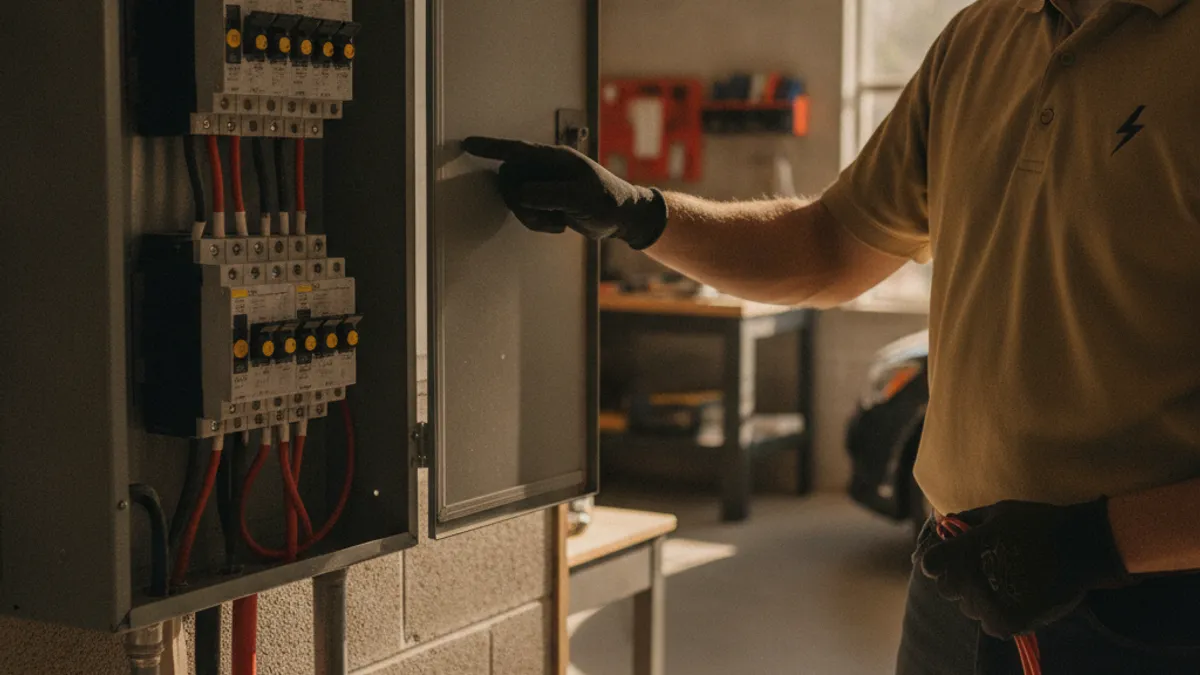
An AFCI breaker looks almost identical to a standard one, but it’s built to catch a different kind of problem. Where a normal breaker trips on overloads and dead shorts, an AFCI breaker is built to detect arcing, the small, sputtering sparks that happen inside damaged wiring or a failing connection, long before that damage turns into heat and fire.
What an arc fault actually is
Picture a wire with a small nick in its insulation, maybe from a nail driven through a wall years ago, or a connection at an outlet that’s worked itself slightly loose over time. Current doesn’t always fail cleanly at a spot like that. Instead, it can arc, jumping a tiny gap and creating a spark each time, on and off, sometimes for months before anything visibly changes.
A standard breaker doesn’t notice this. The current draw looks normal from the panel’s perspective, since an arc doesn’t necessarily pull enough extra current to trip an overload protection. But that repeated arcing generates real heat at the exact point of the fault, and it’s a documented contributor to residential electrical fires, especially inside wall cavities where nobody would smell or see it happening.
An AFCI breaker has a small chip inside it that reads the electrical waveform continuously, watching for the distinctive, irregular signature an arc creates versus the smooth pattern of normal current draw. When it recognizes that signature, it trips, well before a standard breaker would ever react.
Where AFCI protection typically shows up
AFCI breakers are most commonly found protecting bedrooms, living rooms, family rooms, dens, and similar living spaces, the areas where a hidden arc fault behind a wall would go unnoticed longest. Newer homes built in the last several code cycles usually have them throughout most of the living space as standard practice. Older San Diego homes, particularly the ones with original 1960s and 70s panels that haven’t been touched since, often have none at all.
Whether a specific renovation or new circuit needs AFCI protection depends on a few things: the age of the existing wiring, the scope of the work being done, and which version of the electrical code your city has adopted and how it’s being applied to your project. That’s genuinely a case-by-case answer, and it’s not something a general article can settle for your specific address. A licensed electrician can tell you what your panel currently has, and your city’s building or permit department can confirm what’s expected for the exact scope of work you’re planning.
AFCI versus GFCI: two different jobs
These get confused constantly because they look similar and both trip fast, but they’re solving different problems. A GFCI, ground-fault circuit interrupter, protects people from shock by watching for current leaking to ground, which is why they’re standard near water: kitchens, bathrooms, garages, outdoor outlets. An AFCI protects against fire by watching for arcing inside the wiring itself.
Some breakers combine both functions in one device, often called dual-function breakers, which cover shock protection and arc detection on the same circuit. Whether a circuit needs one, the other, both, or neither again comes down to the specific location and the current code your city applies, which is a conversation to have directly with an electrician rather than a guess based on a general rule of thumb.
Why a nuisance trip isn’t the same as a real problem
AFCI breakers have a reputation for tripping on things that aren’t actual arc faults: certain vacuum cleaners with brushed motors, some dimmer switches, older string lights, and shared-neutral wiring configurations can all trigger a trip that isn’t a wiring fault at all. That reputation is part of why some homeowners get frustrated and consider swapping an AFCI breaker for a standard one to make the tripping stop.
That’s worth avoiding. Removing AFCI protection because it’s inconvenient removes a layer of fire detection along with the nuisance, and in many jurisdictions it also puts the circuit out of compliance with whatever code applied when it was installed. If a specific device keeps tripping the breaker, an electrician can usually identify whether it’s the device, the wiring, or the breaker itself causing the problem, which is a more useful fix than bypassing the protection entirely.
What to do next
If you’re planning a remodel, a room addition, or a panel upgrade, ask your electrician directly which circuits will need AFCI protection under the code your city is currently applying, and get that answer before the permit is pulled rather than after. If you’re just trying to understand what’s already in your panel, an electrician can walk through it with you circuit by circuit during a standard electrical troubleshooting visit.
Frequently asked questions
Do I have to replace all my breakers with AFCI ones?
Not automatically. Requirements generally apply to new circuits, new construction, and certain remodel or addition scopes rather than retroactively to an entire existing home. Confirm with an electrician what applies to your specific situation.
Why does my AFCI breaker trip when nothing seems wrong?
Certain appliances and some older lighting equipment can trigger a nuisance trip that isn’t a true arc fault. An electrician can usually isolate whether it’s the device or the wiring causing it.
Can I install an AFCI breaker myself?
Breaker work happens inside a live panel, and an incorrectly seated or mismatched breaker can fail to protect the circuit at all while looking fine from the outside. This is a job for a licensed electrician.
Is AFCI protection only for new homes?
No. Many homeowners add AFCI protection to older circuits during a panel upgrade or a remodel, even when it isn’t strictly triggered by the scope of work, simply as an added safety measure.
To find out what your panel currently has and what an upgrade would involve, call Bright Pro Electric at (858) 988-5580.