
A kitchen that goes dark when the air fryer and toaster share a wall is often a circuit-capacity problem, not a bad toaster. The same pattern shows up with a hair dryer in an older bathroom. This page is about how 15-amp and 20-amp circuits differ, how to read a receptacle without opening the panel, and why swapping a breaker is not an upgrade.
TL;DR
- At 120 volts, a 15-amp circuit is 1,800 watts and a 20-amp circuit is 2,400 watts. The circuit includes the breaker, the wire, and every device on that run.
- A T-shaped neutral slot usually marks a 20-amp receptacle. The breaker handle is the circuit rating, but reading it means looking at a closed panel, not taking the dead front off.
- California’s electrical code is the California Electrical Code, based on the NEC edition the state has adopted. Kitchen small-appliance, bathroom receptacle, laundry, and garage receptacle rules are in that adopted code for new work and for work that triggers those sections, not a promise that every older room was built that way.
- NEC treats many loads that run three hours or more as continuous and sizes conductors and overcurrent at 125% of that load (often described as an 80% continuous-load limit on the breaker rating). That is a code sizing rule, not a Bright Pro service claim.
- Upgrading 15A to 20A means the wire ampacity has to match. Typical published cost on this site: $400 to over $1,000 per circuit. That is not a DIY sequence.
What the amperage rating actually controls
Voltage is the pressure. Ampacity is how much current the assembled circuit can carry without overheating. A 20-amp branch circuit uses larger conductors than a typical 15-amp circuit so it can carry more current before the breaker opens.
Simple math at 120 volts:
- 15-amp circuit: 15 × 120 = 1,800 watts
- 20-amp circuit: 20 × 120 = 2,400 watts
That is 33% more wattage on the 20-amp circuit, if the wire and breaker both belong to that rating.
For loads the NEC treats as continuous (often three hours or more), Article 210/215 sizing uses 125% of the continuous current. On a 15-amp breaker that is 12 amps, or 1,440 watts at 120V. On a 20-amp breaker that is 16 amps, or 1,920 watts. A 1,500-watt space heater on a shared 15-amp bedroom circuit is why so many of those breakers open. The rating applies to the whole circuit, not to one receptacle face.
Where adopted code asks for 20-amp circuits
The National Electrical Code is a model. California adopts a California Electrical Code version, and cities can add local amendments. For new dwelling work and for remodels that fall under those sections, the adopted NEC-based rules commonly require 20-amp circuits for:
- Kitchen countertop small-appliance branch circuits (typically at least two)
- Bathroom receptacle circuits
- Laundry receptacle circuits
- At least one 20-amp circuit for garage receptacles
Older houses in North Park or La Mesa were often built to earlier editions. Tripping in those rooms is common. It does not mean the house is illegal to occupy, and it does not mean every remodel must rewire the whole dwelling. A licensed electrician applies the code edition your permit is reviewed under.
See outlet and switch installation when the job is new devices on correctly sized circuits.
How to read the receptacle without opening the panel
Look at the slots.
- A 15-amp receptacle has two parallel vertical slots.
- A 20-amp receptacle has a T-shaped neutral slot so it can accept a 20-amp plug as well as a 15-amp plug.
You can have 15-amp receptacles on a 20-amp circuit when the code’s multi-receptacle rules are met. You cannot put a 20-amp receptacle on a 15-amp circuit. If the breaker handle (visible with the panel door open, cover on) says 15, treat the circuit as 15 regardless of a T-slot someone installed by mistake.
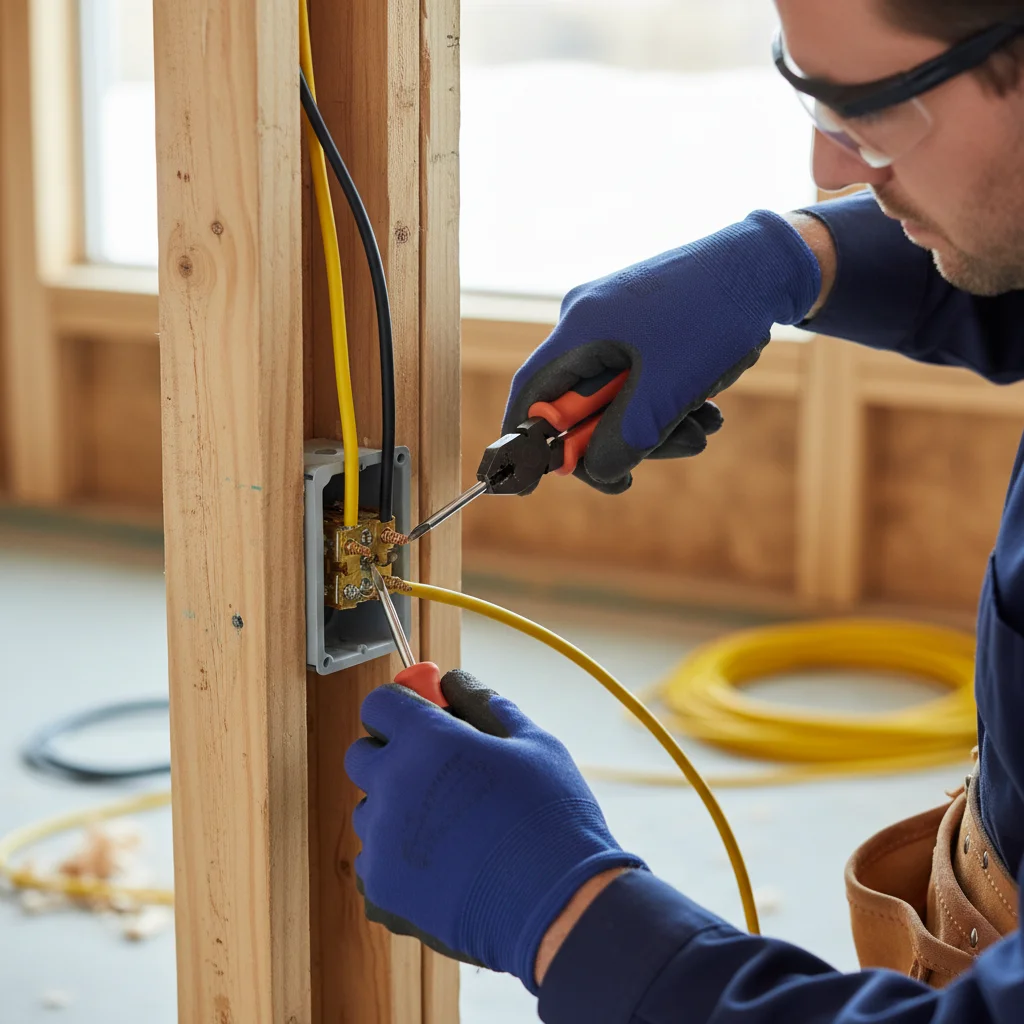
Do not remove the dead front to “be sure.” Do not swap the breaker yourself. The yellow 12-gauge jacket in the photo is what a licensed electrician pulls when the circuit is truly 20 amp.
Kitchen, bath, garage, and laundry in practice
Kitchens: two 20-amp small-appliance circuits are the usual new-work minimum for countertop receptacles. Microwaves, dishwashers, and disposals often need their own circuits because the nameplate says so, not because this page listed a rule of thumb.
Bathrooms: a 20-amp receptacle circuit is the usual new-work rule because a hair dryer can approach 1,800 watts. GFCI protection is a separate requirement in wet locations. See GFCI outlet installation.
Laundry: the washer receptacle is typically a dedicated 20-amp circuit on current new-work rules. Confirm the appliance nameplate.
Garages: at least one 20-amp receptacle circuit is the usual new-work minimum. Tools, a freezer, and a compressor may need more than that one circuit. That is a load conversation, not a count Bright Pro “typically recommends” as a crew.
Cost to change a 15-amp circuit into a 20-amp circuit
This is not swapping the device and the breaker. 15-amp circuits are commonly 14 AWG. 20-amp circuits need 12 AWG copper (or another conductor with that ampacity). A licensed electrician de-energizes the circuit, replaces undersized wire, lands devices, and installs a matching 20-amp breaker. Published San Diego range on this site: about $400 to over $1,000 per circuit, driven by run length and finish (open garage vs plaster).
Do not turn the main off from this article. Do not pull old cable as a weekend project.
When a new dedicated circuit is the better answer
If one appliance is the problem (treadmill, freezer, large microwave), a new homerun can be cleaner than upsizing a shared lighting circuit. See dedicated circuit when you need one and cost to add an outlet.
Frequently asked questions
How do I know if my kitchen outlet is 15 or 20 amps?
Start with the face: a T-slot is a 20-amp receptacle. The breaker number, read with the panel door open and the dead front still on, is the circuit rating. If those disagree, have a licensed electrician open the can.
Can I plug a 20-amp appliance into a 15-amp outlet?
Many 20-amp-rated appliances still use a 15-amp plug shape and will fit. The risk is overheating the 15-amp circuit. The fix is a correctly sized circuit, not a bigger breaker on the old wire.
Can I just swap the breaker from 15 to 20 amps without changing the wire?
No. A 20-amp breaker on 14 AWG can leave the wire unprotected. Breaker and conductor ampacity have to match.
Is it normal for my San Diego bathroom to trip when I use a hair dryer?
It is common on older 15-amp or shared circuits. It is not a reason to ignore it. A licensed electrician can add a bathroom receptacle circuit that matches the adopted code for the permit.
Do garage outlets need to be 20-amp?
For new work, adopted code commonly requires at least one 20-amp garage receptacle circuit. Extra tool or freezer loads are separate circuits sized to the equipment.
When to call
Changing breakers or pulling new cable is licensed electrical work in California when a permit is required, and most circuit changes need one. Bright Pro Electric matches San Diego homeowners with independent licensed electricians. It does not design or install your circuits. Hours are Monday through Saturday, 7am to 7pm. Use the contact form.