Flickering lights in a San Diego home usually fall into a few categories: a short voltage dip when a large appliance starts, a loose connection, an overloaded or failing circuit, a bulb or dimmer mismatch, or an SDG&E issue on the street. A flicker that lasts under a second and lines up with the AC or fridge cycling is often just inrush current. Persistent flicker, whole-house dimming, buzzing, or a burning smell is a different category and needs a licensed electrician, not a wait-and-see plan.
TL;DR
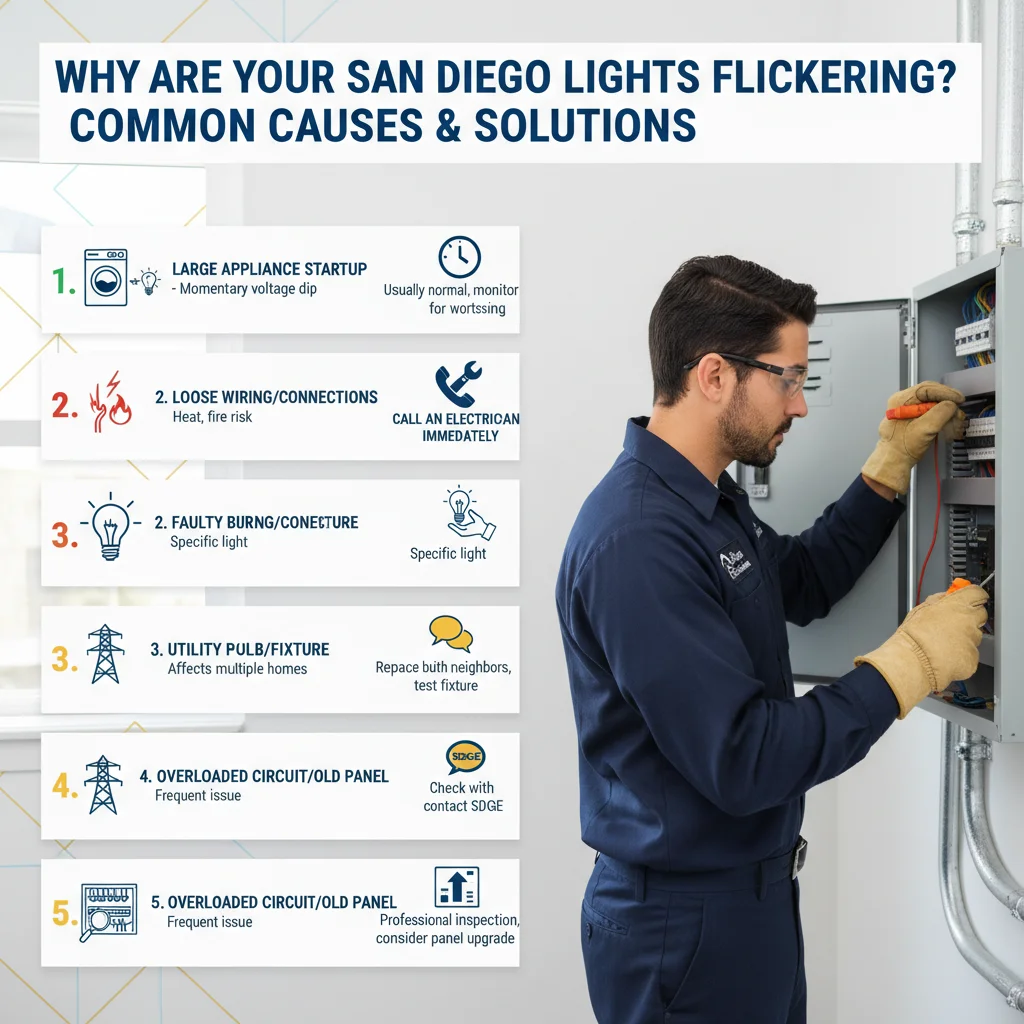
- A brief flicker when a large appliance starts is often a momentary voltage dip on that circuit. It is not proof that the wiring is fine forever.
- Persistent flickering, buzzing, a burning smell, or flicker across several rooms points to loose connections, overload, or a panel/circuit problem that belongs on a licensed inspection.
- LED flicker on an old dimmer is often a compatibility issue. That does not rule out wiring if it also happens on non-dimmed fixtures.
- Whole-home flicker that neighbors also see is more likely a utility-side issue. Report it to SDG&E at 1-800-411-7343.
- Smoke, sparks, or a burning smell: leave the area, call 911, then call a licensed electrician. Do not open the panel or operate the main from this page.
When flickering is a category, not a single cause
Not every flicker means the same failure. A short, subtle dip when a motor starts is one pattern. Aggressive flicker, flicker that never stops, or flicker with heat, smell, or trips is another. Treating every case as “probably the fridge” hides the second group.
LED fixtures add a third pattern. Some LEDs flicker because the dimmer was built for incandescent loads, or because the lamp’s driver is failing. If one or two lamps flicker, swap them or try a different fixture before assuming the circuit is at fault. If several fixtures on the same circuit flicker, including non-dimmed ones, the category shifts back toward the circuit.
Large appliance startups: a common pattern, not a diagnosis
Many San Diego homeowners first notice flicker when the refrigerator compressor, AC, or washer starts. Those motors pull a short burst of current. That can dip voltage on shared lighting for a fraction of a second. The AC version of this pattern has its own walkthrough: why lights flicker when the AC turns on.
That pattern is often harmless when it is brief, predictable, and unchanged for years. It is not proof that the panel has spare capacity. Homes with older service or circuits already near their rating show the dip more clearly. If the dip is getting longer, darker, or showing up with other appliances, the same symptom can mean strain, a loose connection, or a motor that needs its own circuit. A licensed electrician confirms that with measurements, not with a guess from this article.
Loose connections and overloaded circuits
Loose connections are a more serious category. They can sit at a fixture, switch, receptacle, junction, or in the panel. Loose metal under load makes heat. Heat can damage insulation. Persistent flicker, lights that go fully dark then return, flicker on a whole room, buzzing, discoloration, or a burning smell belong here. A breaker that keeps tripping on the same circuit can travel with this pattern.
Do not open the panel to hunt for loose lugs. Do not pull cover plates to “check the wiring” from this guide. If you also have a warm or hot light switch on the same circuit, stop using that switch and have the circuit inspected. Older San Diego housing often still carries original branch wiring. Age is a reason to inspect, not a diagnosis that the panel is the cause of most jobs.
Problems on the SDG&E side of the meter
Sometimes the flicker is not inside the house. A service drop, neighborhood transformer, or wider distribution issue can show up as lights that dip in every room. If neighbors on the same transformer see it too, report it to SDG&E. Check the outage map and call 1-800-411-7343.
Utility confirmation that their side looks clear does not mean the house wiring is fine. It only moves the next check to the customer side of the meter. The splice at the weatherhead, the meter socket, and the service entrance are still licensed work. Bright Pro Electric does not operate SDG&E equipment and does not dispatch utility crews.
What a licensed electrician actually checks
A licensed electrician starts with the pattern you can describe without opening anything: when it started, which rooms, which appliances, whether it is constant or intermittent. Then they test. Typical checks include voltage at the service and at affected circuits, tightness and heat at connections they are licensed to open, breaker condition, and whether LED flicker is limited to a dimmer or driver.
None of that is a Bright Pro truck rolling on a script. Bright Pro Electric is a matching service. It connects San Diego County homeowners with independent licensed electricians. The electrician on site owns the diagnosis, the permit if one is required, and the repair. A panel upgrade is one possible outcome after a load calculation, not the default answer to flicker.
Why persistent flickering is worth treating as a warning
Repeated voltage swings can stress electronics. More important, flicker can be the visible sign of heat at a connection. Faulty wiring and overloaded circuits are known fire pathways. This page does not publish a percentage of San Diego house fires from wiring. If you smell burning, see sparks, or see smoke, leave, call 911, then call for a licensed electrician. Do not stay to “reset” the main.
Frequently asked questions
Why do my lights flicker when the AC kicks on in my San Diego home?
Central air compressors draw a large inrush when they start. If the flicker is under a second and the lights recover immediately, that is often inrush on a shared system. If the dip is severe, longer, or getting worse, the categories to check are circuit load, a loose connection, a worn breaker, or a service that is undersized for the current load. That is a measurement, not a rule of thumb from this page.
What does it mean if my lights flicker in one room but not the rest of the house?
Single-room flicker usually points to that circuit or fixture, not the whole service. Categories include a loose device, a failing fixture or switch, or a circuit running near its rating. Utility-wide flicker is less likely if the rest of the house is stable.
Are flickering LED lights a sign of a wiring problem?
Not always. LEDs are more sensitive to dimmers and driver faults than incandescent lamps. Try an LED-rated dimmer and a known-good lamp. If flicker continues on non-dimmed fixtures, or across several devices on one circuit, treat it as a circuit or connection issue until a licensed electrician says otherwise.
When should I be worried about flickering lights in my home?
Worry when it is persistent, when it spans rooms, when it comes with buzzing or a burning smell, or when outlets or switches feel warm. Any of those with flicker is a stop-and-call situation, not a DIY panel inspection.
When to call
If flicker is persistent, you hear buzzing, you smell burning, or you cannot tell which category you are in, that is licensed work. Bright Pro Electric matches you with a vetted local electrician. Hours are Monday through Saturday, 7am to 7pm. After hours, leave a message. There is no staffed 24-hour desk and no dispatch guarantee. Use the contact form.