San Marcos is a city of contrasts. You’ve got Cal State students crammed into older rentals near campus, young families filling out San Elijo Hills master-plan homes, and longtime residents in lakeside neighborhoods that haven’t seen a panel upgrade since the Carter administration. Those three worlds have almost nothing in common electrically, and that’s what makes San Marcos different from every other North County city.
TL;DR
- Outlet and switch repairs run $150 to $300 for modern wiring; dedicated circuits cost $400 to $700.
- Panel upgrades from 100 to 200 amps average $2,200 to $3,500 in San Marcos.
- EV charger installs in San Elijo Hills typically run $700 to $1,200 with a garage that already has capacity.
- Any work requiring a new circuit, panel move, or EV charger needs a permit through the City of San Marcos Planning and Development Services.
- Ask the electrician whether a diagnostic visit credits toward later work. Bright Pro does not sell that credit.
What San Marcos homeowners pay for common jobs
Costs vary by job type, home age, and what the electrician finds when they open the walls. Typical published ranges for San Marcos jobs:
Outlet and switch repairs run $150 to $300 for a straightforward fix in a home with modern wiring. If the outlet is on an old aluminum-wired circuit or the box is undersized, expect $350 to $500 once the proper materials are included.
Dedicated circuit installs, common for a new dishwasher, microwave, or home office setup, typically run $400 to $700 depending on how far the circuit has to travel from the panel. Finished walls and longer runs push that toward the high end.
Panel upgrades from 100 amps to 200 amps in San Marcos average $2,200 to $3,500. Homes with original Federal Pacific or Zinsco panels tend to need more work, often adding $300 to $600 for proper breaker removal and cleanup.
EV charger installs in San Elijo Hills typically run $700 to $1,200 when the garage already has capacity. Longer runs or a panel that needs headroom push the job higher. Ask the electrician for a written scope. Bright Pro does not quote that install.
Permit process in the City of San Marcos
The City of San Marcos handles electrical permits through its Planning and Development Services Department. Any work that creates a new circuit, moves an existing panel, or changes wiring in a significant way requires a permit. That includes EV charger installs, panel upgrades, sub-panel additions, and most whole-home rewires.
Replacing a switch, outlet, or light fixture in an existing box is typically exempt. But if the work requires a new circuit or changes the load on a panel, pull the permit. An unpermitted panel upgrade creates real problems at resale, and insurance carriers have increasingly started denying claims on unpermitted work.
The permit process in San Marcos is reasonably efficient. A licensed contractor submits plans, pays the fee, and schedules the inspection. Inspections for residential work are usually available within a few days. Independent licensed electricians handle all of this on your behalf so you’re not chasing paperwork.
You can verify that your electrician is licensed at cslb.ca.gov. California requires a C-10 Electrical Contractor license for any electrical work done for compensation.
Cal State San Marcos rentals: a different category of electrical problem
The area around Cal State San Marcos, roughly bounded by Twin Oaks Valley Road and San Marcos Boulevard, has a dense cluster of student rentals, older apartment buildings, and converted single-family homes that get divided into shared housing. These properties have been running above their intended electrical capacity for years.
The most common issues in this corridor: overloaded circuits from multiple mini-fridges, microwaves, and gaming rigs running on 15-amp circuits never designed for that load. Panels that were adequate for a single family in 1985 are now serving four or five independent tenants. Extension cords used as permanent wiring. GFCI protection missing in bathrooms and kitchens.
Landlords in this area have a legal obligation under California’s habitability standards to maintain safe electrical systems. If you own rental property near CSUSM and it has not been inspected in the past few years, a licensed electrician can do a safety assessment and write a scope. Published ranges on this page put a panel assessment around $89 to $150 for about an hour on site. That is the electrician’s visit, not a Bright Pro diagnostic.
Older homes in Lake San Marcos: what to expect
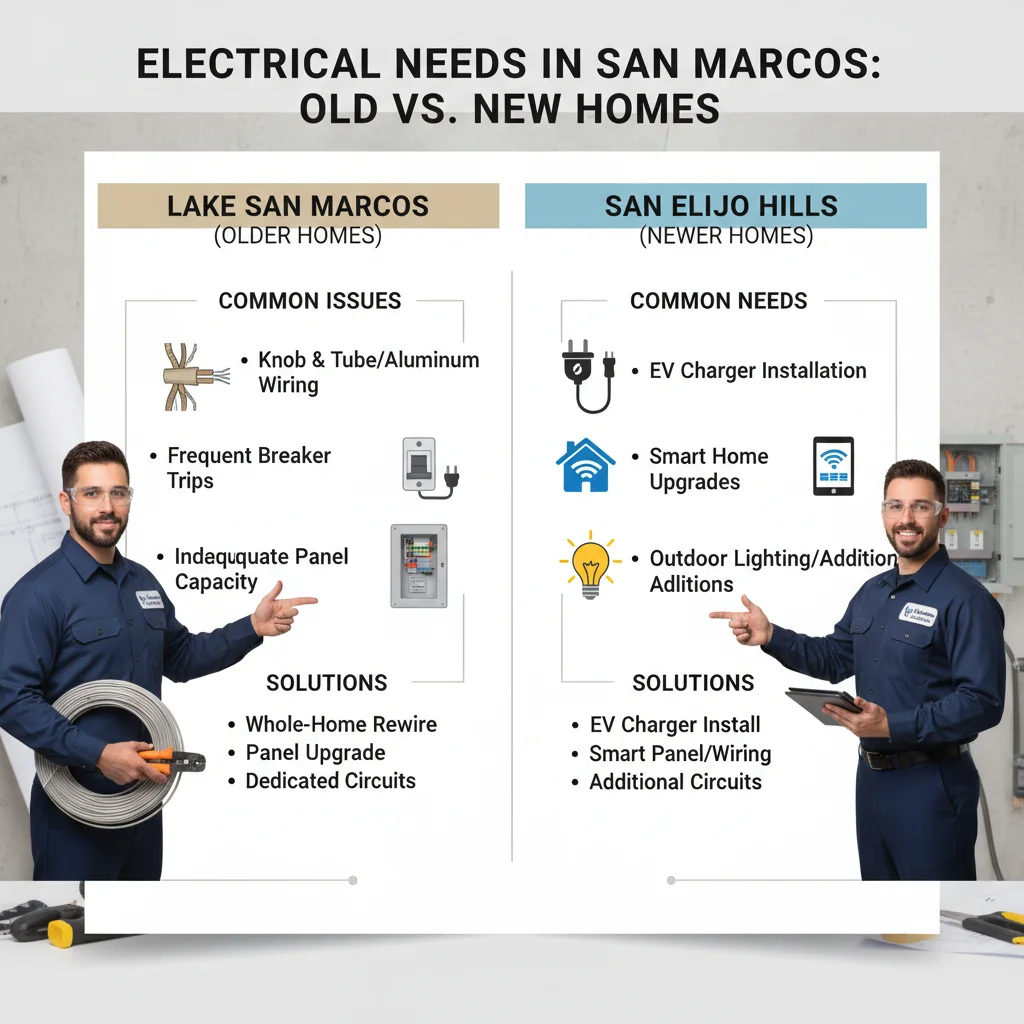
Lake San Marcos is one of the city’s original planned communities, with many homes built in the 1960s and 1970s. These are solid, well-constructed houses, but the electrical systems were sized for a lifestyle that didn’t include EV chargers, air conditioning in every room, or 240-volt ranges.
The wiring in these homes is almost always copper, which is good, but it’s often in 14-gauge on 15-amp circuits throughout. Panels are commonly 100-amp service, sometimes Federal Pacific or Zinsco, both of which have documented reliability issues with breakers not tripping under overload conditions. If you have one of those panels, a replacement is worth prioritizing.
Other common findings: two-prong ungrounded outlets in bathrooms and kitchens, missing GFCI protection, and sub-panels added years ago that aren’t properly bonded. None of these are immediate emergencies in isolation, but together they add up to a home that needs attention.
A panel upgrade to 200-amp service opens up the capacity for a dedicated HVAC circuit, EV charging, and anything else you want to add. It also puts you in a position to add solar if that’s on your list.
San Elijo Hills: EV chargers and the master-plan electrical squeeze
San Elijo Hills was built in phases starting in the early 2000s, and most homes came with 200-amp service, which was appropriate for the time. The problem is that the builders sized the electrical infrastructure for the appliances that were standard then. Now those same homes are being asked to charge one or two EVs, power heat pump systems, and run all the equipment that goes with modern family life.
The EV charger situation in San Elijo Hills is consistent. A Level 2 charger (the 240-volt wall-mounted unit) pulls 32 to 48 amps continuously. A 200-amp panel that’s already running a 4-ton AC unit, electric range, and two water heaters may not have the spare capacity. Before installing a charger, independent licensed electricians do a load calculation to see what’s actually available.
In many cases, the panel has enough room for a 50-amp breaker and a NEMA 14-50 outlet or a dedicated EVSE circuit. In others, the main breaker can be upgraded without replacing the full panel, which keeps costs down. A full EV charger installation, including the permit with the City of San Marcos, typically runs $700 to $1,200 for a garage install with adequate panel capacity.
For newer San Elijo Hills homes pursuing solar, a panel upgrade to 400-amp service or a sub-panel addition for battery storage is increasingly common. The pros we connect you with coordinate directly with the solar installer, so the electrical work supports the full system design.
Panel upgrade needs for growing families
A 100-amp panel was the standard for residential construction through the 1970s. It was plenty for the electrical load of that era. Today, a growing family in San Marcos might have an electric vehicle, a heat pump or mini-split, a home office with dedicated circuit needs, and a kitchen full of high-draw appliances. That same 100-amp service is a bottleneck.
A panel upgrade to 200 amps gives you the capacity to add circuits without constantly calculating what’s already loaded. It also lets you install AFCI breakers on bedroom circuits and GFCI breakers on kitchen and bathroom circuits, both of which are now code-required in California for new work. These provide meaningful fire and shock protection that older panels simply can’t support.
The upgrade process takes most of a day. The electricians coordinate the SDG&E meter pull so the service transfers safely, handle the permit with the city, and schedule the inspection. You’re back to full power the same day in most cases.
Whole-home rewiring: when it makes sense in San Marcos
Most San Marcos homeowners don’t need a whole-home rewire, but some do, and it’s worth knowing when that conversation is appropriate.
The situations where rewiring is the right answer: a home with knob-and-tube wiring still active in the walls, a home where a previous owner ran aluminum branch circuit wiring in the late 1960s or early 1970s, or a home where the wiring has been so extensively modified by unlicensed work that it’s essentially unsafe to build on.
Knob-and-tube wiring is not inherently dangerous if it’s intact and unmodified, but it’s incompatible with modern panels, can’t be covered with insulation, and most insurance carriers won’t issue new policies on homes that have it. If you’re buying a Lake San Marcos home from the 1960s or 1970s and the inspector finds active knob-and-tube, the conversation shifts from “how much is a panel upgrade” to “what does a full rewire cost.”
A whole-home rewire in a 1,500 to 2,000 square foot San Marcos home typically runs $8,000 to $18,000 depending on the extent of the work, the accessibility of the existing wiring pathways, and whether any drywall needs to be opened and patched. It’s a significant project, but it produces a home with modern copper wiring throughout, new boxes, updated GFCI and AFCI protection, and a clean permit history.
A licensed electrician does a thorough assessment before quoting a rewire. Sometimes the scope is smaller because only part of the home has the problematic wiring. Bright Pro does not size that rewire.
Outdoor and landscape electrical in San Marcos
San Marcos has long growing seasons and the outdoor lifestyle that goes with North County, which means outdoor electrical requests are common. Landscape lighting circuits, outdoor kitchen power, pool and spa electrical, and pergola or patio cover wiring all require permitted electrical work.
Outdoor and landscape lighting in San Marcos includes GFCI on outdoor circuits and weatherproof covers on outlets and junction boxes. Underground runs must meet depth rules: direct burial cable at least 24 inches without conduit; PVC conduit can go shallower. The electrician does that work. Bright Pro does not.
Pool and spa electrical is its own specialized category under California’s electrical code and the NEC. Bonding requirements, GFCI protection for all receptacles within 20 feet of the pool edge, and specific lighting requirements apply. The electrician pulls the permit, does the work, and schedules the inspection. This is not a job for an unlicensed handyman.
Pergola and patio cover wiring is one of the most requested outdoor jobs in newer San Marcos neighborhoods. A ceiling fan, a couple of outdoor lights, and a weatherproof outlet on a patio cover requires a new circuit run from the panel, which means a permit. The work itself is usually a half-day to full-day job.
Scheduled work versus hazard calls in San Marcos
For flame, heavy smoke, or sparks, leave and call 911 first. Then use contact. Bright Pro has no overnight desk and no arrival window.
For planned work like an EV charger, panel upgrade, or added circuits, the electrician schedules and pulls any permit. Bright Pro does not.
Bright Pro Electric matches San Marcos homeowners with independent licensed electricians. If you’re comparing options across North County, our post on an electrician in Escondido covers similar territory for the neighboring city.
Choosing a licensed electrician in San Marcos
San Marcos has no shortage of people offering electrical services, and the range in quality and compliance is real. Here’s what to verify before you hire anyone.
California requires a C-10 Electrical Contractor license for anyone doing electrical work for compensation. You can look up any contractor at cslb.ca.gov in about 30 seconds. This also shows whether they carry the required workers’ compensation insurance and whether they have any disciplinary actions on record.
Ask specifically whether the electrician will pull permits for your job. For any work that requires a permit, a legitimate contractor pulls it. If someone quotes you a lower price and says they’ll skip the permit to save time, that’s a warning sign, not a benefit.
Ask for a written estimate that breaks out labor and materials. Verbal quotes leave too much room for scope creep and disputes. A professional electrician provides a written scope before work begins.
Bright Pro matches San Marcos homeowners with C-10 licensed electricians. Those electricians pull permits when the job requires it. Bright Pro does not.
Frequently asked questions
How much does a panel upgrade cost in San Marcos?
Most San Marcos homeowners pay $2,200 to $3,500 to upgrade from 100-amp to 200-amp service. Homes with Federal Pacific or Zinsco panels often add $300 to $600 for proper breaker removal. The job typically takes one full day and includes the SDG&E meter pull, permit, and inspection.
Do I need a permit for an EV charger in San Marcos?
Yes. Any new 240-volt circuit for an EV charger requires a permit from the City of San Marcos Planning and Development Services. A licensed electrician pulls the permit before work starts. Skipping the permit creates problems at resale and can affect an insurance claim. Ask your carrier. It is not automatically void.
What electrical problems are most common in older Lake San Marcos homes?
The most frequent issues independent licensed electricians find are Federal Pacific or Zinsco panels with breakers that don’t trip reliably, two-prong ungrounded outlets in bathrooms and kitchens, and missing GFCI protection. These homes were typically wired on 100-amp service in the 1960s and 1970s, which isn’t enough for modern HVAC, EV charging, and large appliances running simultaneously.
How do I know if my San Elijo Hills panel has enough capacity for an EV charger?
Independent licensed electricians do a load calculation before quoting any EV install. Many 200-amp panels in San Elijo Hills have enough headroom for a 50-amp EV circuit, but some are running close to capacity with AC, electric ranges, and water heaters already on the panel. A load calculation takes about 30 minutes and tells you exactly what’s available before any money changes hands.
Do patio and pergola electrical jobs in San Marcos need a permit?
New circuits do. GFCI is required on outdoor circuits, and underground wiring must meet minimum depth. A typical pergola or patio cover job with a ceiling fan, lights, and a weatherproof outlet runs a half-day to a full day. Bright Pro does not pull that permit.
How to reach a licensed electrician
Whether you are a landlord with an overloaded rental near CSUSM, a Lake San Marcos homeowner with a 1970s panel, or a San Elijo Hills household adding an EV charger, use contact. See the San Marcos electrician service page for city coverage. Bright Pro does not run a diagnostic desk.